During the era of Covid, sneering at panic buyers became a national sport for bored nanny state enthusiasts.
The worst of the body corporate-types were locked in their apartments with nothing better to do than belittle those who feared running out of supplies. Remember the toilet paper memes? I sometimes wonder if any of the naysayers had to quietly wash their butts in the bath.
The instinct to mock to preparedness of others is driven by a mixture of government allegiance and jealousy. Panic buying, by its nature, suggests a lack of confidence in the state to maintain supply. A confident populace doesn’t panic… Then there is the simmering jealousy toward those who have set themselves up with a safety net and, ultimately, a fear that they might be right.
Coveting limited resources removes most of our refined personality traits. The longer panic buying goes on and the emptier the shelves, the more angry its abstainers become. They are terrified they missed out, their government lied, and they will starve.
Preparing for the worst is not a failure of character, it is a survival instinct polished over thousands of years.
Yes, even the American bunker-diggers are part of the human survival backup plan. If the whole world goes to shit, they will be the only thing left of us.
And let me ask, how is their fear of a nuclear apocalypse or disease outbreak any more ridiculous than the billionaires and politicians sitting at their global forums organising civilisation around a ‘climate apocalypse’? They turned the prepper mindset into history’s largest public money fraud.
We are hardwired to default to self-preservation at the slightest noise of disruption.
How many times in the long history of humanity has the harvest season failed? A war interrupted supply? Ration-cards emerged… An idiot political leader dismantled the food supply? A famine risen out of a series of tiny mistakes?
As we have been taught, when it all goes wrong, the government cannot help. Especially not this government.
It is not as if the government has done much to cultivate public confidence.
We are living with a political legacy that sold off our fuel security in favour of convenience and profit which was only made necessary by self-inflicted regulation. This is not a government concerned about the safety of its nation. It is a government that deliberately erased the lessons of the first and second world wars. Whether it’s giving away strategic ports to the largest geopolitical threat in the Pacific, shutting the economy down over a cold, or using the self-serving politics of Climate Change to destroy the agriculture industry, we have been given a masterclass in incompetence.
And so when people saw the Iran war erupt into a regional conflict and the world’s largest refineries burst into flames and rain oil over the desert, they started examining the supply network of Australian fuel. Most people know stockpiles are sitting at dangerous levels, but the inability to refill those, and a lack of domestic refining capability, creates an undeniable risk equation.
When Chris Bowen and Anthony Albanese got up on social media, waved their hands around, and said, ‘Don’t panic!’
Plenty of people realised it was probably time to panic.
And they were right to do so. True to form, there appeared to be arrangements in place to protect the cities. Those who sneered at the Covid preppers turned around and sneered at the truckies and farmers for daring to buy fuel.
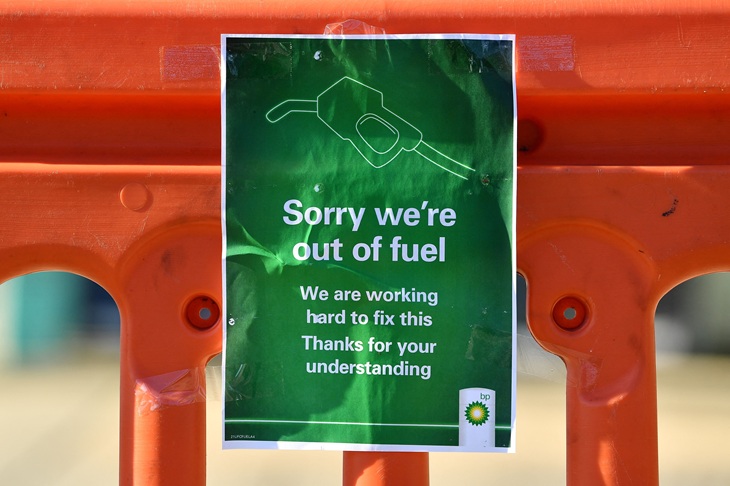
Fuel kept flowing to the cities. Regional areas reported immediate fuel shortages. The pumps ran dry. Owners told customers that the suppliers were not delivering. Farmers, on time critical activities, came to collect their pre-ordered diesel only to be told that it would not be delivered. Preference was given to keeping the major food trucks running with no community engagement, notice, or schedule.
Despite city workers being the most able to adapt with public transport or living within walking distance of the office, it was the farmers and regional communities left stranded.
When I asked our regional subscribers and followers if they had noticed an interruption, barely a week into the war they offered anecdotal evidence of widespread and undocumented restrictions on regional communities.
A government that fails to protect its farming communities is a government stupid enough to create the conditions of a future famine.
It’s the same story, over and over again. In Covid, the government protect big business. Not only protected them, but gifted them a state-enforced captured market. Small and medium businesses were the ones who never recovered and not a damn word of apology has been uttered.
Is it any wonder small farmers took an extra jerry can home with him.
Now, with the Strait of Hormuz a war zone and Iran’s Kharg Island on fire, the Australian government is being accused of serious negligence.
For decades, reports into Australia’s fuel security have been drafted, presented, and ignored citing ‘costs’ by the same government that has wasted hundreds of billions on renewable energy.
Oil refineries don’t win votes in the age of anti-carbon Climate Change hysteria. No one wanted to lead a government that authorised oil refineries or created regulatory protections. The truth is, these weak and frightened politicians who sold themselves as leaders did not have the guts to stand up and argue for national security.
After pinky-promising that the government had ‘enough fuel’, they are now hinting at a ‘national crisis’ while emergency fuel reserves are unlocked.
Freeing ‘emergency’ supplies makes the situation sound like … an emergency.
Lowering the fuel standards for 60 days doesn’t instil confidence either.
And while the government has been quick to blame ‘panic buyers’, it is reasonably clear that 99.99 per cent of the problem relates to insufficient supply for the demand of an entire, fuel-hungry nation – not a couple of extra jerry cans.
‘There is no need to stockpile or hoard fuel. Take what you usually need so that no one has to go without…’ said Climate Change and Energy Minister, Chris Bowen. Okay, so explain why farmers with standing orders are ‘going without’ at critical times?
Frankly, while Angus Taylor is right to say, ‘Labor’s mismanagement of fuel security and the economy is driving up inflation and hitting Australians’ cost of living hard…’ It is a bit rich coming from the former Energy Minister who presided over the closure of oil refineries and faced unresolved criticism relating to declining fuel security during the Morrison era. No one likes to praise Labor, but they did improve the situation (albeit it very slightly).
The Coalition have no moral high ground, only the failure of globalist economic arguments that risked Australia on the narrative of convenience and cost-cutting.
Labor’s empowerment of the unions and expansion of opportunistic environmental legislation, coupled with their all-in support of the anti-fossil fuel narrative, served as the stick beating the Morrison-era into its fuel security failures.
As for the current Labor government, it’s no good threatening fuel wholesalers and distributors with price watching and supply monitoring. The problem is a lack of refineries and the selling of our fuel assets on the cheap to Asia.
So far, the only person to call the situation accurately is One Nation’s Barnaby Joyce: ‘The fruits of the cluster climate policy are now the loss of fuel supplies with small towns. We shut our oil refineries to change the weather and made utilising our oil exploration vastly more complex because of environmental regulations.’
As the world moves toward war, we cannot continue importing 90 per cent of our oil from Asia. Not only because of the obvious disruption that would come if China calls in its threat on Taiwan, but because Asia is sourcing its fuel from the Middle East.
Shipping Australia posted a perfect explanation for this supply change which is sourced from the Department of Environment and Energy.
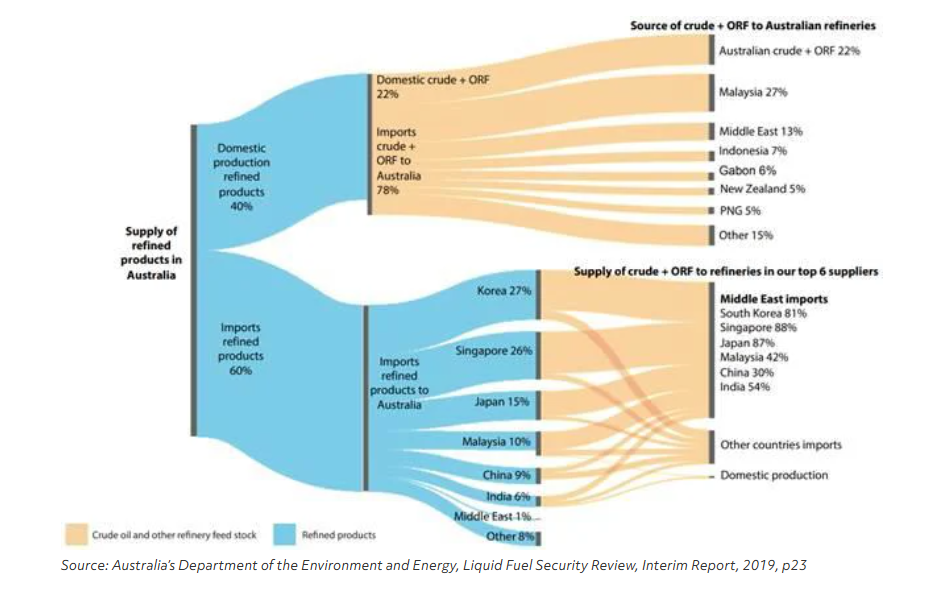
In the year 2000, Australia was at its cultural, economic, social, educational, and production peak. At that time, we had eight refineries. Those in favour of the massive and rapid diversification of the fuel market insisted that there were significant redundancies built in, but those arguments were constructed around minor local disruptions and short-lived, regional conflict. There was, as far as I can tell, no wargaming for actual war and no genuine belief that the globalised world, stuck together with paper and trade deals, could fall apart.
As is quoted in the article by Shipping Australia:
‘Shipping Australia particularly notes the Hale & Twomey conclusion that: “…in reality, it is difficult to envisage a scenario in which shipping is not available and historically we cannot point to an event which saw the collapse of the petroleum tanker market.” (see Australia’s Maritime Petroleum Supply Chain, Hale & Twomey, June 2013.’
How about now?
In the linked report above, the risks considered were a spike in demand for imported product and disruption to product supply. This is the relevant problem which cites things such as ‘a loss of a refinery in Singapore’ or ‘major disease outbreak’ and ‘regional conflict’ in the South China Sea. Keep in mind we speed-ran the disease outbreak scenario with Covid.
The regional conflict scenario assumes only a single disruption that can be mediated by other markets.
I have not read a report that guessed a (frankly, extremely likely and predictable) scenario of war in Europe constraining Russia’s supply, which in turn severely impacts India’s refineries. A second conflict in the South China Sea almost certainly triggered by Chinese aggression against Taiwan. And major war centred in the Middle East. This movement of global powers has been coming for a long time, but the risk never seemed to translate to government strategy.
One of the only Western world leaders who set about deliberately protecting against this risk was Donald Trump and his, ‘Drill, baby, drill!’ policy which expressly laid the ground work for refineries and domestic reserves. At the same time, he ordered the construction of urgent nuclear power plants to offset the grid’s reliance on fossil fuels so that the resource could be reserved for agriculture, transport, and military requirements.
While our media and politicians mocked Trump, he protected America. Now our leaders are scrambling, pretending they ‘didn’t know’.
We, as a civilisation of captive citizens, are waiting to see how loudly and forcefully the powers of the world groan. I predict that we will see, very soon, the establishment of a War Cabinet although it will not immediately be given this name. Parliament will soften its brand and disguise their panic as a Supply and Resources project, or Regional Sustainability. Something of that nature.
The declassified Foreign Policy communiqués of 1937-49 reveal a global house of naive and unprepared leadership stunned by the re-emergence of war and routinely scuttled by the self-serving behaviour of allies. It is a constant gnattering of ministers, advisors, generals, and diplomats that seems indistinguishable from the government announcements and thinly-disguised threats posted to X in the heat of war.
My point is that the machine of global governance is as outdated and ignorant as it always was while the citizens remain sharp-witted and left to make separate arrangements for their supplies and safety.
Whether it is the former Woke Chai-sipping Uber-addicted Green activist suddenly purchasing seeds for his balcony, a mother picking up an extra bottle of cooking oil, or the farmer with a jerry can … perhaps the preppers will be the real winners.
Flat White is written by Alexandra Marshall. If you would like to support her work, shout her a coffee over at donor-box.