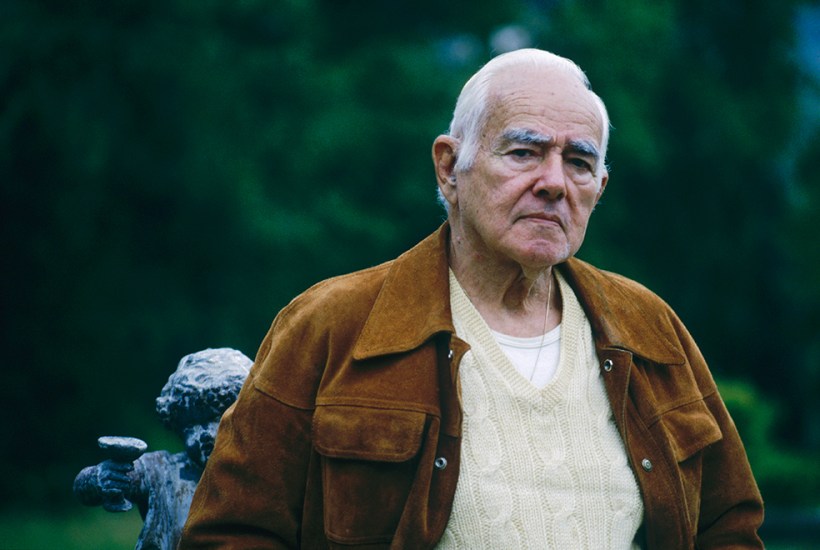
One day Frederic Prokosch wrote a novel. He was 27 years old, living with his parents in New Haven, Connecticut, and desperate to be published. Leafing through an old atlas, he had visions of Lebanon and Syria, of the apricot trees of Damascus, the pilgrims travelling from Transcaucasia, and the Orontes River flowing among the rocks. His visions grew more vivid and the voices clearer: ‘I leaned forward in my chair and started to write as though mesmerised.’
The resultant book, The Asiatics, was an immediate success, praised by the likes of Thomas Mann, Albert Camus and André Gide. Others, however, were less sure. How could one write about Asia without ever having been there? Prokosch, it seemed, had quite the imagination.
Years passed, and though Prokosch continued to write and publish, his star waned. Until one day he wrote a memoir. Published in 1982, Voices once again made him something of a sensation. It details his rootless existence – from his childhood in America to his retirement in the south of France, by way of almost everywhere else – as he pursues the artist’s higher calling. Along the way he records the conversations he has with the celebrated men and women he meets, including Ernest Hemingway, Virginia Woolf and T.S. Eliot. It is a curious sort of memoir, vivid and delightful, but also elliptical, fantastical and ultimately unreliable. Prokosch himself described it as ‘50 framed portraits, around which there is a void, and that void is me’.
‘One day my father announced: “Thomas Mann is coming to dinner.”’ And so Prokosch’s project begins, as a young boy listening intently to ‘the slow, dark phrases of Thomas Mann’. ‘After he left I went to my bedroom and wrote it all down, and this was the first of the dialogues that I scribbled faithfully in my notebooks.’ Soon Prokosch is off to Cambridge, ostensibly to continue his studies of Chaucerian apocrypha. Here he meets Walter de la Mare, A.E. Housman and E.M. Forster. Then to Paris, where he has lunch with Gertrude Stein and tea with James Joyce – who has ‘the air of an embittered provincial surgeon’ and says: ‘I shouldn’t be drinking tea, Nora says it’s very constipating.’ In Italy Prokosch plays tennis with Ezra Pound and retrieves Marc Chagall’s wallet from the Grand Canal. During the second world war he is engaged in some spycraft, crossing paths with Dusko Popov, the double agent rumoured to be the inspiration for James Bond.
The portraits are always striking, the voices beguiling. Bertolt Brecht ‘looked medieval, like a Gothic oak carving, not of a saint but of a playful and malevolent abbot’. Alberto Moravia has ‘the eyes of a murderer who has entered a lonely house’. W.H. Auden, whom Prokosch greatly admired, makes regular and increasingly dissolute appearances. In a dingy New York bathhouse, Auden ‘looked like a naked sea beast as he prowled through the steam’. He rambles wildly as Prokosch listens politely. ‘He clutched at the marble slab, as though seized with a fit of dizziness, then faded into the steam like a fogbound vessel.’
Prokosch himself remains a cipher. Despite some oblique references to his homosexuality, he gives as little away as possible. ‘Being lonely by nature as well as by desire, I tried to exploit that loneliness by becoming a kind of sponge and soaking up the essence of other men’s lives.’ But how much, even, do we learn of these other men? As Kathryn Davis observes in her Introduction: ‘Voices is a novel, just as The Asiatics is a novel.’ Yes, it’s all made up. Or at least partly. But never mind. Voices – whether real or imagined – is the work of one of the 20th century’s most fascinating talents. Don’t ask too many questions, just listen.
Got something to add? Join the discussion and comment below.
You might disagree with half of it, but you’ll enjoy reading all of it. Try your first month for free, then just $2 a week for the remainder of your first year.