A country that has spent a quarter of a century methodically building the world’s most sophisticated machine for preventing wealth creation does not get to act surprised when wealth stops being created.
Australia has done exactly this, and the political class currently presiding over the wreckage is responding with the one tool it has never once put down – another layer of government.
The inflation gutting household budgets is real. The cost-of-living crisis making the 1970s look like a period of enviable abundance is real. The levels of government spending that would have seemed like fever-dream numbers to any treasurer of 20 years ago are real.
The NDIS alone has grown into a fiscal creature of such magnificent proportions that it now consumes more than defence, more than infrastructure, and more than the collective imagination of anyone who originally signed off on it. The grand intellectual response from the political class to all of this? Tax more.
Charles Krauthammer put it with characteristic precision:
Decline is a choice.
The Commonwealth government is making that choice methodically, cheerfully, and without the slightest apparent concern for the consequences.
Here is what nobody in the Cabinet room appears willing to say. The Australian economy cannot sustainably grow above roughly 2 per cent without igniting inflation, and that ceiling is not a law of nature.
It is the accumulated residue of 25 years of regulatory creep so gradual, so consistent, and so thoroughly bipartisan that it now constitutes the connective tissue of the entire economy.
Every sector, every transaction, every commercial ambition must pass through a labyrinth constructed by politicians who were rewarded for building it and never once penalised for what it cost.
The European Union wants to be the ‘regulatory superpower’ but not if Canberra gets its way.
What the Australian Bureau of Statistics will not tell you, because nobody has built the tool to do it and perhaps nobody particularly wants to, is the size of the because-of-government economy. The accountants, the lawyers, the consultants, the compliance officers, the entire expensive professional class whose working lives are devoted not to creating wealth but to managing, documenting, justifying, obfuscating, and navigating regulations that exist because previous governments decided more rules meant more safety, more fairness, and more votes.
These are smart, expensive people doing work that produces nothing, nothing, except permission to do other work. They are a tax on ambition and productivity, levied not on a balance sheet but on the clock, charged by the hour, and compounding annually.
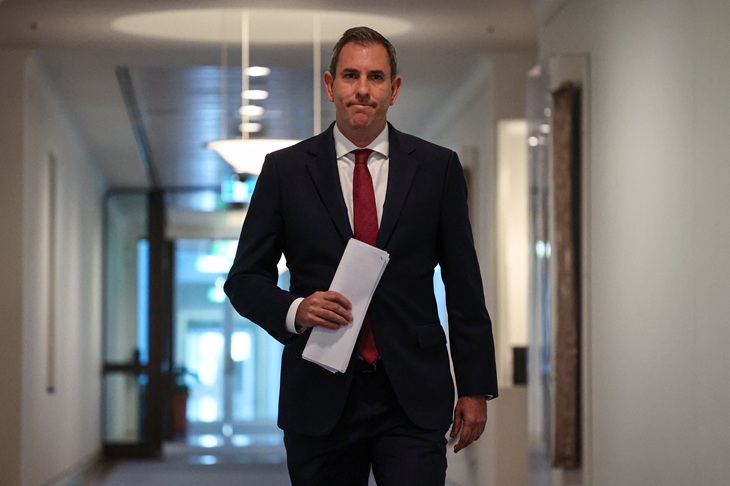
Meanwhile, Treasurer Chalmers, facing an economy visibly struggling to find second gear, has taken the remarkable step of convening yet another consultative encounter group of private sector economists to tell him things his own department should be telling him every morning before breakfast. Consider that for a moment.
The Treasury apparently requires external validation to confirm that taxing and spending too much suppresses growth. What it is apparently not being told, or is choosing not to hear, is that regulating too much is equally destructive, and in many respects harder to reverse.
The question that should sit at the centre of every serious economic conversation in this country is almost entirely absent from it. Not whether the settings are marginally miscalibrated, but whether the entire architecture is wrong.
Whether the project of the past quarter century, the steady, patient, bipartisan expansion of government reach into every corner of commercial and private life, has quietly strangled the productive capacity that once made this country genuinely prosperous.
Whether the reason inflation keeps returning is not that workers are paid too much, but that the economy has been so thoroughly distorted toward compliance, managed outcomes, and the care sector that it has lost the metabolic rate required to grow without overheating.
This conversation is not happening in Parliament, not in the press, and certainly not from the congenital underachievers at the BCA or ACCI, who have long since traded advocacy for access.
It is business as usual: tax, spend, regulate, express theatrical surprise at the results, and repeat.
Only a government institution can build a machine this elaborately designed to slow itself down and then convene a working group to investigate why it cannot accelerate.
Decline is a choice. Australia keeps making it, one regulation at a time, one program at a time, and calling the whole project responsible governance.