From a young age I had two main interests: astronomy and politics (telling, I know).
As a boy, all I wanted was a Celestron telescope. They are large tubes of mirrors, technology and glass, tastefully wrapped in an orange coating. With the punch of a button they will scan the whole night sky and know exactly where they are, and where every visible star is located.
That’s the most fascinating part for the astronomically inclined child: How do we know where the stars are?
The telescope has an inbuilt star map that picks up on bright star locations and logically follows where the rest of the stars in the sky are. But in a few millennia’s time that map will be useless.
This is because behind astronomy lies an unsolvable problem.
For any set of orbiting bodies three or more, it is impossible to predict where they will be to a high accuracy. A 2 per cent deviation in one body’s path is the difference between two bodies crashing into each other, or one being flung far out into space.
This is what is aptly called the Three Body Problem.
Our solar system, despite having many small bodies, is much more stable because the Sun’s gravitational pull is factors of magnitude higher than any other body in the system.
That stops if a larger, free-moving body enters the system. Everything will be flung out of balance and life on earth would cease to exist.
Our political system, much like our solar system, was very stable. There were two large bodies orbiting one another: Labor, and the Coalition.
There have been periods in our political history where one body’s gravitational field was dominant and then decades where the other’s was. This has changed with the introduction of One Nation. With a third body entering the political system with equal gravitational force, it becomes impossible to predict where everything will be in three years.
Stability in the political system is gone.
This is what has the polling all mucked up and our beloved two-party preferred is in disarray. One Nation is drawing voters from both the Coalition and the Labor Party, and each of the latter’s core voters have differing internalised preferences towards One Nation.
In a Labor-held seat, One Nation may have an ever-so-slightly higher primary than the Liberals, and their combined vote may be higher than Labor’s. This could allow for somewhere like Melton, Lara, or Niddrie to flip sides after decades of Labor representation. The same is true for a Liberal electorate. One Nation’s pull becomes stronger so that we enter the final count, however it is almost impossible to predict the direction of their preferences.
Let’s use Antony Green’s analysis as an example.
Statistics on Preference Flows between the Coalition and One Nation
In the seats where One Nation recommended the LNP on their how-to-vote cards, 68.6 per cent of preferences flowed that way. When the LNP recommended Labor over One Nation, Liberal voters split 50-50. When the LNP recommended One Nation in 2020, 76.1 per cent followed. And in regional contests where Labor recommended the LNP over One Nation, 60.2 per cent of Labor voters complied.
This is all well before the meteoric return of ‘minimum chips’ nationalism and this is why the Liberal establishment claims that One Nation is going to hand government to Labor are outright misleading. It frankly can’t be predicted to any great accuracy.
Without going into too much minutiae on statistics there are many biases that come with polling. If a text poll is sent out and 2,400 people respond, this creates a response bias. Perhaps 25,000 people were sent the text, there is no way of knowing by what percentage the intentions of those who didn’t answer are being skewed by those who did.
Response bias can be mitigated for but unless a party can afford to spend $15,000 on each seat they want to earn from voters, they will need to create modelling with Federal or state-wide polling numbers. Even then, a 2 per cent margin of error in a three-horse race could see Liberal and One Nation smashing together, and a Labor MP flung far into the space.
It is not One Nation that is causing this chaos but the voters who intend to vote for them. Australia has a disenfranchised voter base. They rock up, vote, and get their sausage, and many of them make their decision on the day.
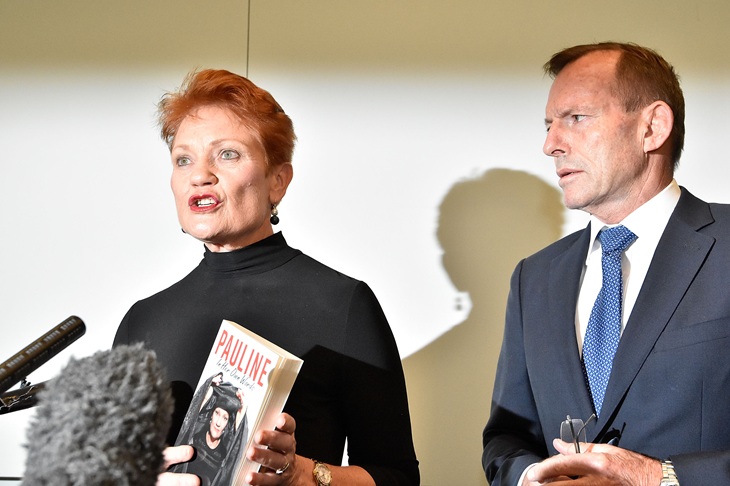
They are flocking to Pauline Hanson not despite her lack of a uni degree and having run a chip shop, but rather because of it. Pauline is a real person. One Nation candidates are real people. Angus Taylor worked at McKinsey, the company that popularised ‘downsizing’ for listed companies to increase shareholder value. Voters don’t want another pollie giving polished answers prepared by political advisors. They want real, raw human beings.
One Nation has put a fire under the arse of every sitting MP. They are forcing every party to preselect real candidates in every three-way electorate. Because without extensive and expensive polling, there really is no predicting who is going to win which seat.
Some might say this is impossible for One Nation given the meteoric rise, lack of hacks or party structure. However, there are hundreds of real people ready to run for the state election, and in many cases, I have been told, more candidates for One Nation in certain seats than the Liberals have had to choose from. With the Victorian Liberals looking down the barrel of a 40 per cent turnover in MLAs and MLCs, One Nation’s candidates will be on even footing with newly preselected Liberals.
They may not be political animals, they might not have media polish, but they are real people. They have had real careers, made genuine contributions, and are running for parliament for the right reasons – to serve the people.
In all this chaos, One Nation is doing one thing for certain. They are bringing parliamentary politics back to what it used to be: the highest form of public service.
And to that I say ‘shoot for the stars’.
Nathan Porter is a Co-Director of Revive Australia and the Convenor of the Young Australia Forum.