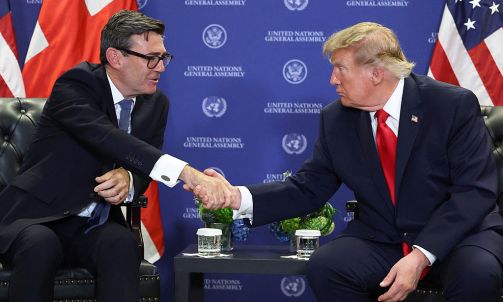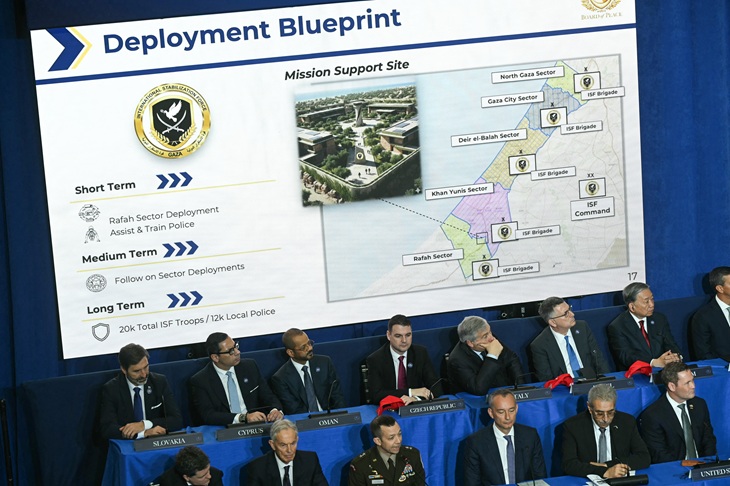
President Trump’s Board of Peace met last week. A few days later his Ambassador to Israel, Mike Huckabee, a man of many talents gubernatorial and pastoral, told Tucker Carlson, ‘It would be fine if they took it all.’ He was referring to a pretty big patch of territory around the current borders of Israel. ‘Israel,’ he told Carlson, ‘is a land that God gave, through Abraham, to a people that he chose. It was a people, a place and a purpose.’
Honest and unfiltered, it was. In no diplomatic universe, though, do such statements make sense.
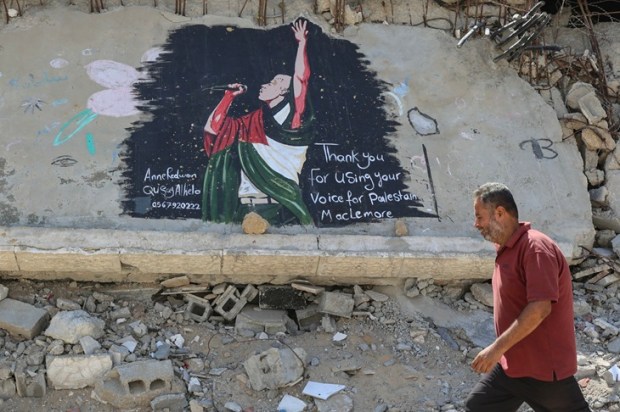
Which brings us to the reconstruction scheme for Gaza. Do you believe that if you rebuild normal life – houses, water systems, wages, ports – legitimacy will slowly grow and militancy will fade? Or do you believe that without prior security and political settlement, normality will not survive long enough to matter? Strip away the communiqués and that is the bet. It has been placed before. It has not yet paid out.
Reconstruction does not happen in abstraction. It sits in a triangle: the United States, Israel, and Turkey. Add Qatar and Egypt and it becomes a pentagon. Each corner has interests that overlap but do not align. Each suspects the others of hedging. Geometry is rarely kind in the Middle East, and this shape has too many angles to survive administrations, elections and the next inevitable crisis.
Concrete can be poured. Grids can be stabilised. Funds can be pledged. None of that is trivial. But infrastructure has never been the scarcest resource in this conflict. Durability is. The question is not whether the Board can raise capital but whether the commitment endures.
There is a particular cruelty in forcing generations to carry the weight of grand narratives while their daily lives remain provisional. Children should not grow up as arguments. They should grow up with functioning schools and a future. If the Board is betting that material normality can soften political extremity it is not irrational – prosperity has reshaped harder societies than Gaza. But prosperity must become routine before it becomes stabilising, and routine requires security that outlasts a news cycle.
Which brings us to the uncomfortable thought.
If annexation without citizenship in the West Bank is intolerable, and sovereignty without stability in Gaza remains elusive, is it immoral to widen the field of choice? Because hope, if it is to be serious, needs insurance.
If Israel moves decisively toward de facto or de jure incorporation of large parts of the West Bank without extending full citizenship, the political temperature will spike beyond containment. Those allergic to such an outcome will not be reconciled by administrative vocabulary. They will look for alternatives – internal, external, legal, illegal. The uncomfortable truth is that many Palestinians already vote with their feet when they can. Migration is not betrayal. It is a human reflex. The question is whether that reflex remains chaotic and individual, or becomes structured, dignified, and strategically stabilising.
Jordan already lives inside the gravity of this conflict. Roughly the size of Tasmania but holding twenty times its population, three-quarters desert, its people clustered in a tight northern corridor under constant water constraint. It survives through calibration – tribal compacts, managed participation, foreign aid balanced against sovereignty, and a security apparatus that knows when to tighten and when to release. Neither a liberal democracy nor a nightmare. It is a managed state that has outlasted most of its neighbours’ political arrangements by declining to be heroic about anything.
Its king was educated at Sandhurst. His mother, Toni Gardiner, came from Suffolk. He does not indulge Islamist theatre – remarkable restraint, given he is descended from the Prophet – and his American and London properties make Luxe Listings Sydney look like tarted-up West Wyalong fibro cottages. A man that comfortable in Western capitals understands what capital can do when deployed at scale rather than trickled in as aid.
What if it were deployed here?
Not a token package. Not another decade of managed dependency. A transformation: desalination infrastructure at Aqaba, energy guarantees, new urban zones built to the standards of a functioning Gulf city – reliable water, industrial corridors, commercial districts that produce wages rather than grievance. The engineering is proven. The constraint is not technical. It is political will and the capital that follows it.
Not expulsion. Not coercion. Not the cold language of transfer, which belongs to darker chapters and must remain there. A door. Voluntary, dignified, backed by real money and real citizenship.
If even 30 per cent of Palestinians in Gaza and the West Bank chose, over time, to take citizenship in a massively capitalised Jordan, the strategic map would alter even if the rhetoric did not. That is approximately 1.5 million people – not a moral gesture but a demographic event, one that would change the density of despair on both sides of the river.
Gaza should be rebuilt as a demilitarised coastal economy under international guarantees: tourism, logistics, light industry, a port that serves commerce rather than smuggling. Not utopia – functionality. The West Bank could evolve toward high-autonomy integration with Israel, economically entangled rather than permanently insurgent, communities that are neither sovereign nor stateless but simply, gradually, normal. Jordan would become the third horizon – not exile but expansion, not the erasure of identity but the addition of a future.
There are serious objections. Jordan fears demographic shock; its monarchy rests on a delicate internal compact and a mass influx, however voluntary, alters that equilibrium. Palestinian leaders will fear the erosion of grievance as political currency. Western publics will flinch at any echo of ‘alternative homeland’ language. History made that phrase radioactive.
All understandable. None decisive.
Because there is nothing noble about trapping families in a theatre of recurring devastation because the map must remain pure. Borders are not holy relics. Lives are. The moral line is straightforward: no one is compelled, no one is erased, a door is opened and backed with the capital the West reserves for problems it considers worth solving. Whether it considers this one worth solving is the real question.
The Board of Peace may yet prove that reconstruction alone can stabilise Gaza. But prudence suggests building a second path before the first one burns again.
Peace in this region has rarely arrived as a treaty signed under chandeliers. It tends to arrive, when it arrives at all, as something quieter: families choosing stability over symbolism, children growing up as students rather than slogans, the politics of revenge becoming, slowly, less fashionable than the politics of the school run.
If that requires building something real in the Jordanian desert – water, cities, citizenship, a future – then the question is not whether the idea is perfect.
The question is whether we are serious.