I met the Tate’s outgoing director Maria Balshaw only once, back when she was in Manchester running both the Whitworth gallery and the city’s municipal art museum. She was given to management-speak and annoying soundbites – she more than once described herself as ‘feisty ’ – but she’d done a superlative job. She was charismatic and supremely competent – in theory, the perfect candidate for the soon-to-be-vacant Tate leadership. She got the job two years later, but the confrontational demeanour that had worked so well up north didn’t wash in London, where the phrase ‘can do’ routinely elicits the same retort: no, you can’t.
Meanwhile, a series of PR cock-ups – largely related to the museum group’s paralysis in the face of political correctness – slammed any sense that Tate was in control of its messaging. And while it wasn’t necessarily Balshaw’s fault that visitor figures plummeted in the wake of the pandemic, the captain is still supposed to go down with the ship. Balshaw eventually did just that, announcing her resignation from the Tate just before Christmas.
In fairness, she’d had Turbine Hall-sized shoes to fill: her predecessor, Nick Serota, had sculpted the job in his own image, an impossible mould to fit. Her response was to oversee a series of exhibitions that reimagined modern art as a global phenomenon marching in step with postcolonial theory, the latest – and most formulaic – of which is Tate Modern’s Nigerian Modernism.
There are some supercharged, bona-fide brilliant displays here: Ben Enwonwu’s sculptural quartet of figures, carved from African hardwood, was commissioned for the HQ of the Daily Mirror in the early 1960s and subsequently lost, eventually resurfacing in a Bethnal Green lock-up. It’s a masterclass in syncretism, melding Italian futurism with the sculptural practices of Enwonwu’s homeland. But it’s a rare highlight in a show that privileges narrative over aesthetics. Such was Balshaw’s problem: she was a student of visual culture, less concerned with actual art than the context in which it was created; and really, I think, she’d have been happier running a regional museum, playing the insurgent upstart to the Tate’s metropolitan art blob.
Seriously. at Sprüth Magers might be the most German show I’ve ever seen
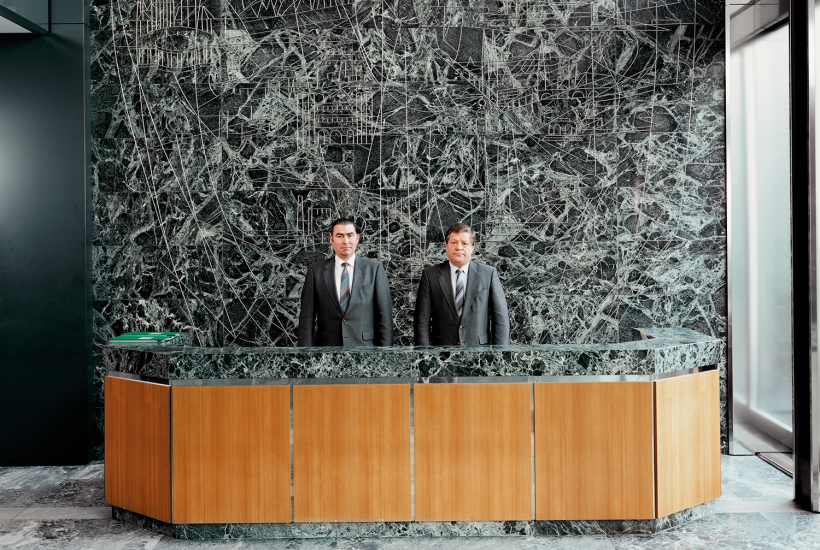
Out in the private sector, the dealers are in weirdly irreverent form. Seriously. at Sprüth Magers might be the most German show I’ve ever seen, themed around the principle that contrary to reputation, conceptual photography can be fun. Observe, the curators seem to say: here is an object and it is humorous. All it lacked was a canned laughter track. For all that, it featured some great things: John Smith’s immortal film Girl Chewing Gum (1976); Keith Arnatt’s series, in which the artist, looking straight on to camera, has himself buried alive; and Andreas Gursky’s deadpan pictures of receptionists at Düsseldorf business HQs stuck behind their desks. I laughed out loud once, and that was at Philip-Lorca diCorcia’s photo of a pair of Afghan hounds transfixed by a hardcore skin-flick.
A few blocks away, Pace is fielding a riotous show dedicated to banality. Claes Oldenburg provides a giant ashtray, hyperrealistic sculptures of ice-cream sundaes on trays and puddings in glasses, pieces matched by Wayne Thiebaud’s studies of chiller cabinets and cakes; there’s a Rachel Whiteread cast of a hot-water bottle; and Keith Coventry’s fabulous series of paintings based on details of the McDonald’s logo, teasing out the constructivist echoes lying between the curves of the Golden Arches.
All this, however, is foggy in the mind, eclipsed by a film. Saodat Ismailova’s Swan Lake is currently screening as part of her mini-retrospective at Gateshead’s Baltic. Born in Tashkent in 1981, Ismailova makes work that can broadly be read as a requiem for a distinct strand of art that emerged from the twilight-era USSR. Swan Lake (2025) is the most impressive expression of this yet, essentially consisting of a collage of clips lifted from films realised in Soviet Central Asia in the last days of Perestroika. Even its title is a nod to the 1991 coup that nearly toppled Gorbachev, during which a Russian TV channel screened nothing but a looped broadcast of the eponymous ballet.
The result is a berserk ride playing out over two adjacent screens, in which goatherds wander through the wilderness, a man licks broken glass, revolvers are drawn from briefcases and blasts of music – from Tchaikovsky to techno – erupt from the speakers. It’s immensely compelling: an entrancing spectacle that rams home the power of the moving image and the artistry of proper editing; and if its monochrome palette and frenetic pace recalls Eisenstein’s Battleship Potemkin, you can be sure it wasn’t accidental.
Got something to add? Join the discussion and comment below.
You might disagree with half of it, but you’ll enjoy reading all of it. Try your first month for free, then just $2 a week for the remainder of your first year.