In a frequently cited analysis, Vaclav Smil demonstrates how the progression of human living standards has been conditioned by inventions creating cheaper energy, especially in the modern era once steam engines were invented.
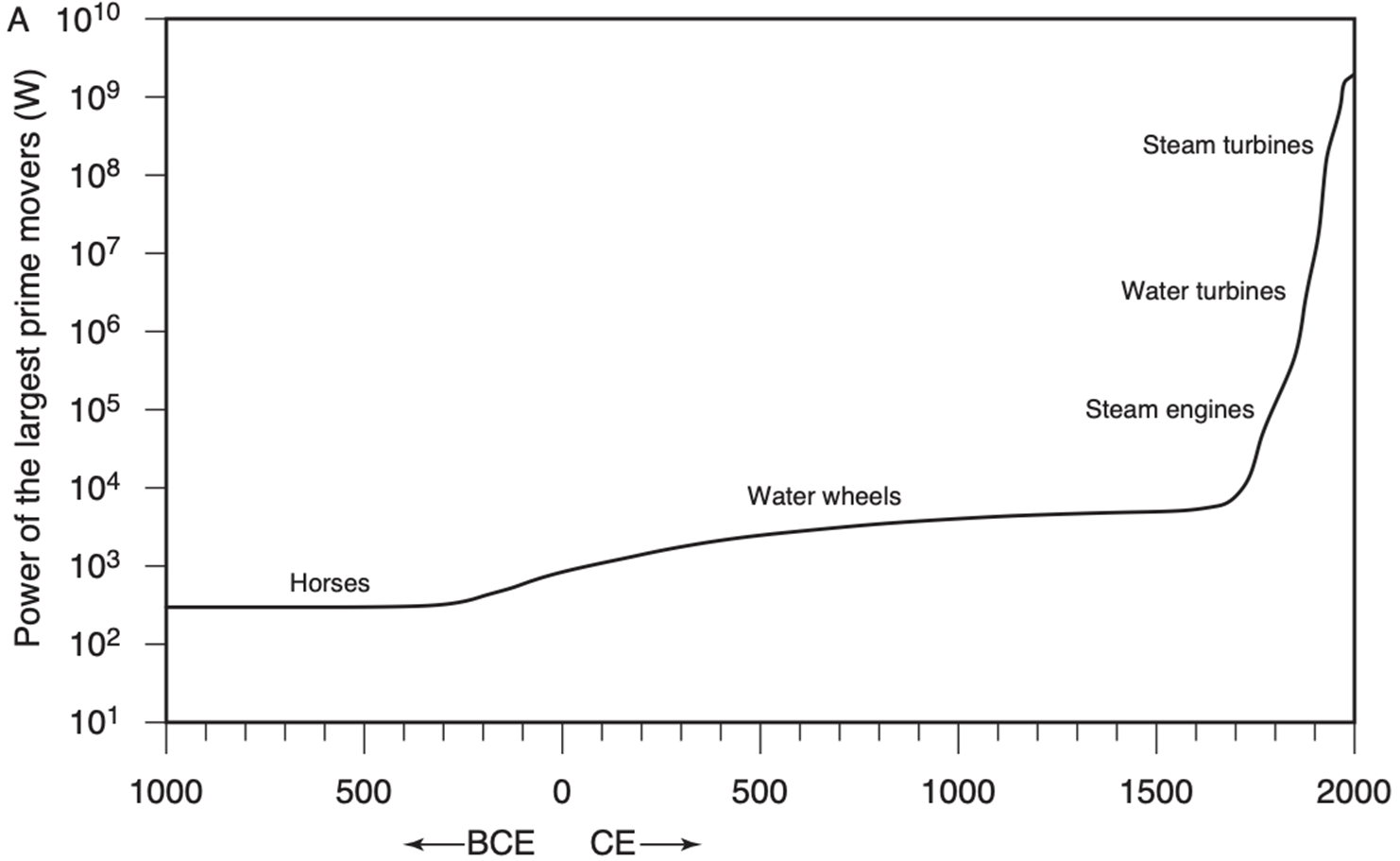
Graph from: https://vaclavsmil.com/wp-content/uploads/2024/10/smil-article-2004world-history-energy.pdf
Smil’s four pillars of modern civilisation – cement, primary iron, plastics, and ammonia – cannot be produced except at great cost by energy sources other than fossil fuels, nuclear, and hydro-electricity (which has little new potential).
He notes how much more expensive renewable energy (wind and solar) are than fossil fuels and nuclear, is sceptical that a ‘transition’ to wind/solar is possible, and considers hydrogen – last year’s great new prospect – to be unfeasible as a bulk power supply source. This is because one kilogram of hydrogen is equivalent to about 33 kWh of electricity but its production by electrolysis of water needs about 50 kWh/kg.
Yet, propelled by hyperbolic fears of global warming, the world’s developed nations have all to some extent pursued policies that seek a replacement of fossil fuels by wind and solar.
The one developed nation fully rejecting such a policy – and then only over the past year – is the US.
Almost all others are showing greater reticence, as testified by their reluctance to present comprehensive emission reduction plans in line with requirements of the UN Framework Convention on Climate Change.
These policies have had clear effects. For, notwithstanding the claims of CSIRO, the cost of renewable energy – as delivered in response to consumer needs – are far in excess of other energy sources. The evidence is clear from cross-country comparisons of electricity prices and the share of renewable energy in supply.
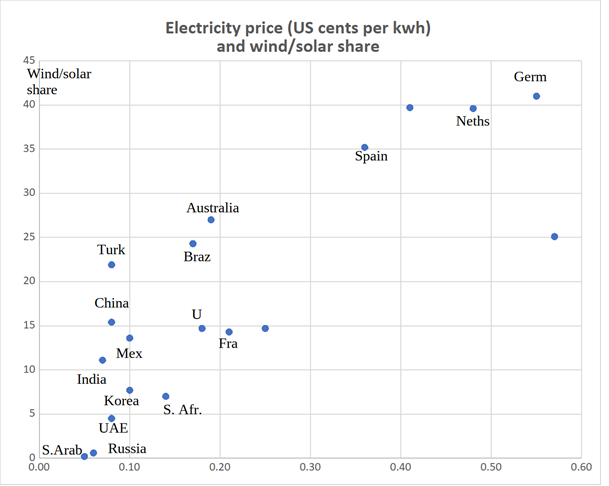
The disadvantages of wind/solar are particularly acute for Australia which has just about the cheapest coal in the world, conveniently located to major urban areas.
Any notions that electricity prices have risen due to global factors, or as a result of a cost increase for fossil fuel generating plants, is refuted by comparisons of prices across different jurisdictions. Twenty-five years ago, the dozen jurisdictions below had prices ranging between two (Russia) and ten (Japan) US cents per kWh. Australia was at the high end but little more than half of Japan’s prices.
Fast forward to today, and Australia and the UK share the wooden spoon, with prices fourfold those of Texas, twice those of California and three times those of resources competitor Indonesia – even Japan has prices two-fifths lower. Australia, the UK and EU have been most enthusiastic in forcing the replacement of fossil fuels with renewables – wind and solar now comprises over a third of Australia’s supply. Developing nations’ emission reduction obligations are in the future and they have shown little appetite for an earlier shift to renewables.

Source: https://www.globalpetrolprices.com/map/electricity_industrial/
These higher prices are taking their toll in nations at the forefront of pioneering emission reduction policies, particularly with energy-intensive activities like smelting, which are being forced to close or are being propped up by subsidies.
Support for renewables in the EU may be declining. German climate activists are concerned about the declining voter interest in decarbonisation: they lament the postponement of the emission trading scheme for buildings and the slowdown in heating law reform.
By contrast, Australia and the UK are redoubling their efforts.
Australia has one of the world’s most comprehensive subsidy programs for renewable energy. Government sources no longer place on the public record the aggregate level of the subsidy costs but from public information they are estimated to be some $16 billion a year.
This includes requirements on energy retailers to incorporate wind/solar, direct subsidies for those sources and costs of the extensive transmission systems their dispersed and low-density power requires. To expedite the transmission roll-out, the government passed a new Environment Protection and Biodiversity Conservation (EPBC) Act, a key provision of which is designed to truncate lengthy approval hearings.
The renewables subsidies also include obligations on the top 215 CO2-emitting firms to reduce their own emissions by 30 per cent and the Capacity Investment Scheme (CIS), announced in December 2022, under which the government contracts wind/solar and batteries, at guaranteed prices for three to seven years. The latest estimate of annualised aggregate costs (excluding additional support announced post the 2025 election) is:
| Subsidies to renewables ($ million per annum) | |||||
| · LRET 33,000 GWH times $7.25 per MWh. | $239 | ||||
| · SRES 26 million to be surrendered this year times $39.95 | $1,039 | ||||
| Batteries $500 million per year | $500 | ||||
| · Safeguard Mechanism: 30 % emission reduction for the top 215 firms by 2030 | $906 | ||||
| · RERT, FCAS and system security | $400 | ||||
| · Clean Energy Regulator | $750 | ||||
| · State Schemes (2019) | $1,408 | ||||
| · Capacity Investment Scheme $85B investment by 2030 55 % of costs to govts | $7,150 | ||||
| $12,392 | |||||
| Long term programs (assume 15 year annualised) |
Total |
Annualised | |||
| · Hydrogen Headstart |
$8B |
$900 | |||
| Other FMA Batteries, solar and NZ tech |
$4.8B |
$488 | |||
| · Expansion of transmission from $23B to $100B |
$77B |
$510 | |||
| · CEFC |
$2.69 |
$40 | |||
| · ARENA | Based on annual Report: Govt. Grant expenses plus admin | $231 | |||
| · Snowy 2 |
$25B |
$1,667 | |||
| · TOTAL | $3,836 | ||||
| $16,228 | |||||
The government commissioned the Nelson Review to advise on future policies. Its report, issued at the end of 2025, recommended a new Electricity Services Entry Mechanism to replace the CIS by increasing the duration of price-guaranteed contracts for renewables for up to 30 years.
In addition, following restraints on new gas development in place in NSW and Victoria since 2012, gas shortages to firm-up the renewables are becoming acute. The Commonwealth has proposed a gas reservation policy to force Queensland gas producers to redirect supply south.
Even if practicable, this will not be enough to bring lower prices.
Australia is becoming a stand-out in the pursuit of Net Zero emissions. Indeed, in doubling down on its policies, the Commonwealth will aggravate the increased electricity prices and reduced reliability that accompanies penalties on fossil fuels (and nuclear), undermining industry competitiveness at considerable costs to consumers and taxpayers.