Last week I was fortunate to be invited as a panel guest for the 2025 Australians for Constitutional Monarchy National Conference run by Professor David Flint.
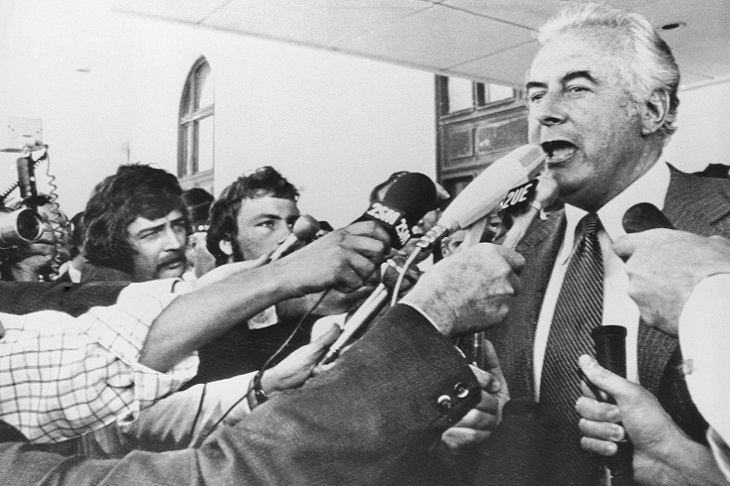
It was, partly, a conversation about how the dismissal of Gough Whitlam is perceived 50 years on. Former Prime Minister John Howard reminisced with his first-hand experience of the dismissal, while others discussed the legal ramifications.
I was one of the few in attendance who had not yet been born at the time of the dismissal and knew of these historical figures – Kerr, Whitlam, and Fraser – purely by legend.
Towering figures are largely fabrications, rebuilt with emotion padding out the corners of truth. That is how they grow.
The story I heard was one spun by the well-practised media and vengeful left-leaning education system. In their eyes, Gough Whitlam was an ideological hero slain by the monstrous Sir John Kerr on behalf of Her Majesty, Queen Elizabeth II. Fraser? He was forgotten.
Whitlam’s fairytale was fed to us across two pages of ‘modern Australian history’ which can be summarised: ‘Woe is me!’
He was presented as a victim while his later electoral defeats were swept aside by the historian’s eraser. As with the apologists of socialism who complain that if they had only been allowed to finish, the Utopia would materialise … so too was Whitlam apparently cut-down mid-stroke on his way to genius.
It is my belief that the re-tellers of his story found it imperative that his rejection did not extend to the rejection of his reforms, as many Labor followers would later attempt to cement them into the political record, failures and all.
By re-framing history as a tale of two men (sometimes three), the detail of Whitlam’s policy failures has been lost.
Twenty years ago, the narrative most children left school believing was that of a monarchy conspiring to unseat a Labor reformer.
Everyone knows the truth is quite a different story.
Whitlam was the architect of his own demise and punished for his behaviour, not by Kerr, but by the people at the ballot box.
As the release of the Palace Letters demonstrated, the Queen knew very little of the unfolding situation and certainly did not order, or in any way arrange, for events to unfold.
Kerr was severely and unfairly punished with a toddler-esque tantrum by the state-funded press and generations of Labor ‘miserables’ who never got over the rejection of Whitlam’s unworkable reforms.
They are still whinging about it today.
Which is a worry, because we may very well be in possession of an unhinged Labor government determined to implement reforms to the fabric of Australia which have not been approved by the people.
A perfect example is the Labor Premier in Victoria, Jacinta Allan, who has decided that she knows better than Victorians who voted ‘No’ to the racial segregation of Parliament and has instead pushed ahead with a ‘treaty’ that fundamentally destroys the understanding of a colour-blind democracy.
What has happened since? Nothing, except the faint reply of a near-dead Opposition. Citizens are quite rightly asking what was the point of a referendum if their state government can brazenly ignore it in favour of the loud and greedy activist class. Are there any real protections for the citizen?
Whatever the legal case may be, the feeling on the ground is one of an arrogant state government indifferent to the sacred norms of Australian politics and that there is no one – not a governor, not a monarch, not a court, and not an Opposition – coming to save them.
The Australian people are starting to feel powerless in their own democracy and so it is natural to ask, could a bad Prime Minister be sacked?
Technically, yes, but after what happened to Kerr there is a fair measure of doubt that anyone would subject themselves to the same inferno of outrage. (Unless the Prime Minister happened to be a conservative, in which case the media would no doubt kneel down in eternal praise of the system. They may even become monarchists.)
If there is one thing the Covid pandemic taught us it is that our rights as citizens are not worth the paper they are written on when there is consensus between politicians and bureaucrats. That lesson still haunts me, as do the words of various court rulings which admitted the scientific incoherence of certain rules that were, nonetheless, ‘legal’ because a politician deemed them so.
The assumed rights that we saw destroyed in those few years have never been addressed by our major parties.
Covid abuses hang above the system of government as a warning that there is no desire from politicians to police themselves.
Governments are powerful, and their safety nets need to be equally robust.
How safe do you feel?
Today, the education system frames Whitlam as a positive reformer. Instead of asking if his reforms were necessary or beneficial, they are asked why they were necessary and beneficial. The removal of choice from the discussion is a common yet subtle theme which stifles critical thinking in the crib.
If a child leaves school with any knowledge of Whitlam, it is that of a tragic fallen Labor hero cut down by the Crown, poisoning a generation against the monarchy in the hope they will one day blindly vote in a referendum to avenge the Ghost of Gough.
Hilariously, even the best plans for propaganda can be defeated – not by critical thinking, but by the sheer passage of time.
The truth that Labor does not want to acknowledge is that the Ghost of Whitlam has faded out of view. Between AI and general disinterest, the education system is starting to fail on the Whitlam saga. I can tell because if you go onto TikTok or X, no one is talking about him. Under 20? No chance. The only people dragging Whitlam through our mastheads are old Labor commentators and legacy networks trying to earn a few extra pennies.
Young people are online screaming as loudly as they can about being stuck in alternate reality separate from their parents and grandparents. It is a sound-proof room where the economic, social, and practical concerns of their existence are completely irrelevant to the ruling political class.
The gaping generational divide is the real lesson of this anniversary. One era has finished, and the next began while no one was looking.
New eras demand fresh conversations.
Labor is overreaching. The Coalition is collapsing. A grassroots network of minor parties are trying to grow through the cartel-like protections of preferential voting put in place by the major parties.
I have no idea where this leads, only that something is coming.
Flat White is written by Alexandra Marshall. If you would like to support her work, shout her a coffee over at donor-box.