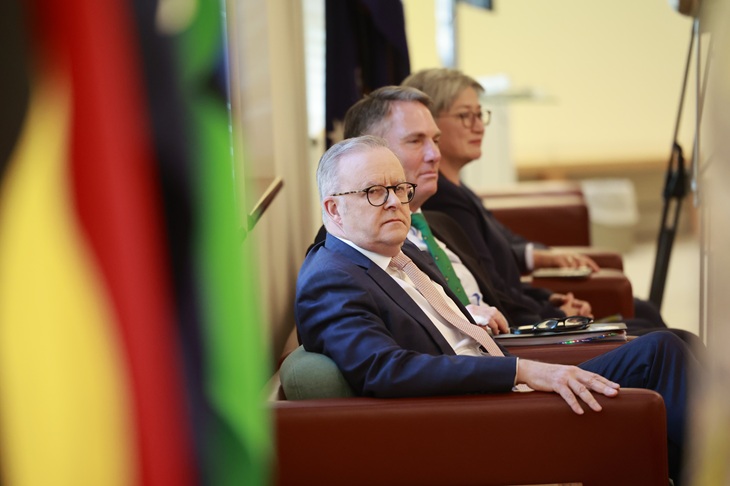
Peta Credlin has speculated that Albanese would like Australia to be a neutral Switzerland of the South Pacific ‘but without the compulsory National Service’.
Switzerland is a nice place: prosperous and peaceful. What could go wrong?
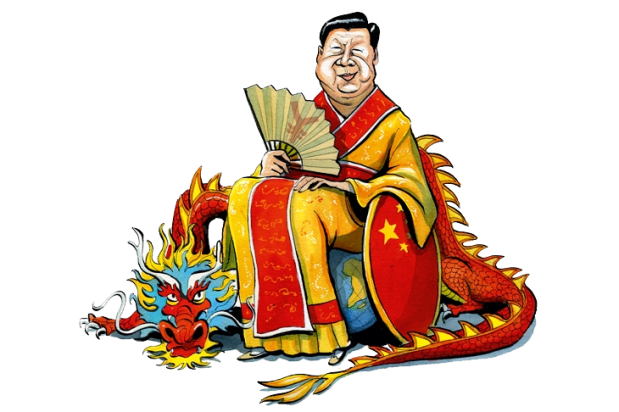
Well for a start there’s the absence of self-defence at a time of disturbing military build-up and sabre rattling on the part of a potentially hostile China.
In 1939, adjacent to a dangerous neighbour, Switzerland mobilised 430,000 combat troops and 210,000 support services out of a population of 4.2 million. Australia’s defence force numbers just 57,000. In relation to its population of 27 million, Australia’s effort amounts to less than 2 per cent of the Swiss 1930s manpower allocation!
Moreover, Switzerland in the 1930s was more than a nation producing cuckoo clocks. Its industry was world class, exporting (mainly to Germany) precision instruments, machinery, anti-aircraft guns, cannon, and ammunition – the sorts of goods that Australia today is increasingly unable to produce for itself and, due to its Net Zero energy policy, is increasingly pricing itself out of the export revenue necessary to import them.
The core of Australia’s defence strategy is to buy three US nuclear submarines in the 2030s with plans for five SSN-AUKUS nuclear submarines in the 2040s. Former Prime Minister Malcolm Turnbull is probably correct in saying we will not actually get any of these. And even on the most optimistic schedule the US boats would be unready for 10 years and their availability will depend on them being integrated under the sort of US strategic command that Albanese cannot accept.
Not only is Australia greatly under-armed and planning to remain so, but people are showing a disturbing indifference to national defence.
According to the Lowy Institute, only 52 per cent said they would, if possible, defend Australia in the event of an attack. Fully 24 per cent said they definitely would not. An increasing proportion of these may owe a greater allegiance to Islam but, even though the government notoriously approved 3,000 visas for Palestinians from Gaza, the latest data indicates less than 12 per cent of new (non-New Zealand) immigrants came from Islamic countries.
Some will argue that the accuracy of people’s stated willingness to act against invasion is uncertain. They might point to the 1933 debate in the Oxford Union Society, ‘That this House will under no circumstances fight for its King and country,’ which passed with 275 votes for the motion and 153 against it, only to see young men drawn from such elites win the battle of Britain eight years later.
But Australia today may be far less unified than was Britain (or indeed Australia) in the 1930s. At that time, less than 1 per cent in either country signified deep hostility against the established framework by voting communist. And the population of both nations was relatively homogeneously British (with the 1 per cent of Australia comprising Aboriginals, then as now, sharing the same loyalties as the European ‘settlers’).
In light of the Darkening Storm in the Europe of the 1930s, though feigning appeasement, Britain commenced a vigorous military re-armament. Albanese has rejected that approach.
This may reflect the ALP’s long-standing anti-Americanism (especially under Republican Administrations), their equally enduring favourability to communism and a belief that, in the final analysis, Australia can free-load because the US would never allow such an important piece of real estate to fall into the hands of its main adversary.
In any event, Albanese cannot allocate more resources to defence unless, first, he recognises the need to reduce election-winning give-aways and secondly, he comes to understand what actually drives prosperity. With attacks on savings in superannuation, with IR policies that weaken the nexus between remuneration and individuals’ productivity, and placing a higher priority on spurious environmental protections, he does not have the same understanding of economic success than the Chinese leadership that he admires.
Australia and China cannot be regarded as moving closer together. Although trade interests are solid in iron ore and gas, the punitive Chinese trade measures in response to Australian criticism of their domestic policies surpass anything that Trump might contemplate. And investment ties are weakening: Chinese investment in Australia was $36 billion in 2024 but has been falling, while Australian investment in China has declined from $16 billion to under $2 billion. US/Australia two-way investment is ten times as great. Albanese’s formula for green steel and green hydrogen as the area for greater Sino-Australian cooperation is totally untethered from economic reality.
Labor, like many other leftist governments is searching for a solution to the stagnation created by interventionist and high tax policies. Abundance, the book by left wing journalists Klein and Thompson, seeks to prod socialistic parties in the direction of Reagan/Thatcher with deregulation policies. Treasurer Chalmers’ deity, Paul Keating, championed many such moves and Bob Hawke famously embarked on ALP apostasy in a 1984 address to the Business Council when he said:
‘I am convinced after 84 years of Federation, we have accumulated an excessive and often irrelevant and obstructive body of laws and regulations… We will maintain regulation which clearly promotes economic efficiency, or which is clearly an effective means by achieving more equitable income distribution and we will abandon regulation which fails these tests.’
There is nothing from the present ALP leadership team that suggests any affinity with this.
Having declared an independence from Trump’s USA, without a revolution in its economic policy stances, the Albanese government has little option but to continue bending the knee to China hoping this will inoculate us from political disaster as it nudges us into continuously declining living standards.