Not everyone will have noticed, but the strains of carol singing were heard less this past Christmas than in previous years. Not because of secularising councils’ anti-Christian campaigns or disingenuous protestations that public celebrations of Christmas ‘offend’ certain minorities, though all that plays its part, but because there are fewer churches to sing them in.
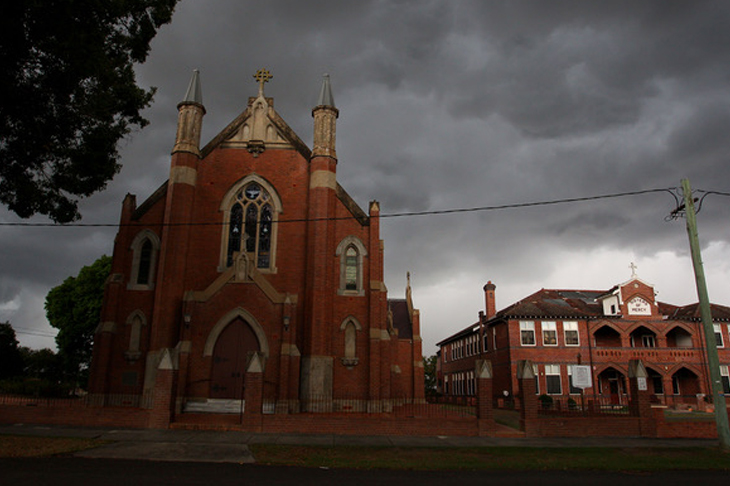
All over Australia, churches are closing down. The public face of Christianity is in retreat. With a few exceptions, congregations are getting older and smaller. Yet the costs they have to bear to keep their buildings open are constantly rising and like everything else have vastly increased under the present federal government. Older churches in particular need a lot of maintenance and keeping them in repair is something many parishes can no longer afford. Appeals may help, but only in a few prominent cases.
Yet churches are the place where, at Christmas, you could be sure of hearing carols. Not so many churches means not so many carols. Christmas carol services in churches, often modelled on the Nine Lessons service in King’s College Chapel, Cambridge, were generally well attended, even by people who don’t otherwise go to church.
That, of course, is now the great majority of Australians. Irrespective of periodic surveys that show that we are still a ‘spiritual’ nation, whatever that might mean, the local church has become irrelevant to most of us. The story is the same throughout the Western world. The suburban parish with its cluster of youth groups and tennis clubs is quietly disappearing. Its influence on the lives of the people who live around it has been edged out by such disparate forces as sport on Sundays, wedding ceremonies in gardens and on beaches and funerals at the golf club. Distrust of the clergy, justified or not, as a result of abuse scandals, hasn’t helped, nor have media and academic dismissal of Christianity as intellectually respectable and the general indifference to non-material things that the complacence of prosperity seems invariably to generate.
Where the local church continues to survive in recognisable form it has become a minority club for people who are interested in religion or perhaps simply the externals of religious and liturgical practice, on the level of a local philatelic society or kung-fu class.
This definition applies above all to the Anglican and Protestant denominations. It is not true of the Pentecostalist and revivalist tradition with its appeal to a specific type of religious sensibility. Nor is it strictly true of the Roman Catholic Church, where a visible parochial identity rests on the shoulders of the Catholic school system. Yet even here the prospects are far from rosy. Only four per cent of Catholic students practise their religion by the time they leave school.
As if to symbolise the future, one of Melbourne’s most prominent churches, a vast nineteenth-century Neo-Gothic building, high on a hill in the bayside suburb of St Kilda, with a spire that can be seen from far and near and out to sea, has just been sold by the Presbyterian Church. Its stonework and interior expensively restored only a few years ago, this church, built to accommodate hundreds, has long been too big for its present congregation, who, after a long and uphill battle to keep it going, have given up the struggle.
This church was advertised as suitable for conversion into flats or offices. This means that, like so many others, its splendid interior will be ruined with internal walls and mezzanines, for although ‘heritage’ protection generally applies to the exterior of such buildings, valued not as places of worship but as elements in the ‘streetscape’, their interior, with its furnishings, often of great aesthetic value, is subject to alteration for new purposes, which, no matter how often described by agents and architects as ‘sensitive’ or ‘sympathetic’, is what would once have been considered vandalistic iconoclasm.
Somewhere in the last two or three generations, people lost the habit of going to church. The Anglican Church – to which a quarter of Australians once professed to belong – has been badly hit. If we take Melbourne as a representative metropolis, at least fifteen churches have shut down in the last decade – and a glance at a typical Sunday morning in most parishes suggests there will soon be more. An historic church in Ballarat, Victoria, with – unusually – a healthy congregation is for sale because of an impossible repair bill.
This is not universally accepted as evidence of decline. The Melbourne Anglican diocese raised $69 million from the sale of properties between 1998 and 2020, most of which went into churches in new areas and other forms of ‘mission’. Even so, the picture overall is one of retreat. Apart from anything else, new churches are invariably small, built for a tiny percentage of the population, quite unlike the capacious buildings that were going up until the 1960s.
Six years ago the Anglican Church in Tasmania put up for sale a substantial proportion of its churches, largely to raise money for abuse ‘survivors’, though some were sparsely attended and probably would have gone anyway in the next few years.
If the prospects for churches in the suburbs are bleak, they are worse in the country. Closed churches, converted into ‘arts hubs’, antiques markets or pizza bars (‘Heavenly Pizzas’, ‘Divine Souvlaki’ say the signs) can be seen in every country town.
In smaller hamlets there is sometimes no functioning church where once there were three or four. Solar panels on the roof, unharmonious extensions tacked on to naves, show that the surviving buildings are now someone’s weekender.
‘O come all ye faithful’ some of us sang at Christmas. If only more would, must be many a cleric’s prayer.
Got something to add? Join the discussion and comment below.
You might disagree with half of it, but you’ll enjoy reading all of it. Try your first month for free, then just $2 a week for the remainder of your first year.