As Donald Trump marches towards the Republican nomination, a spectre is haunting Europe: how should they prepare for a world in which Nato becomes dead letter? For some, the answer is ‘strategic autonomy’; for others, it lies in procuring as much US-made kit as possible to buy goodwill with the future administration.
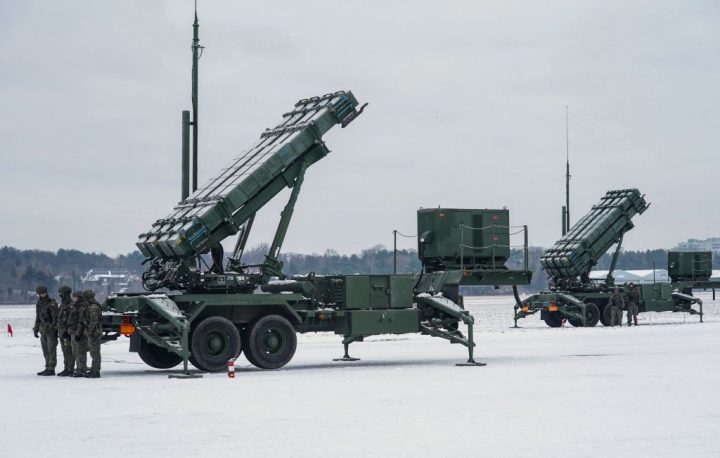
One obvious response, however, has been left by the wayside: nuclear deterrence. When it comes to Trump-proofing the security of Eastern Europe, few measures would be as effective as arming the largest country of the region – Poland – with nuclear weapons.
In a post-American world, a Polish nuclear umbrella could help secure Europe’s Eastern flank
Even centrist EU politicians, such as Manfred Weber – the current leader of the European People’s party – are thinking about nuclear deterrence as a possible answer to Mr Trump’s return. Weber proposes to allowing France, with its large nuclear capabilities, to lead a European deterrent effort. His scheme could include the United Kingdom, with the purpose of collectively turning the EU and its closest European partners into a nuclear power.
The basic rationale is sound, whether or not Mr Trump will decide to remove US nukes from Germany, Belgium, and Italy. Many Ukrainians will admit that giving up the country’s nuclear arsenal in the 1990s was a tragic mistake, setting the stage for Russian interference and aggression in the years to come.
There is no sugarcoating the situation for the Europe: Mr Trump will not be ‘tough’ on Russia, nor will he be interested in strengthening Nato. The former president called the alliance obsolete and has mused about leaving it. Forget ‘adults in the room’ – the prospective Trump administration will be staffed far more heavily by sycophants and Trump loyalists than by traditional Republicans.
The bipartisan bill passed last year that supposedly prevents US presidents from withdrawing from the alliance without either the Senate’s approval or an act of Congress is legally hollow. The threat to the alliance is not America’s formal withdrawal but rather the possibility that a future president would simply choose not to come to the defence of an ally under attack and invoking Article 5.
Europeans should be doing much more to strengthen their military capabilities – including their nuclear ones. Yet, Weber’s scheme is completely unrealistic. Under the existing system of unanimity, it is equivalent of asking France to acquiesce to, say, a prospective Hungarian veto over the use of its nuclear arsenal. And if the federalists’ pipe dreams were to come true, Paris would face the prospect of being outvoted on the matter by the Council’s qualified majority– a politically unpalatable proposition to any French leader.
Currently there simply isn’t enough trust or a sufficiently shared understanding of geopolitical threats to ‘Europeanise’ any lethal power, much less France’s nuclear force. Furthermore, seen from Warsaw or Tallinn, a European nuclear force that is controlled primarily by a Franco-German tandem would look largely useless given the track record of both in misreading and accommodating Russia.
But that doesn’t mean that Europe, and particularly Eastern Europe, is helpless. For one, there is a sizeable contingent of countries that do trust each other, have a shared view of Russia and who could easily acquire and sustain their own nuclear deterrent – Poland, the Baltic states, and the Nordics. In fact, it would be enough for just one of those countries to move ahead and absorb the fixed cost, and then offer a nuke-sharing arrangement to other parties that might be interested.
Poland, heavily investing both in its military and its nuclear energy, would be an obvious first mover. The cost may be surprisingly modest. The UK’s Trident system, acquired in the 1980s, cost around £21 billion in today’s prices. Expenses were spread over more than a decade with annual maintenance coming in at around £3 billion. Simply announcing such as intention may prompt France and/or the UK to offer a bilateral, nuke-sharing deal to Warsaw, which may also do the trick. But, ultimately, for deterrence to be credible the weapons ought to be controlled by the party that bears the most direct risk of Russia’s attack: Poland itself.
In a post-American world, a Polish nuclear umbrella could help secure Europe’s Eastern flank. It would also provide an alternative way of guaranteeing Ukraine’s security once the fighting stops, especially if Nato membership were no longer an option. More fundamentally, however, a nuclear Poland would provide an answer to a perennial problem of Europe’s geopolitics: how to prevent Germany and Russia from seeking to dominate the Eurasian landmass.