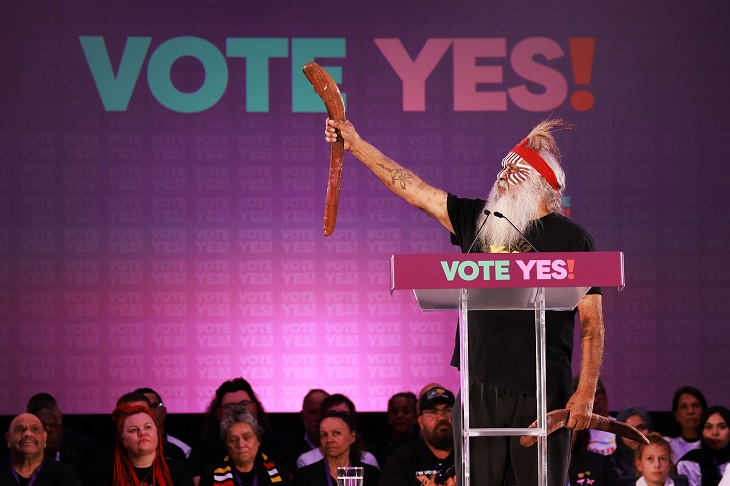
In the week before the Voice referendum, the esteemed commentator for the Australian newspaper Paul Kelly argued if the ‘No’ vote prevailed it would be wrong to see the result as a significant turning point in the battle of ideas.
Kelly writes:
‘If the ‘No’ vote prevails Dutton must beware an emotional resurgence of populist conservatism and far-right elements driven by the false notion the ‘No’ vote constitutes a cultural and ideological turning point.’I beg to differ. Putting aside the emotive and misleading phrase ‘beware an emotional resurgence of populist conservatism and far-right elements’, Kelly’s argument that the referendum’s defeat cannot be seen as a significant turning point in the culture wars is inherently flawed. As argued by the American commentator Andrew Breitbart, culture is upstream of politics. Politicians do not exist in a vacuum and history tells us politicians, whether they know it or not, are influenced and guided by larger cultural and ideological forces. The Labor Party’s slogan ‘It’s Time’ was so successful because it encapsulated the cultural climate of the late 1960s and early 1970s; a time of Woodstock, Vietnam moratoriums, sit-ins, the birth control pill, and the age of Aquarius. This was a time of forward-looking progressivism by breaking with the past. John Howard’s argument ‘we will decide who comes to this country’ was instrumental in his victory in the 2001 federal election as a significant number of Australians felt anxious about the uncontrolled arrival of boat people at the nation’s borders. One reason Donald Trump became President was because he energised the great mass of what Hilary Clinton described as the deplorables with the slogan ‘Make America Great Again’. It was a slogan that reflected the fear and anger of those less privileged Americans fed up with educated, wealthy, East Coast elites controlling the nation’s destiny. Post-referendum analysis concludes one of the principal reasons the ‘No’ campaign achieved such a significant victory was because its slogan ‘Say No To The Voice Of Division’ resonated with voters. Voters prefer national unity where all are treated equally instead of creating two nations based on ancestry and race. Associated with the call for national unity was the opposition leader Peter Dutton’s argument that allowing the referendum to succeed would result in yet another Canberra-based elitist bureaucracy. By saying no to dividing the country into two classes of citizens, with only one with a direct line to government and the executive, and no to creating yet another elitist bureaucracy the ‘No’ campaign tapped into key memes associated with the culture wars. The culture wars refers to the battle of ideas that has been ongoing since the establishment of the Frankfurt School in Germany in the early 1920s by a group of communist academics convinced that the best way forward was to take control of key institutions including schools and universities. The Uluru Statement from the Heart, instead of being modest as argued by Albanese, champions neo-Marxist-inspired critical, post-colonial and critical race theories. Western societies like Australia are condemned as structurally racist and non-Indigenous Australians are forever guilty of past, present and future crimes as a result of white supremacy. Instead of being in control of their own lives and responsible for their actions, Aboriginals who succumb to alcoholism, instigate domestic violence, or commit rape are excused on the basis that they suffer inter-generational violence and lateral violence caused by white supremacism. In opposition to cultural Marxism is what Roger Scruton describes as a ‘post-war conservative movement’ associated with Russell Kirk’s book The Conservative Mind and William Buckley’s journal National Review. Central to this movement is a commitment to continuity as well as change and the traditions and institutions associated with Western civilisation that have stood the test of time. When explaining the unexpected result of the Brexit referendum, where voters decided to withdraw the United Kingdom from the European Union, Scruton refers to the inherently conservative nature of the British people and their love of country and commitment to family and their local communities. In opposition to citizens who identify with what is local and feel national pride are what Scruton describes as the intellectual elites who view patriotism as racist, xenophobic, and imperialistic. Similar to journalists arguing ‘No’ voters are ignorant and easily duped, such elites have a condescending view of any who fail to conform to their Woke ideology. ‘Yes’ campaigners championed a black armband view of history where the arrival of the First Fleet was presented as an invasion leading to genocide, and then argued that ‘No’ voters were racist and ignorant, so it should not surprise us that so many millions of Australians in the outer suburbs and country Australia voted ‘No’. The fact highly educated elites living in the inner city Teal electorates supported the Voice and wealthy corporates from the top end of town including Qantas, BHP, Western Mining, Wesfarmers, and Westpac gave millions to the ‘Yes’ campaign proves Scruton correct. Western societies like Australia are divided between wealthy, privileged, cosmopolitan elites and the majority of less affluent, more conservative citizens in the outer suburbs and country Australia are concerned with immediate practical issues like the cost of living, finding somewhere to live, and raising a family in what are difficult and stressful times. Dr Kevin Donnelly is a senior fellow at the ACU’s PM Glynn Institute.