Australia’s national decline relates directly to the corruption of our constitutional and political institutions. That would have been exacerbated by our becoming a ‘politicians’ republic. In fact, the 1999 republic referendum was never about becoming a republic. Australia was already a republic – a crowned republic, with an Australian as head of state: the governor-general. The referendum’s real purpose was to hand a prime minister powers unknown in any republic in history. To head off a repeat of the 1975 Dismissal, it would empower the prime minister to sack the president at any time, without notice, grounds, or right of appeal to obtain restitution.
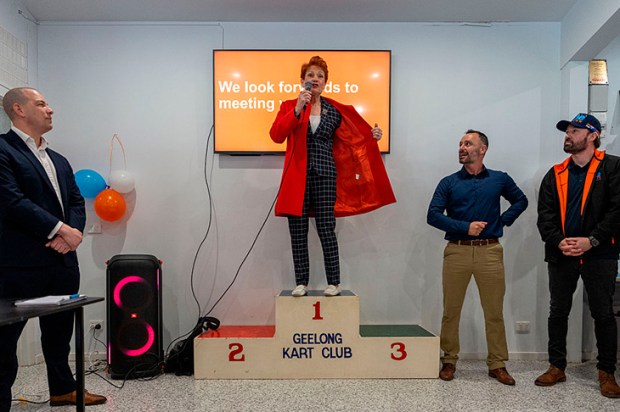
Had the referendum passed, a prime minister could, with impunity, rule without supply or clear government accounts and hide the cash at the Labor Council, as NSW Premier Jack Lang once did. Yet almost the entire political and media establishment supported what Australians for a Constitutional Monarchy identified as a ‘politicians’ republic’. In 1999, only a courageous minority of politicians stood against it, Senator Pauline Hanson prominent among them. Over the decades since, she has demonstrated common sense, courage and consistency.
During the campaign, ACM alone operated independently in every electorate. Designed by Army officer David Elliott, this allowed a tight military-style campaign under what Kerry Jones called a ‘high command’ convening daily, operating through state and territory commands. Mr Turnbull’s Australian Republican Movement, by contrast, relied on the Labor party network. Only two political parties dared to stand alongside ACM – the Nationals and One Nation.
After prevailing in the referendum – and also restoring the NSW governor to Government House – ACM remained ready for the promised ‘second bite at the cherry’. None materialised. If it is not dead and buried, ‘the’ republic is comatose, awaiting the day some politician desperately needs a distraction.
That part of ACM’s motto ‘to preserve, to protect, and to defend’ the Australian Constitution was the centrepiece of its recent National Conference, uniquely held every year since the referendum.
Introduced by Rowan Dean, I argued that defending the ‘original intention’ of the Constitution had become an urgent economic and social necessity, not an exercise in nostalgia. The clear danger is that Australia risks becoming the Argentina of the South Seas.
As detailed in Give Us Back Our Country (2014), modern economic research confirms that what makes a nation prosperous is neither geography, nor race, nor even vast reserves of fossil fuels and minerals. It is the inclusive quality of its institutions.
At Federation, Australians enjoyed probably the highest standard of living in the world, alongside world-leading public education and democratic franchises. That success was anchored by extraordinarily advanced constitutional and political institutions. These were safeguarded during the first two decades following Federation by the great founding justices of the High Court – Sir Samuel Griffith, Sir Edmund Barton, and Richard O’Connor – men who were so closely involved in the drafting of the Constitution that their understanding of its exact intent was unsurpassed.
Once those founders passed away, the Court fell under the influence of centralists who had failed to persuade the 1897-98 Convention to concentrate power in what would become Canberra. Determined to prevail anyway, in 1920 – through a judicial coup – the Court overturned the founders’ interpretation of our Constitution as a federal compact. Declaring in the Engineers case that the Constitution should be read not as a federal compact but as an ordinary Act of Parliament – a ‘Dog and Goat Act’ approach – the Court barred lawyers using the convention debates and began expanding Commonwealth power at the expense of the states and the people, corrupting the Constitution and defying the clear and original intention of the founders and the voters who approved it in ten referendums. To do so, they flouted the bedrock principle of popular sovereignty expressed in the Preamble and section 128, which dictates that the Constitution may be altered only with the voters’ explicit approval.
A century later, the consequences are plain. Exploited by a self-serving class of career politicians, many controlled by the Leninist ‘caucus rule’, Australia has been reduced to a fake federation. Canberra now collects an astonishing 80 per cent of all taxation revenue – compared with 30 per cent by the Swiss federal government – and doles a portion back to the states, often with strict instructions on how it must be spent.
Unlike Americans, Australians cannot vote with their feet by moving from high-tax, heavily regulated states to better-governed ones. Every part of this continent is now subject to Canberra’s disastrous overreach.
This institutional decay explains why Australia is falling behind. Landlocked Switzerland, lacking Australia’s mineral wealth, outstrips our annual national income per head by well over A$70,000 or about A$45,000 adjusted for living costs, Resource-poor Singapore leads by around A$50,000 or a massive A$150,000 similarly adjusted. When a resource-rich continent underperforms both a landlocked alpine nation or a once-impoverished island on that scale, the culprit is unmistakable: the long-term degradation of our governing institutions.
This explains why One Nation is increasingly seen as common-sense, providing a practical remedy to our institutional malaise. While not campaigning as constitutional originalists, Senator Hanson’s dialogue with me revealed that her party’s policies directly address our system’s twin failures.
First, One Nation proposes dismantling the sprawling waste generated by Canberra exercising powers it was never meant to hold. From abolishing the multi-billion-dollar climate bureaucracy and halting runaway projects like Snowy 2.0 – where the latest cost estimate, including transmission lines, is A$75 billion – to returning mining approvals to the states, curbing treaty overreach, and replacing divisive race-based spending with assistance based on individual need, One Nation’s agenda would directly roll back the centralist bloat.
Second, One Nation’s founding platform would restore the ultimate sovereignty of the Australian people through direct democracy. Just as Switzerland’s prosperity rests on a sophisticated system of citizen-initiated referendums (CIR) – far superior to California’s patchwork model – One Nation’s long-standing CIR policy would empower Australians to initiate legislative change or constitutional clarification, forcing career politicians and activist courts to answer directly to the electorate.
Combining fiscal common sense with popular sovereignty points back to the prosperous Commonwealth our founders designed – which research indicates would lift GDP by 8 per cent, or around A$240 billion annually.
Got something to add? Join the discussion and comment below.
The dialogue between David Flint and Pauline Hanson, introduced by Rowan Dean, can be seen on the YouTube Monarchy Australia channel (http://www.youtube.com/watch?v=8TboO3ZurN8).
You might disagree with half of it, but you’ll enjoy reading all of it. Try your first month for free, then just $2 a week for the remainder of your first year.