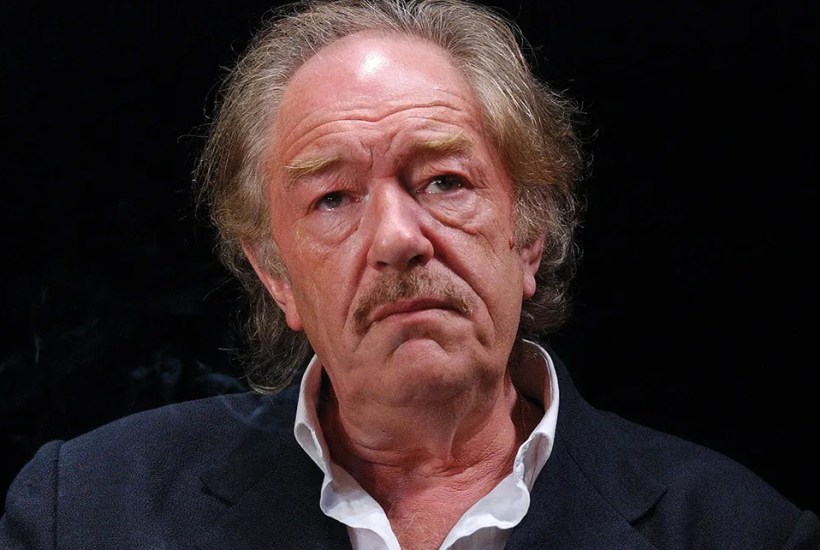
When Michael Gambon was made a CBE, Ian McKellen wrote generously on behalf of the acting profession: ‘We think you’re the best.’ Arthur Miller pronounced him greater than Laurence Olivier. From a spear-carrying start in the early days – indeed on the first day – of the National Theatre, Gambon rose steadily to stardom and eventually, via a series of movie flops, to the well-paid prison of the Harry Potter films. On stage, in Shakespeare, Beckett, Pinter and Ayckbourn, or on television in The Singing Detective and Longitude, there was a might and scale to his talent that few could match – a force that did not preclude delicacy and emotional truth, his physical bulk capable of both high comedy and balletic grace.
The essence of Gambon’s art was contradiction. He could be simultaneously dishevelled and elegant, grotesque and sensuous. His captivating face managed to be bony and spongy at once. He wasn’t camp, but he could do camp, perfecting a kind of blokey refinement. When he misfired, he was out of control, imprecise and erratic, most sadly of all as Falstaff. Anxiety and bad teeth made a disappointment of what had seemed perfect casting. But when he was good – as Brecht’s Galileo; in David Hare’s Skylight or Miller’s A View from the Bridge – he was matchless. He had technique to burn (except in mastering foreign accents) but was an instinctive performer, disdainful of research, acting from the guts.
He could be disdainful of the theatre too, famously describing it as shouting in the evenings for money. This attitude was cover, of course; he was far too serious about acting to take it seriously. Hence the stories. The stories! Mention Gambon to any actor who worked with him, and out pour the legendary pranks, off stage and on. The time Gambon told a journalist that he’d tried homosexuality but gave it up because it made his eyes water. Or when, as a keen amateur pilot, he took an aerophobic friend up in a plane and promptly staged a heart attack. Or when he reversed the names of the main characters in Romeo and Juliet: ‘For never was a story of more woe, than this of Romeo and… her Julieto.’ Few actors who worked with him escaped a dousing from a water pistol. Some were damp already, having wet themselves in an attempt not to laugh as he wrote obscenities on his eyelids, muttered filth under his breath or, for Penelope Keith’s delectation, carved the word ‘fart’ in the butter. Nobody knew which of his stories was authentic. Even Gambon lost track, falling for his own lies in order to tell the truth, as any good actor must.
Jasper Rees’s tremendous book cleverly avoids the looping of most theatrical biographies (rehearsals, first nights, reviews, repeat) by alternating the life story, in which his subject is always ‘Michael’, with virtuosic interludes about ‘Gambon’: his love of cars and antique pistols, his hands (big), feet (bigger) and voice (biggest). Rees goes to town on the anecdotes, often having to play the regretful spoilsport (‘the pay-off, sadly, is a fiction’ or ‘this can’t have happened, alas’). But he adroitly navigates the tightrope between dutiful correction and an understanding that the fantasy is what matters.
His is an ‘authorised’ life, written with the support of Gambon’s wife and eldest son, who have offered access to illuminating material from private archives. Gambon had an unauthorised life, too. One extra-marital relationship led to his becoming, in his late sixties and already fragile, a father to two more boys. Rees deals elegantly with what I assume to have been a condition of his authorised status, namely to omit all but passing reference to Gambon’s private lives or late fatherhood. (His younger sons contributed a touching afterword to Milly Ellis’s The Great Gambon, published last year, a charming complementary pendant to Rees’s larger-scale study.)
The revelation of the book is instead the extent of what Rees calls ‘Gambonery’, an on-stage tomfoolery that could descend into hair-raising chaos. In Pinter’s The Caretaker Gambon lurched into cod-Swahili. Once, he resorted to letting off the sprinklers in the theatre foyer. A lot of things got kicked to pieces: mirrors, microphones, relationships. Many a director was maddened. Nicholas Hytner snapped a pencil in half. No practical joker of Gambon’s invention can quite escape the charge of cruelty. But his almost feral lawlessness emerges as the result of some inner demon that led him gleefully to sabotage not only others but himself. Greta Scacchi, who suffered most from his ribaldries, thought he had ‘demons in his head’. When Gambon arrived at a great performance, he began systematically to destroy it.
The demons resulted from the usual things: class, looks, parents. His was not the life expected of him. The child of a seamstress and an engineer, born in Ireland but raised in Camden, he was an apprentice toolmaker when he began auditioning on the sly. His father saw him perform only once, and found nothing to say. The burden of Gambon’s childhood, his sense of unbelonging, of being unattractive and uneducated, never left him. He thought himself thick, either as pigshit or as two short planks. Minding his unconventional looks, apparently oblivious to his sexual magnetism, he was tormented by critics’ teasing when he was cast as a romantic lead. But the greatest burden of all was his own astonishing gift. As Hytner puts it: ‘He always needed an escape valve from the sheer magnitude of his own talent.’ Eventually the disruption came from an awareness of encroaching dementia, which descended earlier than anyone ever liked to admit, robbing him of his ability to learn lines.
Gambon was the last British actor to play Othello in blackface, which he did twice, the second time, against his better judgment, in 1990. He was initially disturbed by his eldest son’s homosexuality, as he was by homosexuality in general, although his affectionately filthy send-up of gay men, whom he played often and convincingly, could be evidence of curiosity. His behaviour and bawdiness would have no place in the modern rehearsal room, which may be the modern rehearsal room’s loss.
But Rees does not waste time excoriating his subject for daring to hold the attitudes of his class and generation and instead writes about Gambon almost as a geographical phenomenon, a microclimate in the postwar actorly world. Having conducted dozens of new interviews, and trawled everything from stage reports to Gambon’s annotated scripts, he lands with precision on his subject’s unique brand of coarse sensitivity, his outrageous and wayward brilliance. The reader will discover that Gambon had a mole in front of his left ear; from which bit-part actor he once bought a Jaguar; and that his first advert voiceover was for Danish bacon but that, paid in rashers, Gambon had no freezer in which to store his porky windfall. (Talk about bringing home the bacon.) This makes for an overstuffed book, perhaps, but it is about an overstuffed life, a personality that split its own seams.
It is a testament to Rees’s skill that the abiding atmosphere of this sometimes painful biography is of laughter, and of Gambon’s being mostly the object of unwavering admiration and love. If he remains forever elusive, that is not his biographer’s fault. Gambon himself did not know who he was, and, offstage, seemed barely to exist. Alan Bennett, with whom he once shared a dressing room, noted there was ‘no evidence of his occupancy at all’. His digs showed no sign of his having lived there beyond a teabag in a bin. Any good book about a great actor will really be about theatre’s evanescence, the transience of performance, the burden of talent and the fear of its diminution. Even Gambon’s was dissolved, the pageant faded, leaving just a teabag behind.
Got something to add? Join the discussion and comment below.
You might disagree with half of it, but you’ll enjoy reading all of it. Try your first month for free, then just $2 a week for the remainder of your first year.