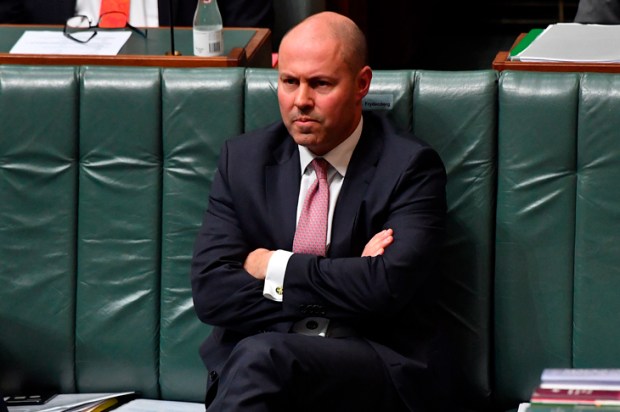
‘I’ve been here a week, and I can’t figure it out,’ says Dr Jared Cooney Horvath, neuroscientist, teacher and now the figurehead in the fight to get screens out of classrooms. ‘Every other country is pulling the trigger on rolling EdTech back. But here, you’re spending £900 million a year on it, more than any other country – and no one gives a shit!’
He apologises for being sweary – but he’s passionate about this stuff and: ‘Hey, I’m an American!’ I wave it away: plenty of parents who control screen time at home – but feel undermined by online homework and school-issued iPads – are finding similar words creeping into their vocabulary, I say.
Horvath is in London for the publication of his book, The Digital Delusion, which sets out in stark terms how classroom tech is damaging children’s learning. He self-published the book last December after learning how long it would take via the traditional route. After testifying in front of a US Senate committee in January on screen time in schools, the book shifted thousands of copies, before being picked up by Penguin.
‘I saw all these countries banning smartphones. The next fruit on that tree is EdTech’
‘Thank God I ran as fast as I could,’ he says. ‘I saw all these countries banning smartphones and starting to move on social media, and the next fruit on that tree is EdTech. I think a lot of parents are like, “Yeah, ban smartphones, but because that screen is slightly larger and has my school’s name stamped on it, it must be good.” And I just wanted to get the data and arguments out before the EdTech people had the chance to swoop in.’
In The Digital Delusion, Horvath demonstrates conclusively that children are less cognitively capable than their parents were at the same age because of ‘the rise of educational technology’. The surge in digital learning is driven by ‘a wave of invasive tools designed by for-profit tech companies’, he argues, that are ‘deliberately engineered for addiction’. He’s crunched the numbers to prove the ‘screen inferiority complex’ – that people ‘learn better and retain more when reading from paper rather than from screens.’
For a sobering picture of what Horvath’s findings mean in terms of children’s outcomes, he points to NAEP (National Assessment of Educational Progress) – an American biennial test for fourth graders (ages nine to ten) in maths and reading. ‘I took each state and looked at when that state went tech-heavy,’ he says, showing me a graph. ‘Here’s what we see – and I’ve taken out all the Covid data, so look, screw you if you think it’s Covid. That dark box is when everything goes tech.’
I follow Horvath’s finger as he traces a steady upwards incline. At the point where that state went digital, the incline falls away – like a black run plunging downhill. ‘It’s all happened wickedly fast,’ he says.
So why, to use his own phrase, is nobody ‘giving a shit’ in the UK? ‘It is happening in the UK,’ he stresses, ‘but if you look at the UK data writ large, it looks like y’all fine.’
This false sense of security is due to our Pisa results. Pisa (Programme for International Student Assessment) is a worldwide study run every three years by the OECD, that measures 15-year-olds’ ability to apply their reading, maths and science skills to real-life problems. Pisa last ran in 2025 ‘and everyone flipped ’cos it got worse than Covid [the 2022 results]. But in the UK, the 2025 result was the same as 2022. So why worry?’
But Horvath has cracked the reason why we appear fine in Britain – and his findings will appal fee-paying parents. ‘If you split the data, after adjusting for socioeconomic status, your state schools – which use smaller amounts of tech – have been increasing 18 absolute points per decade. It’s the independent schools that are using all the tech and they’ve been decreasing 21 points per decade. Their reading scores especially are dropping like rocks.’
The issue of EdTech, though, is clearly affecting schools in both the state and independent sector, as Lara Brown outlines on p10. So what would he like to see? ‘No more student-facing free-for-all tech, that’s the stupidest. No more homework online. That’s nonsense.’ All children need, he insists, is a pen, paper and books.
Compare this ideal with some of our most prestigious – and expensive – fee-paying schools. When I asked around, I was inundated with egregious examples of EdTech. At Downe House, I’m told that devices are used ‘most of the time in nearly all academic subjects’. One pupil says she sees girls ‘playing games or watching YouTube shorts all the time during lessons and prep’.
A Farleigh parent found that her son had become addicted to the school-issued iPad to the ‘point of obsession’, while a contact at Walhampton told me how Year 8 boys frequently play Minecraft on school laptops at the back of the classroom. They find they can easily bypass the firewall.
Winchester has been praised for its back to pen and paper approach – yet laptops are still used in the classroom. Eton, controversially, continues to issue all boys with an iPad. I asked the school if pupils could opt out and received a nebulous answer about the device as one of ‘many teaching tools’.
Why do these schools still think that inserting a sea of Apple logos between teacher and pupils is a good idea – when there’s overwhelming evidence that it’s a terrible way to learn? Is it tweedy old governors dazzled by technology? The feeling that top schools must be in the vanguard of the shiny and new? Or parental demand?
‘The argument you’ll always get,’ says Horvath, ‘is “The future is digital”, “How will my kids get a job without it?”’ But Gen Alpha is ‘less digitally literate than Gen X. Who the hell taught Gen X tech? Nobody. Why are we better at it? Because we were taught how to think and how to learn.’
As with the anti-smartphone movement, Horvath says the pushback needs to come from parents – ‘Because teachers’ jobs are at risk.’ He cites Sydney, where ‘the four most sought-after schools are now analogue’, as an example of how the tide can turn.
With this government committed to providing AI tutors for the poorest children, the fight against EdTech can’t come soon enough. This revolution will not be televised but fought with pens, paper and joined-up handwriting.
Got something to add? Join the discussion and comment below.
You might disagree with half of it, but you’ll enjoy reading all of it. Try your first month for free, then just $2 a week for the remainder of your first year.