Elon Musk enjoys winding up chess players. In 2022, he posted on X that chess is ‘too simple to be useful in real life’, noting ‘a mere 8 by 8 grid, no fog of war, no technology tree, no random map or spawn position, only 2 players, both sides exact same pieces, etc. Polytopia addresses these limitations.’ Facetious, of course, but still some took umbrage at a perceived slur on the game.
Could chess ever be solved? Last week, Musk weighed in on X to a viral post about the game’s complexity, countering that the number of non-stupid moves is ‘tiny’ and that the game would one day be ‘fully solved’. Chess.com’s account shot back with two words: ‘skill issue’ – internet shorthand for ‘You’re just not good enough.’ A palpable hit for the plucky David, but what got lost in the cheering is that Goliath had a point.
Musk barrelled on: chess, he said, is ‘hard for humans, but not for computers’ and people enjoy it anyway. Chess.com responded with facts and snark combined: ‘There are more possible chess games, by about 40 orders of magnitude, than atoms in the observable universe… Good luck’ – implicitly invoking the mathematician Claude Shannon’s estimate of 10120 (1 with 120 zeros) possible games, against roughly 1080 atoms in the cosmos.
That’s relevant, but misleading, and Musk’s comeback was valid: legal chess positions, he said, number ‘~40 oom [orders of magnitude] less’ than the atom count – something closer to 1040. It’s a decent ballpark estimate, and for ‘solving’ the game, positions matter far more than games. It’s rather like the distinction between counting words and sentences.
The notion that chess might one day be fully solved still seems bonkers, but perhaps – who knows? – not quite beyond the laws of physics. Moreover, Musk claimed that ‘ASI [Artificial Superintelligence] will figure out ways to solve and compress that are far beyond what we could possibly comprehend.’ Pie in the sky? Very likely. Disprovable? Not by me.
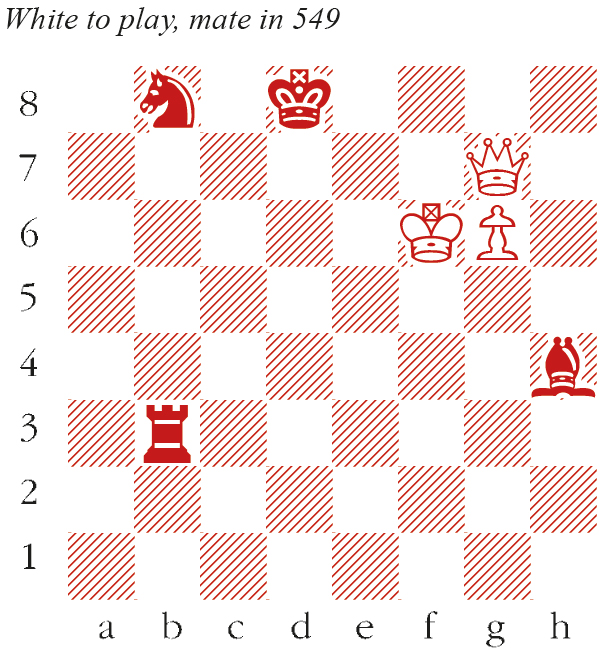
The strictest sense of ‘solving’ chess has been tackled by computer chess experts for decades. They have built databases (so-called ‘tablebases’) which show, for every possible position, whether it’s won, lost or drawn, given perfect play. These are useful tools, but as of 2026 complete tablebases only cover scenarios with up to seven pieces remaining (kings included). Progressing from six to seven pieces took seven years, while the eighth is exponentially harder: 14 years on, only fragments exist. The holy grail – 32-piece tablebases – remains unfathomably distant.
The diagram above shows a gem from the tablebase: with perfect play, White can force mate in 549 moves – and not a move sooner! The sequence, I assure you, defies human understanding.
Yet nobody seriously doubts the answer: with best play, chess is a draw. The Danish grandmaster Peter Heine Nielsen put it neatly on X. ‘Theoretically Musk is wrong, practically he is right.’ He went on: ‘Todays engines has [sic] from a practical point of view solved chess. My prediction is that Stockfish 19 [the pre-eminent chess engine] at a reasonable depth, will never lose a game of chess. “Better” engines will of course be created, but not strong enough to beat the current ones.’
My hunch is that claim is too bold, but I can’t deny Nielsen’s authority; as Magnus Carlsen’s long-time coach, few people have spent more time searching for ‘truth’ with a chess engine. Stockfish 19 is like a batsman who can never be bowled out, even if the run rate isn’t quite as high as it might be.
Got something to add? Join the discussion and comment below.
You might disagree with half of it, but you’ll enjoy reading all of it. Try your first month for free, then just $2 a week for the remainder of your first year.