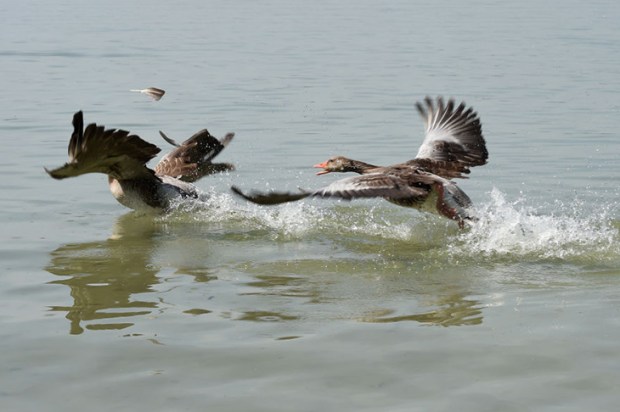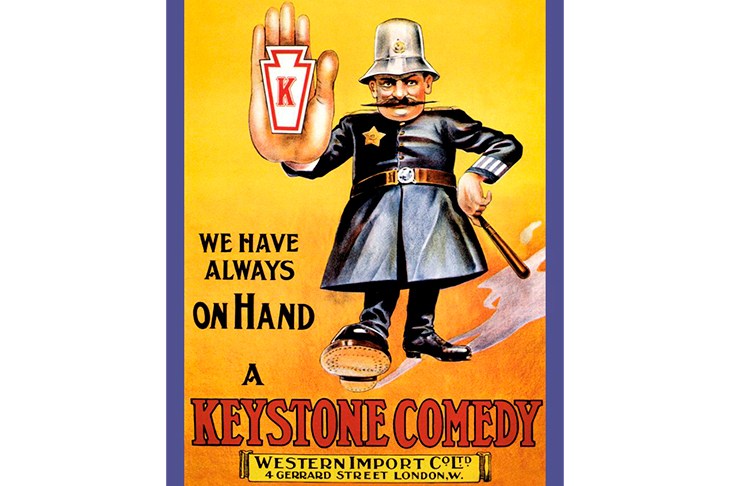
They keep inventing them, don’t they? New expressions we didn’t have before, and I’m not entirely persuaded we need now! ‘Keystone species’ appears to have been coined in 1969 in the ecology community and first appeared in a journal called American Naturalist. It means ‘a species exerting a major influence on an ecosystem, especially one on whose activities the survival of other species depends’ (Oxford). Of course, various species have been going extinct since the dawn of time. That’s why you won’t bump into a stray dinosaur in your supermarket parking lot. This just seems to be part of the pattern of life on earth. But according to at least some ecologists – this should stop! And stop now! No more species going extinct! Well, good luck with that, since the pattern seems to be rather deeply embedded in the nature of this planet. And as part of their ‘non-extinction’ program they identify these ‘keystone species’ which are important because other species depend on them. Hence, if a ‘keystone species’ happens to go extinct, so will all the others that depend on them. I suspect that a lot of ‘keystone species’ are prey that get caught and eaten by bigger, nastier creatures, and if the prey die out then the bigger, nastier creatures will also die out. At a guess (and this comes from a non-ecologist) I suspect that ‘plankton’ might be a ‘keystone species’ – since these very small, floating organisms get eaten by everything bigger than they are (and that’s almost everything, up to and including whales). The qualifying word ‘keystone’ has been borrowed from stone masons who use this word for the central stone at the summit of an arch or vault which locks the whole structure together – hence, the ‘key’ stone.
‘The best thing since sliced bread’ is an American phrase, coined in the 1920s. The world’s first sliced bread was sold by the Chillicothe Baking Company in Missouri on 7 July, 1922 – made possible by the invention of a new bread slicing machine. By 1933, 80 per cent of the bread sold in America was sliced. This was such a useful, labour-saving invention, it came to be regarded as a great breakthrough for ordinary households. By the 1930s this phrase was firmly embedded in American English as the way to label any new invention, product or idea. (The great unanswered question is: what was the best thing before sliced bread?)
Speccie reader David asks me why we call petrol pumps ‘bowsers’. It’s a good question, because our name for pumps is used nowhere else in world. It turns out that this odd name comes from an American man who invented a very early type of petrol pump. He was Sylvanus Bowser of Fort Wayne, Indiana. His pump was launched onto the market in 1905. And the very earliest petrol pumps installed in Australia were his, and prominently displayed his name – ’S. F. Bowser and Company’. I suspect that Mr Bowser sold more pumps here than he did in the US, because we alone adopted his name to christen the pumps. Yes, David, it is an odd name for a pump – and now you know why.
There was Anthony Albanese on his feet in question time sprouting claptrap once again. He has his own range of claptrap that goes from denial to obfuscation, to pure fiction, to changing the topic entirely and just ignoring the question. But where does this word ‘claptrap’ come from? It goes back to the 1730s and began life in the theatres of London. Originally a ‘claptrap’ was a piece of amusing or dramatic ‘business’ (as actors call it) – a trick or device to catch applause; perhaps a facial expression or an ad-libbed remark, designed to elicit thunderous clapping from the front stalls. It was something done on stage to (literally) ‘trap the claps’.Such stunts were usually nonsense, so by the early-1800s ‘claptrap’ was being used to mean ‘nonsense, rubbish’. And since it is clear that Albo can’t cope with any criticism and requires constant approval, it is clear that his ‘claptrap’ is similarly a desperate attempt to trap a few claps.
Got something to add? Join the discussion and comment below.
Contact Kel at ozwords.com.au
You might disagree with half of it, but you’ll enjoy reading all of it. Try your first month for free, then just $2 a week for the remainder of your first year.