It’s now 24 years since I started writing about the urgent need to reform or quit the asylum provisions of conventions to which Britain is party. My Times column in June 2002 was headlined ‘This foolish Convention on refugees should be scrapped’. My argument was simple. The 1951 Geneva Convention Relating to the Status of Refugees (the lodestone of the application of the European Convention on Human Rights to the problem) was designed for a very different era. The second world war had redrawn our continental map and a principled framework was needed to rescue beached groups at risk.
The key section of that Geneva Convention defines a refugee as someone who ‘has a well-founded fear of persecution because of their race, religion, nationality, membership of a particular social group, or political opinion; is outside their country of nationality; and is unable or unwilling, because of that fear, to seek that country’s protection’. The challenges in giving effect to this protection were considerable, but finite. Pace the Ukrainian conflict, Europeans have over the last half-century more or less settled down within agreed borders.
We centrists must wake up to currents that run deeper than we can explain: if we do not, they will carry us away
What the Geneva Convention did not provide for – and nor does the ECHR – was a world in which a potentially almost limitless number of people from many poor and chaotic countries worldwide, often with cultural values starkly different from our own continent’s, and often near-destitute, see Europe both as a place of escape from grim circumstances, and a place of hope for a new life where they may prosper. As is often the case, these would-be migrations are spearheaded by young men; but families follow.
My point was this: mercy (and the Convention is founded on mercy) is possible, even desirable, when numbers are limited. But if they rise from hundreds of thousands to potentially hundreds of millions and, as word of mouth spreads, each successful asylum application generates many more, the point is reached when a continent like ours must finally cry Stop. We have reached that point.
Preferably the Geneva and the European Human Rights conventions could be amended to proscribe the practice of simply touching the soil of the desired host country in order to gain a right to apply; but if inter-national or European consensus for such restrictions cannot be found, each host country will have to revise its options. Ours, I suggest, must include the threat, at least, of withdrawal from both conventions. Note that the United States has long declined to be party to the Geneva Convention.
Seven times since then, in both the Times and The Spectator, I have revisited these arguments. I freely admit I’ve been repeating myself. When I started making this case, the arrival of boatloads of cross-Channel asylum seekers wasn’t as hot an issue in our politics as it has now become. They smuggled themselves on to lorries instead. Now it is red-hot, both here and in (for instance) Spain, Greece, Italy and France. The recent success of the AfD in the Saxony-Anhalt elections in Germany carries a warning for us in the UK.
I believe it no exaggeration to say that when it comes to immigration, mainstream centre-right and centre-left parties across the continent are facing the biggest threat they’ve seen in decades. If they are not careful, they may soon be fighting for their lives. In Britain these parties are Labour, the Conservatives and the Liberal Democrats. For all three, the threat comes from the Reform party and Rupert Lowe’s Restore. ‘The boats’ are the eye-catching manifestation of Farage’s case.
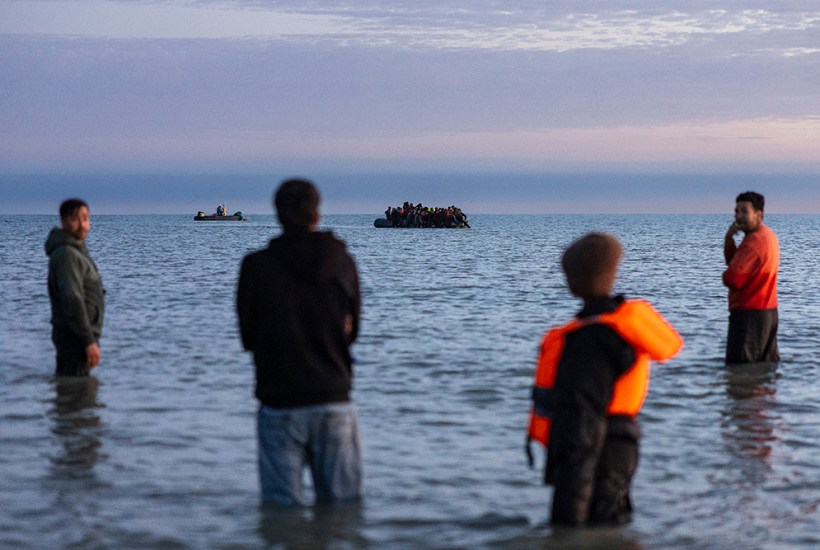
It is no good rolling our eyes, as my type of centrist tends to do. It is no good rehearsing the actual figures and pointing out that landings by rubber dinghy are tiny in number when compared with the immigration overall that began with the Boris wave. It is no good asking our fellow citizens to think of the individual arrivals as desperate (and brave) people rather than part of a faceless horde; no good pointing out that immigrants tend to be young and able-bodied, and in time will help bear the burden of an ageing population; no good reminding ourselves that many of them will accept menial jobs that native Britons appear unwilling to do. As I’ve learned on the doorstep from decades of party-political canvassing, if voters nod their recognition of the strength of your counter-argument but then revert to their original position, you are wasting your breath: something buried within them renders them deaf to your logic. We centrists must wake up to currents that run deeper than perhaps we can explain. If we do not face them, they will carry us away.
The leaderships of the Labour and Liberal Democrat parties are incapable of facing it: their members will not let them. But Kemi Badenoch is under no such constraints, and she has not held back. On paper her party’s stated position is strong: leaving the ECHR, repealing our Human Rights Act, removing unlawful arrivals within a week (whither is a little unclear); and denying to unlawful arrivals any right to claim asylum. These ideas would answer the widespread popular desire to put a stop to the Channel crossings. But do the voters know about them?
Everybody knows where Farage’s party stands. Immigration is probably the only area of Reform policy that most voters could name. Indeed, subtract ‘stopping the boats’ from Reform’s putative manifesto and the party loses much of its raison d’être. I doubt Reform would last long if voters knew that Conservative plans are clear, well-developed and tough-minded. Rishi Sunak, a much milder leader than Badenoch, did of course have the advantage of office in stating his proposals to stop the boats; but Badenoch could build on that. How about reviving the Rwanda plan? Or the Falklands? St Helena? Name a destination. A hell of a row will follow. Good. Bring it on. The Tory position will lodge itself in voters’ minds.
Illegal immigration is Farage’s fox. Shoot it. It’s as simple as that.
Got something to add? Join the discussion and comment below.
You might disagree with half of it, but you’ll enjoy reading all of it. Try your first month for free, then just $2 a week for the remainder of your first year.