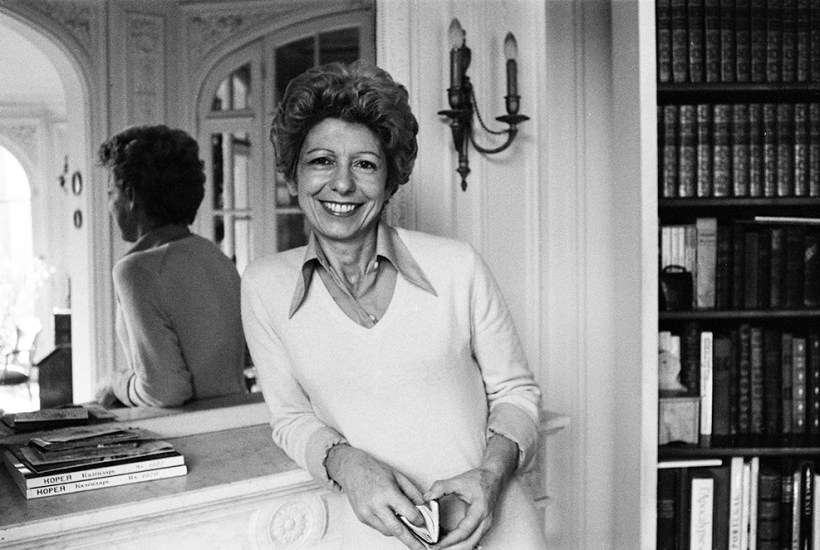
In our family histories we all have ghosts, but few of us go in search of them and even fewer of us write about them. The French author Emmanuel Carrère discovered how devastating that search can be with his book My Life as a Russian Novel (2007). For two years he and his mother, Hélène Carrère d’Encausse, an eminent historian of Russia and the steely secretary of the Académie Française, didn’t speak. Hélène’s aggrieved response to the publication of her son’s inquiry into the suspected status of her father, Georges Zurabishvili, as a collaborator of the Nazis during the second world war, shouldn’t have come as a surprise. Carrère understood perfectly well that he was betraying his mother’s trust and admitted as much in one of the book’s closing chapters: ‘My mother has forbidden me to write about my grandfather.’
Emmanuel Carrère’s obsession with the truth borders on a form of fanaticism
In the end, France’s high-profile mother-son duo smoothed things over. But we were left wanting. Carrère’s justification for the decision to publicly expose the family secret was scattered like crumbs, insubstantial and fleeting, throughout My Life. The cosmic force that appeared to make the writing of that book inevitable – ‘sooner or later, one way or another, I will have to defy her to do what I must do’ – felt somewhat contrived, even melodramatic. Kolkhoz, Carrère’s latest book, alleviates those suspicions. Set in the aftermath of his mother’s death, it is ostensibly a family history that spans four generations. But, at its core, it is the biography of a formidable woman, written by her grieving son.
Published in the original French last year and now translated by John Lambert, Kolkhoz opens with the state funeral of Hélène and closes, in its nonlinear chronology, with the moment of her death. In between, there are the stories of her Georgian and Russian ancestors; their emigration to France after the Russian Revolution; the disappearance of Hélène’s father, Georges, or more accurately his abduction; and the trauma, especially for Hélène’s brother, Nicholas.
Then there are the digressive odes to Nabokov, Tolstoy and Dostoevsky; more reflections on family life; Hélène’s marriage to Carrère’s father, Louis; and the infidelities and eventual love loss. If the first part of the book strains under the sheer weight of information (a vulnerability Carrère himself anticipates when he stops to assure us that soon ‘the field narrows, the faces become clearer’), the remainder, true to the author’s word, picks up a leaner narrative arc in the lives of his newly married parents.
What distinguishes this family chronicle from other forms of historical writing is Carrère’s ability to inhabit the inner worlds of the people he writes about, almost as if they were fictional characters of his own creation. This is partly due to the highly intimate nature of his source material. Carrère has worked from ‘five copious folders’ of research compiled by his father, three years of correspondence between Hélène and her mother-in-law, and a 500-page memoir written by his uncle Nicholas. But it is also due to the gift of a writer who approaches the world in a determinedly observant and attentive fashion. That determination – or what Carrère calls his ‘obsession with the truth’ – borders on a form of fanaticism which, we learn, is the same force which drove him to forge ahead with the controversial publication of My Life.
This tendency of Carrère’s, as we discover in Kolkhoz, is a response to the disturbing pattern of denial which characterised the relationship between his mother and her brother. After their father was abducted, whisked away forever as political reprisal for his Nazi collaboration, Hélène, who had assumed the role of family head in the wake of her mother’s breakdown, assured her adolescent brother that their ‘father had gone on a trip, that he’d be back soon and that everything would be fine’. It wasn’t until Nicholas discovered a document in his mother’s handbag declaring her husband to be dead that he truly understood what had happened. Worse still, a few years later, when their mother lay dying, Hélène once again withheld the truth. She continued to reassure Nicholas that all was well right up until the moment he returned home from scout camp to find his mother’s cold body before him.
As a child, Carrère loved his mother as he has ‘never loved and will never love anyone else’, whereas in adolescence it was Nicholas whose presence loomed largest. He became for Carrère more than an uncle – a ‘role model’, a ‘big brother’ and eventually his ‘closest friend’ – and in response to the shroud of lies in which he was raised, he passed on to Carrère a near biological obsession with the truth. In the decades since, this obsession has been the animating force behind Carrère’s creative non-fiction. But in Kolkhoz it is simply the means of accessing what Carrère himself acknowledges to be the primary source of the book: the ‘boundless love’ that once united mother and son.
Got something to add? Join the discussion and comment below.
You might disagree with half of it, but you’ll enjoy reading all of it. Try your first month for free, then just $2 a week for the remainder of your first year.