If Andy Burnham wants a reminder of the case for artificial intelligence (AI), he need only walk down the streets of his Makerfield constituency. Drives are dominated by Ford Transits and VW Transporters, the favoured vans of the self-employed. Blue-collar, hard-working, manual labourers: these will be the people most secure in the coming jobs revolution. Their accounting is made easier via new online systems; their public services smoothed by better programmes. Wigan council is using AI to cut costs in the care system; the nearby Heinz factory deploys it in its production line.
Burnham wants a ‘Makerfield test’ for all aspects of policy. Yet what does that really mean when AI is so fast-changing?
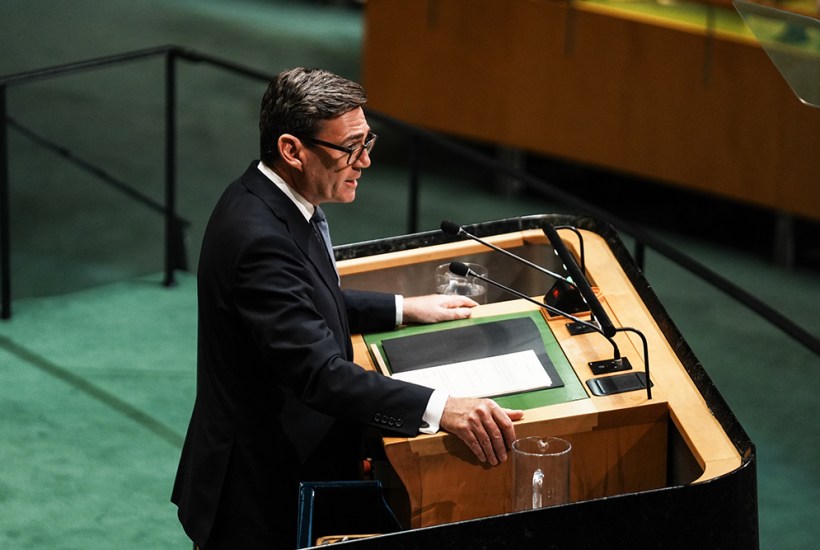
Such hedging was on display when Burnham made his trip to New York this week. AI might be the big new challenge, but the Prime Minister stuck to a familiar line: champion British interests while not irritating the Americans. From the UN pulpit, he urged the world to adopt a set of global principles, just as he snubbed a Finnish proposal for compulsory testing of cutting-edge models before release.
The UK, he insisted, has ‘a unique position as an honest broker’: well placed to mediate between America and China and make AI the centrepiece of the G20 presidency next year. It was Burnham’s bid to pose as the Greeks to America’s Romans – even if there is little sign this White House wants to subscribe to our (supposedly) Athenian imperial virtues.
For all the wide-eyed claims of California’s tech bros, Burnham’s current stance on AI fits the broader trend of his postwar predecessors. To avoid the fate of Blue Streak, Hawker Siddeley and Ferranti, Britain must box clever, aware that it cannot compete with the clout and resources of East and West.
The UK AI scene is arguably the third best in the world: the Knowledge Quarter in King’s Cross hosts DeepMind, Meta and Microsoft, with AI office space in the capital increasing tenfold in a year. The likes of James Wise, the head of the Sovereign AI Unit, are helping scale up capabilities. But with technological leadership perhaps out of reach, some, including the Tony Blair Institute, believe we are best placed to now focus on diffusion rather than innovation.
The Prime Minister has the chance to reassure his party that the tech won’t spell the end of the world
Burnham’s record on AI is mixed. One Labour figure suggests that as mayor of Greater Manchester, Burnham was a more hesitant figure in this space than Richard Parker in the West Midlands, preferring to talk of buses and homelessness to AI skills bootcamps. ‘It doesn’t fit neatly into his political economy of people and place,’ says one MP. One of his first acts as Prime Minister was to abolish the Department for Science and Technology, with its distinctively innovative culture, where 70 per cent of staff were under 40. His cabinet has swapped AI evangelists Darren Jones, Liz Kendall and Peter Kyle for sceptics like Lisa Nandy and Chris Bryant.
But there are positive signs: the promotion of Kanishka Narayan, Labour’s AI minister and sole Old Etonian, to senior status has been hailed by Sunak-era Tories. Some of the work done by Morgan McSweeney, Keir Starmer’s chief of staff, is being built on, with more junior ministers now boasting ‘digital’ as part of their brief, including Jake Richards (Justice) and Lillian Greenwood (Welfare). Yet the mood in parts of the parliamentary party is shifting, with Anneliese Dodds leading the charge against it. Feelings are not helped by a deluge of AI-fuelled casework swamping MPs’ inboxes. ‘Everyone now has a first-class lawyer available to them,’ remarks one.
For now, Britain can at least boast that there is more elite cross-party support behind AI than in America. Much of the team advising Burnham, including Henry de Zoete and Jade Leung at the AI Security Institute, served under his predecessors, offering a degree of continuity. The Tories give a hesitant thumbs-up to parts of the Burnham agenda – yet ask why China and Iran would comply with international agreements. Reform, with its streak of Anglo-Futurist thinking, welcomes the opportunity for AI to slash benefits and transform Whitehall. ‘We can sack 500,000 civil servants and get Palantir to run it,’ boasts one.
Burnham is a sensitive figure, mindful of, and receptive towards, shifts in public thinking. The ‘techlash’ could well be a defining trend in the markedly more polarised climate of the forthcoming US midterms. But already, there are signs of a similar trend happening here, with protests in recent weeks in Edinburgh, Devon, London, Leeds and Larbert over planned data centres. The Greens, a historically degrowth party, are determined to take advantage, with Zack Polanski demanding Labour ‘slam the brakes’ on development. Given Britain’s famously nimby-ish approach to building, it will take courage not to buckle.
Jobs are the other great fear in the Labour party, with experts divided about whether white-collar employment will take a mass hit. Optimists recall the predictions of Geoffrey Hinton, the godfather of AI, who once argued it would make radiologists obsolete; numbers are now at a record high. Estimates by the Economist suggest AI has actually added one million new jobs in America.
A potential ‘Blue Labour’ opening is available to Burnham if he wishes to seize it. The AI hardware plan, announced in Starmer’s dying days, is handing out hundreds of millions to ‘buy British’ and build up our chips capacity. To embrace this effectively, he may have to address industrial energy costs, the real drag on greater capacity.
Labour has ducked this challenge since coming to power in 2024 – yet all signs point to AI being more of a feature in future policymaking. In July, the UK’s Security Institute warned recent open-weight models now lag frontier closed models’ cyber capabilities by just four to seven months – a narrower gap than the six to ten months measured internally through most of 2025. Given exponential growth, this will only speed up.
Amid all the talk of an ‘AI-pocalypse’, Burnham could take a leaf out of the book of the other ex-mayor to become PM. ‘There are no disasters, only opportunities,’ proclaimed Boris Johnson. Burnham, another gifted communicator, has the chance to give a lead on this in the week ahead, and reassure the Labour movement that AI really will not be the end of the world.
Got something to add? Join the discussion and comment below.
You might disagree with half of it, but you’ll enjoy reading all of it. Try your first month for free, then just $2 a week for the remainder of your first year.