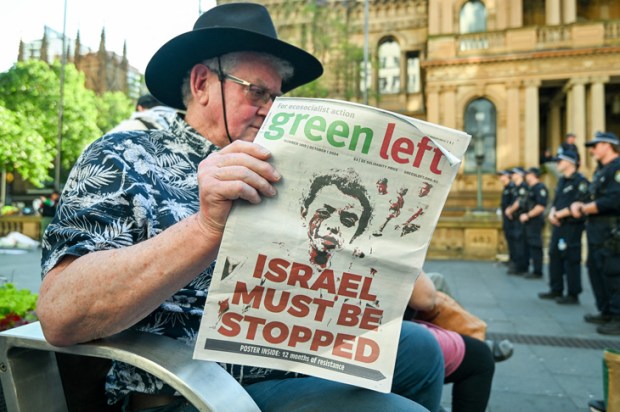
One of the unforeseen consequences of the war in Gaza has been a significant erosion of freedom of speech in Australia. This is reflected in a wave of legislation at the federal and state levels that creates criminal offences for what are essentially expressions of political opinion.
This is quite different from making incitements to violence against individuals or groups in the community a criminal offence. As it happens, such incitements do not need to be made unlawful by legislation as they have been an offence for centuries under the common law.
As an example of the new laws enacted as a result of the conflict in Gaza, take the treatment of the slogan ‘From the river to the sea’ whose use has been made criminal conduct this year in Queensland in circumstances where it might reasonably be expected to cause a member of the public to feel menaced, harassed or offended. As a long-time supporter of the state of Israel, I have no illusions as to what this catchcry implies. It calls for the elimination of Israel as a state and the substitution of a Palestinian entity in the same area of land. It rather disingenuously passes over what is to happen to Israel’s existing population. Is it seriously suggested that they would be resettled in some other parts of the world or are they to be simply exterminated as part of the new order?
But, despite their unstated implication, these words are an expression of political opinion. It is, of course, an extreme opinion in that it calls for the abolition of an existing nation but it is still a comment on the politics of the Middle East and how the disputes in that region should be resolved. The legislation has been challenged in the courts on the basis that it contravenes the implied freedom of political communication under the Constitution but that challenge has not yet been determined. It should not, however, be left to the courts to consider questions of freedom of speech. These are matters for elected members of parliament and they should be conscious of the importance of protecting the expression of political opinions, however unattractive they may be to some or all members of the community. In this case those members of the Queensland parliament who voted for this measure have failed to understand that importance.
The problem for freedom of speech is that once legislation moves beyond incitements to violence it inevitably begins to restrict the expression of political opinions. The real test for freedom of speech only starts with statements that most, perhaps almost all, members of the community find seriously offensive. No one wants to ban publications with which they agree but it is much more difficult to support the right to express views that most people find offensive or even completely abhorrent. The real test for those who profess to believe in freedom of speech only comes when they are confronted by an opinion that they find disgusting and would hope never to have heard.
This was the point being made by the American jurist, Oliver Wendell Holmes, when he said in one of his judgments for the US Supreme Court in 1919: ‘I think that we should be eternally vigilant against attempts to check the expression of opinions that we loathe and believe to be fraught with death.’ There is a recognition in Holmes’ warning that, once some political opinions are singled out for prohibition, the same fate can easily befall other unpopular views at some time in the future.
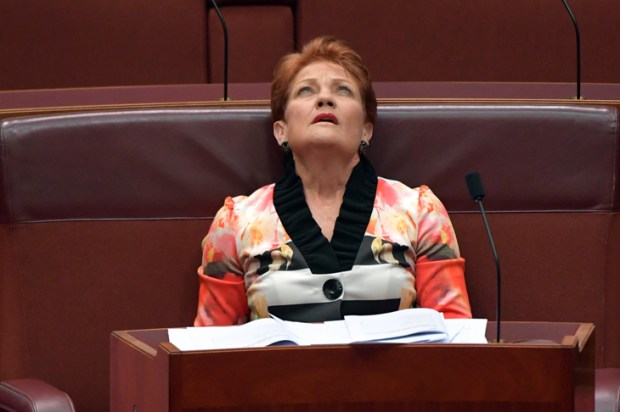
It is true that, even before the conflict in Gaza, there was a handful of federal and state laws that restricted expressions of political opinion but they were relatively few and far between. The most prominent was section 18C of the federal Racial Discrimination Act which makes unlawful various publications, including statements that offend or insult individuals or groups in the community where the statements are made because of the race, colour or national or ethnic origin of the individual or group. It was this provision that One Nation Senator Pauline Hanson was found to have contravened by the Federal Court in an exchange with a Greens Senator in 2024. It might be thought that statements that are offensive or insulting are too low a threshold to have legislation making them unlawful. There is also a crucial difference between this kind of legislation and the law of defamation where it is a complete defence to prove the truth of the statements that have been made. But section 18C is not concerned with truth or falsity. If a statement is offensive or insulting, it does not matter whether it is true or not.
In 2017 the Turnbull government tried to amend section 18C to deal with some of these problems but the proposed changes were rejected by the Senate, where the government did not have the numbers. What is interesting is that not a word in support of the amendment attempt was heard from bodies such as universities and civil liberties organisations, which might be thought to place some value on freedom of speech.
Freedom of speech was in many ways a product of the Enlightenment and is arguably the most important value in Western civilisation because it is the value at the heart of all other freedoms. As another American jurist, Benjamin Cardozo said in the 1930s: ‘Freedom of expression is the matrix, the indispensable condition of nearly every other form of freedom.’ Whether its diminishment as a result of the conflict in Gaza can ever be reversed is a question that hopefully will become a subject of public debate in coming years. At present this foreign war has left an unfortunate legislative legacy in this country that has the potential to limit the open discussion of political issues long after the war itself has finished.
Got something to add? Join the discussion and comment below.
You might disagree with half of it, but you’ll enjoy reading all of it. Try your first month for free, then just $2 a week for the remainder of your first year.