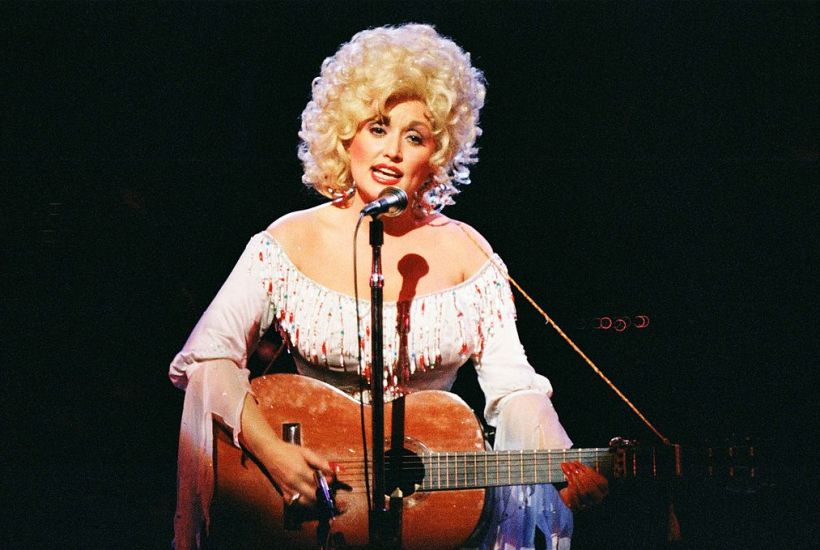
Dolly Parton was all-American. Born into the dirt-poor Tennessee hills of the Great Smokey Mountains, her upbringing reflected the indigent nature of country life in the South, even as the urban and suburban United States reaped the rewards of peacetime. Her father was, among other things, a tobacco farmer but struggled to support his wife and 12 children, all but one of whom survived infancy. It was a childhood steeped in hard work, mountain wisdom, and most important of all, the Bible.
Dolly Parton’s fame and fortune were built on talent, toil, personality and moral character
But unlike some country singers, Parton did not wallow in her hardscrabble childhood. In fact, she considered herself to have been rich in love, if lacking in money, a theme she sketched out in her 1971 song “Coat of Many Colors.” Drawing on a true story from her girlhood, Parton recounted how her mother turned a box of multicolored fabric scraps into a winter coat for her daughter. “Momma sewed the rags together/Sewin’ every piece with love/She made my coat of many colors/That I was so proud of.” This leads the young Dolly to conclude that “one is only poor/Only if they choose to be.”
Parton did become financially wealthy, and in the remarkable career she built for herself often collided with the sexist attitudes that prevailed in the country and western scene in the 1960s and 70s. She was able to overcome these obstacles with force of personality and sheer talent – not to mention the backing of country legend Porter Wagoner, who showcased her on his TV series and recorded with her.
Stardom in her own right came with a series of hits beginning with 1970’s “Joshua”, another number retelling her origins among hill people. “Joshua” was a country chart number one, as was “Jolene”, perhaps her most celebrated record, three years later. It’s a song that rises above its mundane subject matter – fending off a rival temptress to hold onto a man – and has become a heartbreak standard for the depths of love and desperation it conveys.
Thereafter the hits came thick and fast, from “I Will Always Love You” and “Love is Like a Butterfly” in the mid-Seventies, to “Heartbreaker” towards the end of the decade, and spilling over into the Eighties with “Old Flames Can’t Hold a Candle to You” and “But You Know I Love You”, culminating in one of her biggest triumphs at home and abroad, 1983’s “Islands in the Stream”, one of a handful of duets with Kenny Rogers.
Around this time, Parton turned her hand to acting, making her feature film debut in 9 to 5, a 1980 comedy where she played alongside Jane Fonda and Lily Tomlin as a trio of secretaries who snap under years of sexism and harassment and take revenge on their chauvinist boss. Parton also recorded the title track of the same name, giving her a massive hit outside the country charts. Roles followed in The Best Little Whorehouse in Texas, for which she was nominated for the best supporting actress Oscar, and the Sylvester Stallone film, Rhinestone, a disaster she quickly put behind her to return in bittersweet comedy Steel Magnolias, another hit.
One of the charms that endeared Parton to her legion fans was her down-home nature and her unwillingness to forget her Tennessee roots. She was always a Southern girl and proud of it. She was also a prodigious philanthropist, plowing her millions into hospitals, HIV/Aids research, and underwriting the distribution of more than 100 million free books to children. Although not one of those celebrities eager to share her political prescriptions with the world, she made an exception for gay and later trans rights. For much of her career, she was known as a gay icon and attracted great devotion from gay men across the world.
Her death aged 80, one year after the passing of her husband of almost 60 years, Carl Dean, brings to an end one of those remarkable journeys of rags to riches – that really aren’t all that remarkable in American life. Dolly Parton’s fame and fortune were built on talent, toil, personality and moral character. In an age of performative cruelty and callous indifference, her attitude to life was as irresistible as her musical gifts. She was in the business of living and loving: big boobs, big heart, and big checks.
Dolly Parton became a star but never forgot the girl she was or the people and places that shaped her. High up in the icy mists, in the hills overlooking Locust Ridge, amid the calls of chuck-will’s-widows and whip-poor-wills, a familiar voice returns to its Tennessee mountain home.