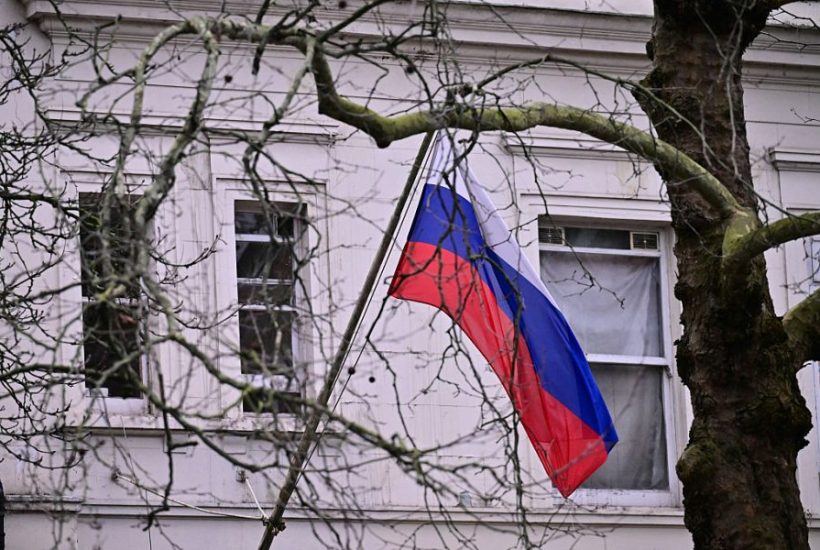
So farewell Andrei Kelin, for seven no doubt increasingly uncomfortable years Moscow’s man in London. With not a bang but a whisper: it transpires that he left the embassy last month, and so far there is still no suggestion of who (if anyone) will replace him.
As a result, there is talk that the Russians are thinking of scaling back their diplomatic representation to the Court of St James, leaving matters in the hands of the chargé d’affairs, Vasily Tsyganov. This has been kind of denied by the embassy, which stated simply that it has said nothing to imply ‘that the Russian side intends to downgrade the level of diplomatic relations between our two countries’. At the same time, the statement noted that ‘as for the state of Russia-UK relations across all areas, they have deteriorated to an unprecedentedly low level entirely on London’s initiative’.
The fact that no replacement for Kelin has yet been mooted is noteworthy but hardly unique. Indeed, there was a gap of a couple of months between Kelin assuming his position and the departure of his predecessor, Alexander Yakovenko, in 2019.
The real questions, then, are why the delay and who succeeds Kelin?
Having served in post for almost seven years, this is not a case of an ambassador being ‘withdrawn’. That would imply either a diplomatic rebuke for the host nation – in which case, why not make it public, given that Kelin informed his own people back in June? – or else a demotion for the diplomat in question.
Kelin arrived in London in 2019, when relations were already distinctly rocky in the aftermath of the Skripal affair, and they were only going to get worse following the 2022 invasion of Ukraine. He had to earn that Order of Alexander Nevsky he received in 2023.
Nonetheless, the job of an ambassador is ultimately often not to charm and persuade but to lie, bluff, dissemble and bully for their country. This Kelin did, often advancing the most outrageous and offensive positions. Nonetheless, given his difficult brief and unreceptive hosts, Kelin seems to have been highly rated in Moscow, as he maintained what could be described as a manner of abrasive avuncularity, largely without descending to the peevishness of some of his counterparts in other Russian embassies.
China has its so-called ‘wolf warrior’ diplomats who seem to go out of their way to pick public fights with their host countries in the name of asserting Beijing’s new international status. Kelin was one of what we could call Russia’s ‘bears’, who tried to project a certain cosy charm but find themselves often having to bear their teeth in the new, confrontational era. At that, he was considered effective – back in 2021, a desk officer at the Ministry of Foreign Affairs (MID) described him to me as a ‘legend’.
Kelin turns 70 next May, so his departure could be part of a retirement process. Then again, as Putin’s government becomes a gerontocracy, there might yet be a last hurrah: there’s talk of a seat in the Senate. After all, Foreign Minister Sergei Lavrov is 76. Kelin’s deputy at the embassy, the 49-year-old Tsyganov, is a high flier from a diplomatic family but probably not seasoned enough for the London job. He had previously been deputy director of MID’s Department of Pan-European Cooperation, a position Kelin himself had held earlier in his career – later heading it, before taking up his position in London.
The real questions, then, are why the delay and who succeeds Kelin? It is tempting to blame the former on ‘cucumber season’, the summer slowdown in Moscow, as anyone who can disappears, whether for Dubai or the dacha. More likely, it reflects the difficulty in finding a candidate who is both capable and willing.
However much the Russians love publicly to dismiss Britain as a has-been nation, a toothless lion dreaming of glory days of yore, the paradox is that they also portray it as a sinister and devious enemy, behind every Russian mishap, from giving Zelensky his orders to coordinating Ukrainian assassinations. This is still a job for a heavyweight.
It’s also an increasingly difficult and unpleasant one. You are the target for every MP or commentator who wants to make a Churchillian soundbite, spending your days defending the indefensible, while presiding over a embassy hollowed out by tit-for-tat expulsions. In 2021, there were 58 accredited Russian diplomats there – now it is 35. And I imagine they get invited to far fewer parties. It does seem that those who could do the job don’t necessarily want to.
In due course, though, there will be a new ambassador. On one level, quite who he or she is may seem to make no difference. Yet while it is always the national governments that call the shots, ambassadors play a crucial role not only in informing the policymakers at home, but in modulating and articulating the message abroad. Whether London eventually gets a wolf, a bear, a nobody, or a potential bridge-builder may say something about Moscow’s vision of its future relationship with the UK.