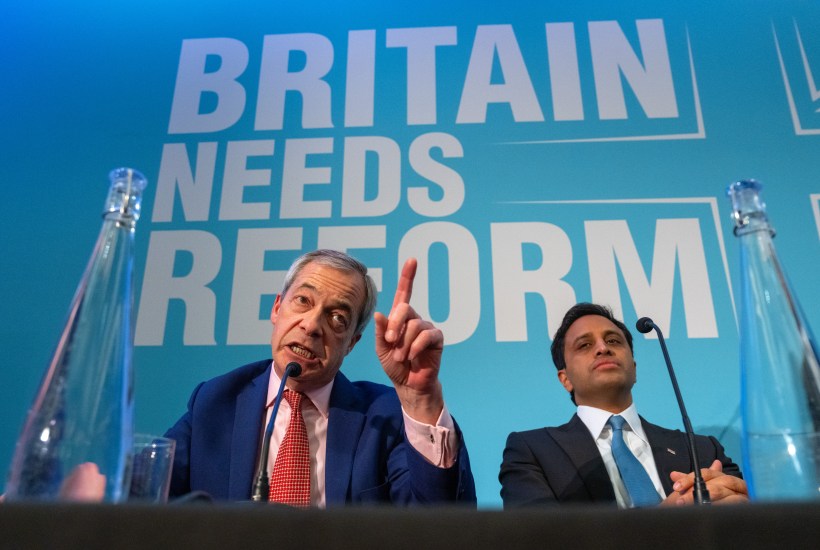
There is something sulphurous about Zia Yusuf. The deep-set, unblinking eyes; the ardent belief in his own mission; the position as a Rasputin at the court of Tsar Nigel Farage; a fervid, prophetic interloper. When not prowling the streets of Dover, hunting for an aquatic Afghan to harangue, Yusuf seems to spend his time falling out with his Reform colleagues, having rings run around him by the former editor of this magazine on panels, and speaking about new arrivals with an acidity that only a second-generation immigrant can command. Reader, he terrifies me.
I’m no great fan of Ben Wallace; the Afghan resettlement cover-up was a national disgrace. But as Stephen Pollard has written, Yusuf’s branding of him as a ‘traitor’ was a step too far: nasty for the sake of being nasty. It was little surprise when the papers reported that Farage has given him a ‘ticking off’. In his Coffee House Shots showing yesterday, Tim Montgomerie made clear that Yusuf has been acting like a petulant child, ignoring those who dare to take a different view, lashing out at those colleagues who disagreed, more interested in promoting himself within Reform than working towards government.
I remain to be convinced that Nigel Farage actually wants to be prime minister
But clearly all this does something for Reform supporters. As Ed Shackle has highlighted, ask the party’s voters who they would want to lead if Farage was knocked down by a bus tomorrow and ‘don’t know’ is way out in front at 37 per cent. Yusuf is in second on 14 per cent. A low base. But since ‘don’t know’ wouldn’t be expected to run in any future leadership contest, it’s a helpful starting position. Playing to the base, spinning down the purity spiral, worked for Liz Truss and Jeremy Corbyn. But how many elections did those two win?
Then again, Reform without Farage would be a pointless exercise – Hamlet without the prince, the feast without the wine, a body without a soul. The party’s rapid rise was driven by several factors: the long tail of Brexit, successive incompetence of the Tories and Labour, long-standing problems over the NHS, living standards and, most obviously, immigration. But it all hinged upon Nigel: a politician with unique name recognition and credibility who has been wanging on about immigration for years and years. With Farage gone, Reform wouldn’t disappear. But many Reform-curious voters would see Yusuf’s dark mutterings and run a mile.
This is why Montgomerie being kicked out from Reform is so significant. Reform’s online outriders – comforted by the illusion that it was only Montgomerie who was speaking to the papers – see him as a Tory plant, a hostile force, a worrying growth who has now been excised from the Reform body. But a party which cannot take the gentle criticisms of a long-standing hack – who once performed a similar job for his former party to great success – is not a healthy one. The more I see, the more I think Reform are heading for a spectacular smash-up.
Seeing Farage recently – especially after he rage-quit as an MP to squabble with that Taff bin – he does not seem happy. He seems worn out. I remain to be convinced that he actually wants to be prime minister. He likes kicking the Tories. He likes campaigning before adoring crowds. But he never expected to be on course to Downing Street. He hates the scrutiny. He hates the compromises, the people management, the unsexy work of writing Stepping Stones 2.0. I think Dominic Cummings is right: that Farage may flounce out before the election.
The mention of Cummings is pertinent. I think his prediction earlier this year – that the establishment will do everything it can to stop Reform – is certainly true. But in his zeal and his unwillingness to butter up the SW1 old guard, he also reminds me of Yusuf. Yet there is a depth to Cummings (as impenetrable as his Substacks can sometimes be) and a record of achievement. Can the same be said of Yusuf? He was a successful businessman. Reformers often praise his work internally. But if he doesn’t believe that tactical voting is a problem – and even if he really is so focused on his own position – then he is delusional and a barrier to Reform’s success. I can see him going (again!) before too long.
Despite rumours to the contrary, I’m not a Reform member. Every time I thought about making the leap, something put me off: the latest farcical policy, internal spat or media cock-up. I’ve remained a Tory, even if I’m far from a paid-up member of the Kemi cult. It has taken her a year and a half to get to where Robert Jenrick aimed to be on day one, largely through dumping her old chums, and replacing them with the movement’s long marchers. Her inactivity left a void into which Reform swiftly stepped. Even with the boost in her personal ratings, she is still the woman who took the Tories from first to third.
But Reform failed to kill them off; the Right remains split. If Reform remains a viable force against Labour in the North, Midlands and coastal areas, and the Tories can win back the wealthy South from the Lib Dems, the best outcome for the Right looks like that to which we pointed to in January: a coalition. For all the defections and squabbles, we still end up with Kemi Badenoch, Robert Jenrick and Neil O’Brien around the same cabinet table, with Tim Montgomerie commentating on it and Zia Yusuf denouncing it on Twitter.
Perhaps I’m wrong about Reform. There’s certainly a lot of talent within it – far bigger brains and more experienced players than myself. Perhaps I’ve put too much stock in a fellow ConservativeHome veteran and in my own oft-fallible instincts. Perhaps I don’t know the situation within Millbank Tower half as well as I think I do, and Reform will come roaring back as soon as Andy Burnham proves to be a palpable dud. Or perhaps I’m right. In which case, does Farage have that iron in him? Or is he reaching the end of his pier show?