As the author of this engaging book makes plain, it is with good reason that owls are such cherished birds. They possess the most acute sense of hearing not just of any avian group but possibly of any creature. In experimental conditions of total darkness, barn owls were able to catch mice merely by hearing their rustling as they moved. The owls’ own flight is soundless because of special comb-like structures on the leading edges of their wings. Almost all owl species are adapted to see acutely at night and the largest are able to catch deer or pluck young eagles from the nest.
But it is not merely these definable physical attributes that set owls apart. They also have a psychological aura. Their forward-facing eyes in a rather flat-faced configuration mimic our own arrangement. There are myths and legends worldwide of humans and gods taking owl form; and so much of their lives is conducted behind a screen of darkness, giving them an indefinable allure, that almost every encounter with an owl feels like a revelation.
Chris Sperring is thus not unusual in his fixation. What is exceptional is the time he has spent devoted to their well-being. His career with the Hawk and Owl Trust is also noteworthy for other reasons. As a child, he was so wildlife obsessed that he flunked his exams and left school without a single qualification. His first job was in a factory, laminating book covers, until the chemicals started to damage his lungs. In a sense, Ghosts of the Night is as much an example of what we can achieve when driven by passion as it is a memoir about birds.
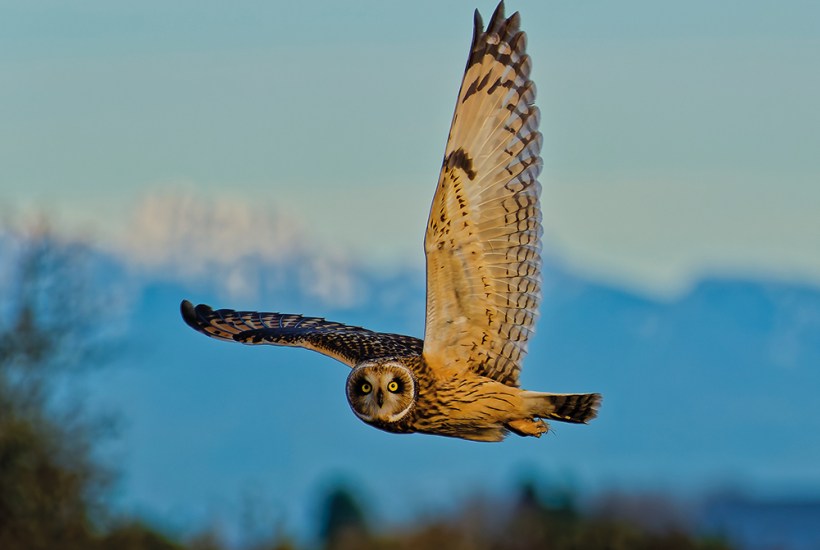
Sperring’s primary subject is how owls have fared in the modern British landscape. The short answer is not particularly well. There are only five species in the UK (four native and one introduced) compared with Germany’s nine and Sweden’s ten. All our five – barn, tawny, little, long-eared and short-eared – have either already declined or are starting to do so. The short-eared, an inhabitant of northern upland moors and my favourite, is down to just 620 breeding pairs. Even the tawny, whose haunting song can still be heard in most British towns, has declined by 40 per cent since 1967.
Happily, Sperring is a mix of grounded realist and unconventional maverick. When ‘experts’ told him that his proposal to bring barn owls to an industrialised landscape west of Bristol were unrealistic, he rejected the idea that ‘unless it’s perfect you shouldn’t do it’. Part of the problem was that as owls moved north from breeding areas in Somerset, they were often being killed in collisions with vehicles. A study at a comparable Shropshire site showed that almost two-thirds of all the barn owls that were ringed were recovered as road casualties.
Sperring took the evidence on board but pointed out that risks are there to be taken and not simply assessed. In these matters, their champion is only following where his beloved birds lead: ‘Owls are nothing if not pragmatic.’ He was able to convince the developers at Bristol docks to back his work and devote half their site – an area he calls ‘Vole City’ – to his plans. It allowed barn owls to return to the county of Avon for the first time in decades, and the area now supports all five owl species.
In his opening pages, Sperring writes: ‘I have spent countless hours studying the habits of short-tailed voles.’ This is because barn owls are in effect made of voles, just as voles are made from unmown, untrammelled vegetation. The author’s whole approach is founded on this kind of bottom-up understanding of nature, which is in turn rooted in a lifetime of direct observation. The value of both is writ large in Ghosts of the Night.
Got something to add? Join the discussion and comment below.
You might disagree with half of it, but you’ll enjoy reading all of it. Try your first month for free, then just $2 a week for the remainder of your first year.