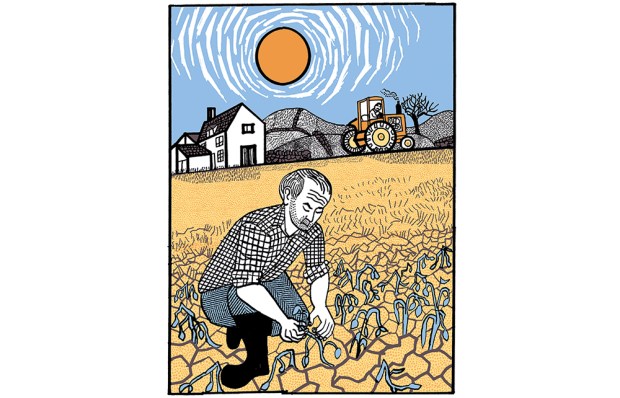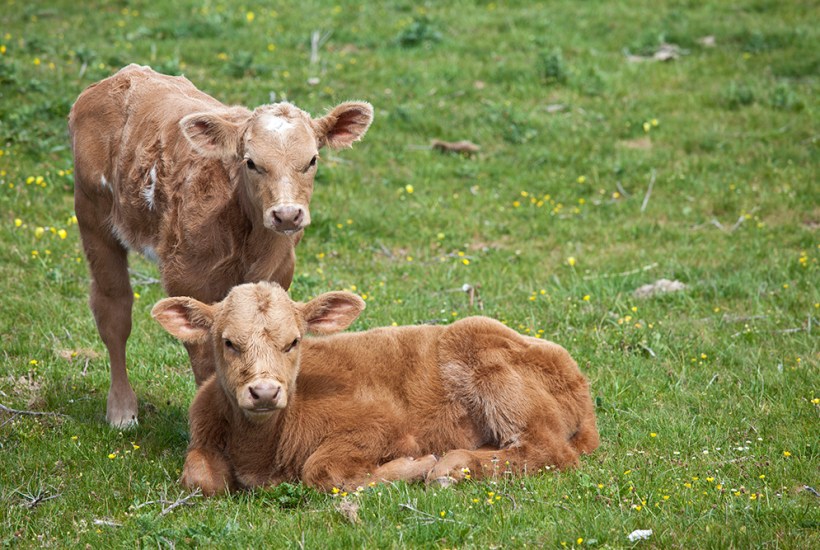
It has been calving time in Devon and I arrive from London ready to work hard. The day starts at 6.30 a.m., when we check the field to see if any cows have calved. We check the ‘springer’ herd every two hours until 10 p.m. and intervene if a cow is in difficulty. Newborn calves are fed colostrum and taken down to the shed with their mothers. The farm I am working on keeps its cows outside all year round – not for this herd that little patch of blue some call the sky. But what the cattle gain in freedom, the farm labourers lose in comfort. The last time I was here for calving, in the spring of 2018, the weather was biblical: it was still snowing in April.
Thankfully, the weather has held, but I’m not sure the same can be said of my body. I’ve walked up the hill to the calving field at least eight times each day, often having to go back down to fetch something I’ve forgotten before trudging up again. I’ve tipped up hay bales for the main herd, carried batteries and rolled-up reels of electric wire, hammered wooden fence posts into the ground and picked up newborn Jersey heifers and heavy Hereford calves so we can drive them down to the shed. In short, and in the words of Mike Tyson, I think that ‘my back is broken’. Like Thackeray’s Redmond Barry, I have been ‘so sated with the luxuries and pleasures of life’ in London that I worry I will fall to pieces.
I do at least have the relief of being driven each day from one farm to another. The farm where we do the calving is in Mid Devon, but the main farm – with the milking parlour and most of the grazing land – is in North Devon. This means we must drive the newly calved cows from one to the other, gradually adding them to the milking herd. Each safely calved cow will produce the milk upon which the farm will rely for another year, having produced the calf on which its future depends.
What could be a tiresome round journey is enlivened by the country through which we travel. As we drive from Rackleigh to Hayne, the lanes run tightly through closely packed fields and hedgerows. We move briefly from Devon into Somerset and back again, passing the aptly named Counties meet Farm, before the valley suddenly opens and you can see all the way to Exmoor. It’s a sight that makes you want to sing ‘Jerusalem’, bang Drake’s Drum and shout: ‘Cry God for Devon, England and St George!’
Not every moment is so uplifting, and no farm labourer’s notebook would be complete without a complaint about the weather. But before that, I shall give you my three rules of dairy farm labouring. Rule one: to stop a cow from kicking, hold its tail firmly upwards. Rule two: when a cow lifts its tail, it is about to use you for target practice. Withdraw immediately. Unfortunately, applying rule one makes knowledge of rule two irrelevant. So rule three is essential: always keep your tobacco in a waterproof container.
Now imagine that you have forgotten rule three and instead, before the morning milking, rolled a cigarette of the Golden Virginia variety, tucked it behind your ear and milked 240 cows, then walked the herd almost a mile to their new field, before being caught in a hailstorm on the way back. Could you then smoke said cigarette? You could, but it wouldn’t taste much like tobacco. To top it all, imagine you step in a pool of slurry and realise that there is a hole in your boot. Could you keep your sense of humour? I doubt it.
Jeffrey Bernard, the late Low Life columnist, said there is no romance in manual labour, but I’m not sure that is true. One morning, as I go to herd the cows for milking, the ‘naked earth is warm with spring,/ And with green grass and bursting trees/ Leans to the sun’s gaze glorying,/ And quivers in the sunny breeze;/ And life is Colour and Warmth and Light’. After evening milking, I shut the cows in their field, walk back to the farmhouse and watch the sun set over distant Dartmoor. My calluses feel hard-earned and slightly poetic.
Calving is almost over for another year and it’s bluebell time in Devon. The cows are in their field, the milk is in its tank and there’s cider in the fridge. I’m reminded of the brothers in On the Black Hill, who ‘knew their lives had not been wasted and that time, in its healing circle, has wiped away the pain and the anger, the shame and the sterility, and had broken into the future with the promise of new things’. What else could they have been but farmers?
Got something to add? Join the discussion and comment below.
You might disagree with half of it, but you’ll enjoy reading all of it. Try your first month for free, then just $2 a week for the remainder of your first year.