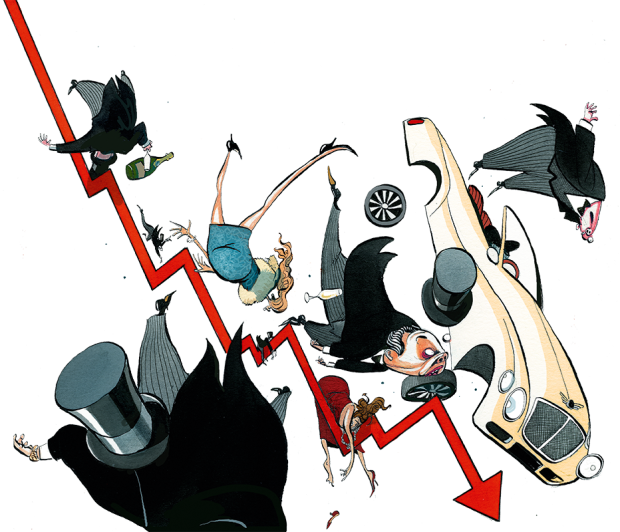

Is the flotation of Elon Musk’s SpaceX venture on the US Nasdaq exchange a beacon for the future of earthly capital markets and interplanetary relations, or just bonkers? The answer is it’s both, as well as being a stratospheric ego trip for Musk himself, who according to the prospectus will not only retain 85 per cent of the company’s voting rights but will also be awarded an extra billion shares if it succeeds in establishing ‘a permanent human colony on Mars’. In every sense, like Star Trek’s USS Enterprise, this spaceship is heading where no man has gone before.
On the positive side, SpaceX’s Starlink satellite internet constellation, with ten million subscribers, is already profitable. And its satellite launch service has pioneered reusable rockets, dramatically reducing the cost of sending anything into orbit and making Musk’s ambition to put low-cost AI-data centres in space a serious possibility. On the scarier side, the indicated $1.7 trillion valuation represents a multiple of 80 to 90 times current revenues, beyond even dotcom-boom levels; the prospectus admits SpaceX’s mix of tested science and science fiction ‘may not achieve or, if achieved, sustain profitability in the future’; and there’s the uncountable risk factor of what one analyst calls ‘Musk-amplified volatility’.
So why on earth (or Mars) would you take a bet on SpaceX? As always in stock markets, but to an even greater extent here, there’s far more herd instinct and hope in play than analysis of future value. The $75 billion of new shares on offer will be absorbed chiefly by institutions that need them because SpaceX will be big enough to be an essential component of every large and passive portfolio. Retail punters who chased shares in Musk’s Tesla car company to its late-2025 peak and still think he’s cool will pile into the secondary market if SpaceX’s post-float price dips and probably even if it doesn’t.
And the bankers and brokers promoting the issue – led by mighty Goldman Sachs, with Morgan Stanley close behind – will make out, as ever, like bandits.
Truman Show suburb
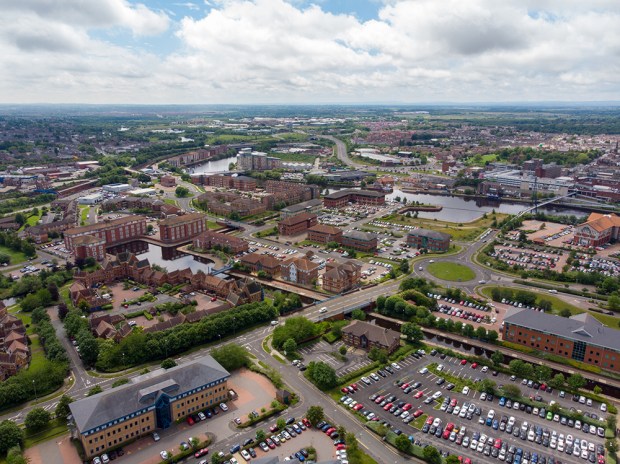
To Nine Elms, for a reception at the American embassy with its spectacular penthouse view of the Thames. For a first-time visitor, the apartment blocks clustered around the moated diplomatic fortress (which replaced the old Grosvenor Square embassy in 2017) form a strangely un-British urbscape, notable for its ‘sky pool’ see-through bridge 115 feet overhead between towers. But together with the nearby Battersea power station development, the Nine Elms scheme has turned a semi-industrial wasteland bounded by railway tracks into a Truman Show suburb of some 10,000 new homes so far, served by a Northern Line spur and within jogging distance of Westminster.
The large number of flats listed for sale on Rightmove for more than two years suggests a stagnant local market, but that’s true almost everywhere these days. More significant is the fact that – because of post-Grenfell safety regulations, construction-cost inflation and depressed selling prices – nothing else like this is currently being built to relieve London’s housing shortage, or likely to be in the next decade.
Compare Old Oak Common in west London: 655 brownfield hectares identified as long ago as 2004 as ‘an area of opportunity’ and presented by Boris Johnson as mayor in 2015 as a masterplan-cum-pipe-dream of 25,000 lower-cost homes for the capital’s workforce around a transport hub connecting HS2, the Elizabeth Line and national rail services, ten minutes from Heathrow and the West End. Up to now, fewer than 4,000 homes have been completed, while the Elizabeth Line station won’t open until at least 2029 and the start-date for HS2 services to Birmingham is ‘2036 to 2039’ or never.
The local MP Rupa Huq has spoken of residents ‘living on a building site for the past ten years… enjoying none of the benefits they were promised’. But perhaps someone in Downing Street will declare: ‘Let’s rationalise the planning, incentivise the developers, knock heads together and finish what’s been started. In fact, let’s do it like Manchester.’ Or is that just another pipe dream?
Brussels sting
Sir Keir Starmer says a new Brexit debate ‘might happen years down the line’. Wes Streeting calls the UK’s departure from the EU ‘a catastrophic mistake’, while Andy Burnham hopes to see it reversed ‘in my lifetime’. None of which will amount to a hill of beans if revived voter suspicion of Brussels reinforces Nigel Farage’s hand for the next general election. Meanwhile, let’s hope whoever is responsible for the vaunted trade ‘reset’ after the current leadership chaos will wade in to oppose another penalty that’s about to fall on small UK exporters.
From 1 July, all items worth less than €150 imported into the EU will be subject to a temporary flat customs fee of €3. From November, there will also be a €2 ‘handling fee’. The duty will be assessed per ‘unique tariff code’, rather than per parcel, so that three items in one parcel could be assessed at €9 plus €2. These measures (applicable until 2028, when a new EU-wide customs regime is expected) are aimed at curbing huge volumes of imports of cheap clothes and other goods by Chinese e-commerce giants such as Shein and Temu, taking advantage of previous ‘de minimis’ exemptions.
But the Federation of Small Businesses says three in ten small and medium UK enterprises expect to reduce EU trade, or give up on it altogether, if red tape and costs don’t change for the better. And the worst news of all is that – unintentionally, we must assume – magazines are caught in the crosshairs. Weekly copies of The Spectator sent from the UK to an EU address could attract more than €250 a year of duty and handling fees.
We certainly don’t want our many Eurocrat readers in Brussels, for whom we’re a secret lifeline of wisdom, to start cancelling their subscriptions. Labour ministers: stop squabbling over an imaginary future and sort this problem pronto.
Got something to add? Join the discussion and comment below.
You might disagree with half of it, but you’ll enjoy reading all of it. Try your first month for free, then just $2 a week for the remainder of your first year.