‘Sometimes, in the search for originality, the most obvious dishes are forgotten,’ says Elizabeth David, the doyenne of cookery, in her book French Provincial Cooking. I often think of this phrase when I’m writing about vintage cookery. So much of food (and food writing, and writing, and media, and life) is trend-driven. It’s all about novelty. I look at the handwritten list of my planned vintage recipes – ‘chocolate mousse, custard slice, beef olives???’ – and have to acknowledge that my particular wheelhouse is anything but original. I try, though, to hold David’s words close: those ‘obvious’ dishes are known for a reason. And their familiarity is part of their appeal.
David was writing, specifically, about oeuf mayonnaise. She was, in fact, apologising for including a recipe for something ‘so basic’, fearing her reader may find such instructions ‘superfluous’.
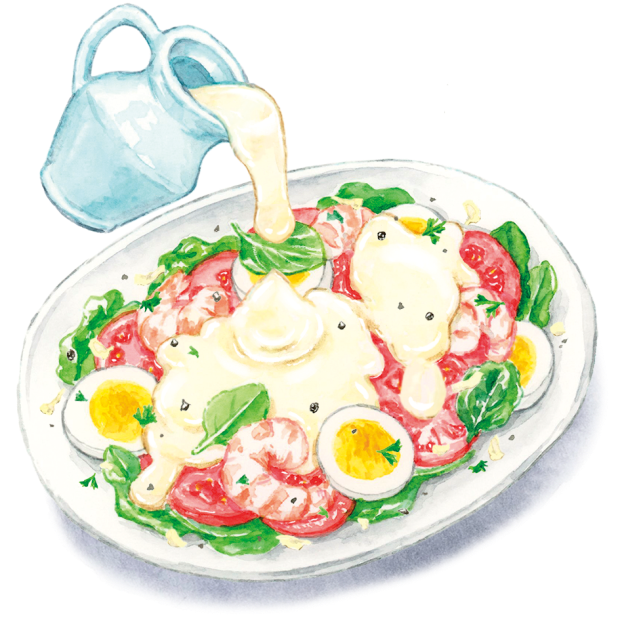
Oeuf mayonnaise is such a classic of French bistros that it would be mad to assume universal knowledge of the perfect version. Peculiarly, it hasn’t quite made the jump in the way other bistro classics have: outside of France, steak tartare abounds, croque monsieurs are ten a centime, French onion soup has become universal onion soup. But oeuf mayonnaise, eggs covered in egg sauce? It doesn’t quite translate. Perhaps it’s the Inception-like nature of the dish that has prevented its cultural exportation. But we have no issue with duck confit (duck in duck fat) or îles flotantes (sweet eggs in sweet egg sauce).
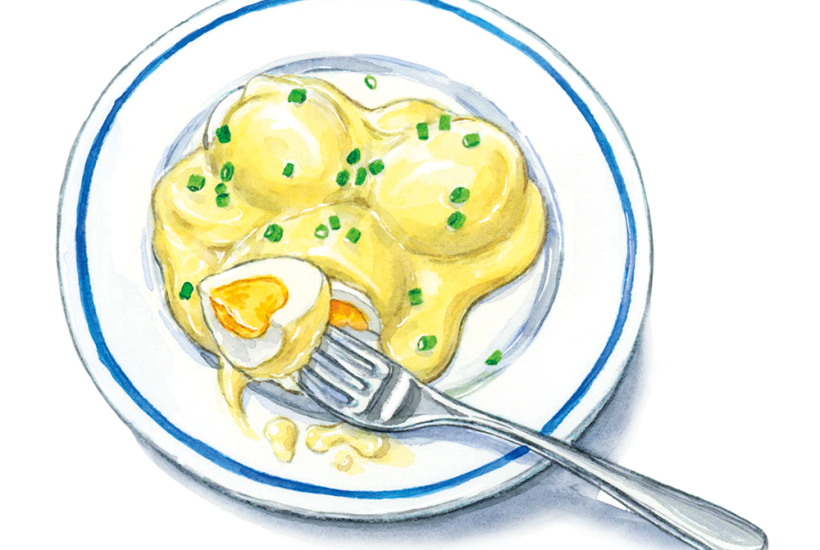
The mayonnaise needs to be soft. It should lie on the eggs like a blanket, gleaming softly
I worry it may be its overt simplicity which confines it to the bistro. It is almost aggressively minimalist in design. Unlike our egg mayo, or the American egg salad, oeuf mayonnaise has no time for your finely sliced celery or handful of cornichons; the Tabasco and paprika of devilled eggs have no place here. A classic oeuf mayonnaise is whole or half hard-boiled eggs, enrobed in mayonnaise, nothing more. Of course, the truth is that it is that simplicity which is what makes the oeuf mayonnaise so delightful. There are no distractions, no fripperies.
As with most very simple dishes, the art is in the execution. The eggs must be cooked perfectly: too soft and their yolk will be dribbling all over the place; too hard, and the white will be rubbery and the yolk chalky. I want a fudgy, creamy yolk. That means simmering large eggs for eight and a half minutes and then immediately plunging them into very cold water to arrest the cooking.
Then there’s the mayonnaise. I am, as you know, never one to decry convenience, or frankly anything that makes cooking accessible. But when it comes to oeuf mayonnaise, I’m afraid the stuff in a bottle or jar won’t work. It’s too thick, too jellied. The mayonnaise here needs to be softer. It should lie on the eggs like a blanket, gleaming softly.
Thankfully, there is great pleasure in making mayonnaise by hand. I know, isn’t that just the sort of nonsense a food writer would say? But please bear in mind my inveterate laziness. You can just bung all the ingredients in an immersion blender and let it do the work for you, but for that supple, spoonable mayonnaise, a bowl and a whisk are your best route. In fact, you don’t even need a whisk – a wooden spoon will do. You’re not trying to aerate the mixture, just agitate it while the emulsion is forming and strengthening. If you are a novice, I promise it is nothing to be feared. Use a neutral-tasting oil for the bulk of it (I prefer sunflower or rapeseed); I add a little extra virgin olive oil at the end, but using it exclusively can be bitter and overpowering. Give yourself time – ten full minutes – to ensure that you do not rush the drip drip drip of the oil as you begin adding it. In the early moments doubt may creep in, but once you’ve made it through two thirds of the oil, the mayonnaise will start to feel heavy on your spoon, it will fall off in dollops, rather than streaming in ribbons.
Oeuf mayonnaise is never going to win prizes for innovation. But perhaps that’s OK? Maybe, actually, originality is overrated.
Serves: 2
Hands-on time: 10 minutes
Cooking time: 10 minutes
- 3 large eggs
- Chives, to garnish
For the mayonnaise
- 1 large egg yolk
- 1 tablespoon white wine vinegar
- 1 tablespoon Dijon mustard
- 150ml neutral oil
- 50ml olive oil
- Fine salt, to taste
- Bring a pan of water to a simmer, and carefully lower the three eggs into the water. Maintain a simmer for eight and a half minutes, then remove the eggs, plunge them into iced water, and leave them to cool for five minutes.
- Make the mayonnaise: whisk together the egg yolk, white wine vinegar and mustard. Begin adding the two oils, starting very slowly – drop by drop at first, whisking thoroughly each time. As the mixture starts to come together and thicken, you can add the oil in a thin stream, constantly whisking. When you have added all of the oil, the mayonnaise should be as thick as softly whipped cream, hanging heavily on the whisk, and have a satin sheen.
- Peel the eggs under running water: start at the base of the egg, where the air pocket sits in the shell. Dry the eggs on some kitchen paper, and slice each in half, longways.
- Place three of the egg halves on each plate, then spoon the mayonnaise generously over the top of each half. Garnish with finely sliced chives, and serve immediately.
Got something to add? Join the discussion and comment below.
You might disagree with half of it, but you’ll enjoy reading all of it. Try your first month for free, then just $2 a week for the remainder of your first year.