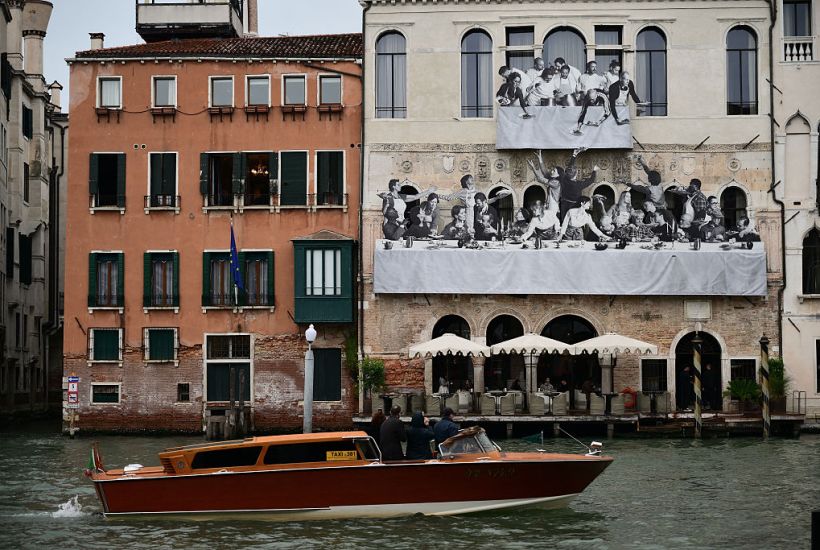
The who’s who of the international art world meet every two years at the Venice Biennale to hobnob, clink champagne glasses and gawk at contemporary art showcased in national pavilions along the Giardini della Biennale. The exhibition should be a celebration of artistic merit, with the international jury awarding the coveted Golden Lion to the best national pavilion and artist. This year, however, the 61st Venice Biennale, scheduled to open on May 9, has already decided that the art will take a back seat to identity politics.
Israel is represented by sculptor Belu-Simion Fainaru, and his early exclusion from the chance of winning a prize has caused an uproar
The exhibition’s theme, ‘In Minor Keys,’ was selected by chief curator Koyo Kouoh. Before dying last year from cancer, she described the curatorial objective as: ‘In refusing the spectacle of horror, the time has come to listen to the minor keys, to tune in sotto voce to the whispers, to the lower frequencies; to find the oasis, the islands, where the dignity of all living beings is safeguarded.’
But on April 23, the Biennale’s five-member International Jury announced that the dignity of some ‘living beings’ won’t, after all, be safeguarded. They released a statement declaring that national pavilions and artists representing countries ‘whose leaders are currently charged with crimes against humanity by the International Criminal Court [ICC]’ will not be considered for prizes.
Pavilions and artists representing Russia and Israel are not eligible for the Golden Lion. In the past three years, the ICC has issued arrest warrants for both Russian President Vladimir Putin and Israeli Prime Minister Benjamin Netanyahu on accusations of war crimes in Ukraine and Gaza, respectively.
The jury’s move followed an open letter published in early April, signed by hundreds of artists, curators, and workers demanding the exclusion of Israel from the biennale because of the war in Gaza. Another letter called for the boycott of the US over its recent war with Iran.
This is not the first time artistic merit and dignity have been challenged by identity politics as biases over the geopolitical landscape increasingly determine the Biennale’s criteria for ‘good art.’
In 2022, the Russian curatorial team pulled out of the Biennale at the last minute because of the geopolitical controversy over Russia’s invasion of Ukraine. The pastel-coloured, neoclassical Russian pavilion sat dark, empty and surrounded by armed guards. Russia also remained on the sidelines in 2024, renting out its pavilion to Bolivia.
This year, the exhibition’s governing Biennale Foundation approved Russia’s participation, stating that ‘no regulations have been violated and sanctions against the Russian Federation have been fully complied with.’ Still, the idea of a Russian-sponsored exhibit on Italian soil infuriated minister of culture Alessandro Giuli to the point where he is refusing to appear at the exhibition’s opening ceremony. The European Union has also vowed to cut its €2 million grant to the Biennale over the return of Russia.
The traumatic events of October 7 and the violent cultural boycotts against Israel following its war on Hamas in Gaza also presented the Israeli curators and artists at the 2024 Biennale with the difficult decision of whether or not to open their pavilion. Opening would certainly incite protests and vandalism, while shuttering its doors would look like Israel had taken its cue from Russia. ‘Israel is not Russia,’ the curators told me in an interview. Israel’s war ‘was initiated by a horrific massacre. It’s not the same as Russia. And art should have a place here.’
The decision in 2024 was made to launch Israeli artist Ruth Patir’s exhibition inside the national pavilion, but to postpone opening its doors until a ceasefire and hostage release agreement was reached, which never occurred during the duration of the Biennale. The art was alive, and those who walked by could see it, but the doors would remain closed.
This year, Israel is represented by sculptor Belu-Simion Fainaru, and his early exclusion from the chance of winning a prize has caused an uproar. The Israeli foreign ministry posted on April 26 that ‘The boycott of Israeli artist Belu-Simion Fainaru by the International Jury of the Venice Biennale is a contamination of the art world. The political jury has transformed the Biennale from an open artistic space of free, boundless ideas into a spectacle of false, anti-Israeli political indoctrination.’
Fainaru is consulting lawyers about the jury’s ban, calling the decision racial discrimination. ‘I’m an artist and have equal rights, and I can’t be judged by belonging to a country or a race… I should just be judged on the quality and message of my art,’ he said in an interview.
A week after the jury announced its controversial decision, all five members resigned with just nine days before the exhibition’s scheduled opening.
The Biennale Foundation quickly tried to salvage the situation. All national participants are eligible for prizes, they stated, ‘following the principle of inclusion and equal treatment among all participants… consistent with the founding spirit of La Biennale, based on openness, dialogue, and the rejection of any form of closure or censorship.’
New awards have been created to replace the traditional Golden Lion. Registered visitors to the exhibition – regardless of their knowledge or appreciation for the actual art – will vote on the winners. ‘Each ticket holder may cast one vote for each of the two awards, in one single session,’ the foundation announced, and the best pavilion and artist will now receive a ‘Visitors’ Lion.’
But the damage has already been done, and the commitment to safeguard dignity and artistic freedom stained by identity politics.