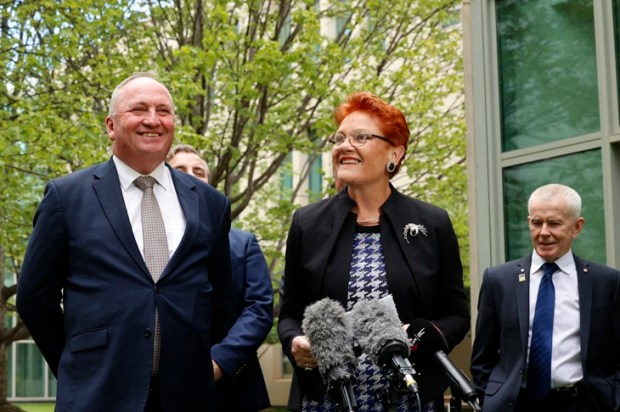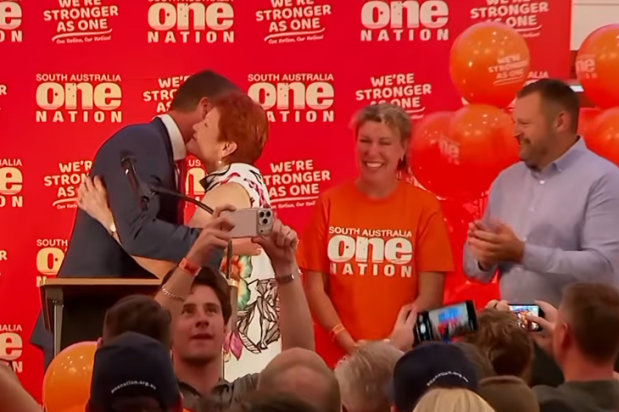
One Nation is now the most intriguing phenomenon in Australian politics. Thirty years after Pauline Hanson first entered federal Parliament, her political creation is reaching heights few foresaw. Nothing in its history – not even the 1998 Queensland breakthrough – foreshadowed a national vote now in the mid-twenties, extending deep into Victoria and South Australia.
At the same time, the Liberal Party has imploded, not just federally but in every mainland state bar Queensland. As our polling shows, the Liberal Party’s loss has been One Nation’s gain, with around half of traditional Coalition voters now saying they would vote for One Nation if an election were held next weekend.
While Labor’s vote federally is fragile, its state brands are mostly strong, so whatever is going on is something only on the right of politics, and it is more fundamental than anything that has happened for at least the last 80 years.
Immigration can explain part of this rise, based on precedents in the USA, UK, and Europe, but it does not explain the collapse of the state Liberal parties. Something else was missing.
After polling on the policies of the federal government on Covid it seems that it is the missing element. Whether one agreed with the measures or not, they represented the greatest curtailment of Australians’ liberties outside wartime. Many respondents now also believe governments misled them.
What the research reveals is that Covid was indeed an emotional break that led a clear majority of defecting Coalition voters to feel betrayed by their party. The pattern suggests many gave Peter Dutton the benefit of the doubt, but after a campaign in which Liberal promises often appeared to mirror Labor’s, they decided it was time to find a party that reflected their values more closely. That party was One Nation – the one party that had consistently opposed most of the Covid measures.
It is now four years since Covid, and it barely appeared in the verbatims of our January polling because respondents were looking forward. Yet its fingerprints are all over voter motivation when respondents are asked about it directly.
When we matched attitudes to current vote intention, One Nation voters disapproved most heavily of the federal government’s Covid policies, by 71 per cent to 15 per cent. Coalition voters were almost evenly split, with 40 per cent approving and 39 per cent disapproving. Remarkably, both Labor and Greens voters approved on balance, despite their normal tribal instincts against the Coalition.
When we looked at traditional voting patterns, 69 per cent of traditional Coalition voters who have now switched to One Nation disagreed with the federal government’s Covid policies, while 92 per cent of traditional One Nation voters also disagreed. By contrast, among traditional Coalition voters still voting Coalition, 41 per cent were likely to approve of the federal government’s performance.
An even more extreme pattern emerged on immigration. 93 per cent of traditional Coalition voters who have shifted to One Nation think immigration is too high, with 86 per cent saying it is ‘much too high’. By contrast, among those still voting Coalition, 75 per cent think it is too high, but only 18 per cent say it is ‘much too high’. The key difference is intensity.
The anti-Semitism legislation revealed a similar convergence between defecting traditional Coalition voters and traditional One Nation voters. 81 per cent of defectors disapproved of the legislation (58 per cent strongly), while 82 per cent of traditional One Nation voters disapproved (63 per cent strongly).
Traditional Coalition voters remaining with the Coalition were still 50 per cent disapproving, with only 23 per cent approving, suggesting the Coalition has a significant problem with its base on this issue and could yet lose further support.
The polling trend since the last election dramatises the movement. There is a steady erosion of both Labor and Liberal votes and a rise in One Nation’s.
The Bondi Hanukkah massacre appears to have temporarily arrested the Coalition’s decline, likely because the event placed questions of authority and public order at the centre of the national conversation in an otherwise politically dormant period. The subsequent anti-Semitism legislation then appears to have reversed that stabilisation, coinciding with a renewed and steeper shift to One Nation.
What we are seeing, then, is the pro-individual, pro-free-enterprise wing of the Coalition being shaken loose during Covid, when collectivist and paternalist solutions were imposed by the party they still regarded as home.
They initially placed their faith in Peter Dutton to restore the party’s instincts. Instead, the subsequent election defeat against a government they deeply disliked, followed by the Coalition’s failure to differentiate itself on immigration and civil-liberties questions, deepened their institutional disillusionment.
The final phase – where One Nation begins to eclipse the Coalition – reflects the growing belief that an establishment duopoly has emerged, of which these voters no longer feel part.
Covid broke trust. Immigration organised the break. The anti-Semitism legislation completed it.