Kemi Badenoch is right to draw attention to the crisis facing Britain’s historic churches.
When nearly a thousand places of worship are at risk of closure, as Historic England has warned, we are witnessing more than the loss of beautiful buildings. We are losing irreplaceable anchors of memory, community, and spiritual order.
Badenoch’s call to restore adequate funding for the Listed Places of Worship grant scheme is timely and necessary. Yet from a (Roman) Catholic perspective, saving churches requires more than financial rescue or appeals to social cohesion. It demands a recovery of the Church’s own understanding of what a church building truly is.
A Catholic church, at its heart, is not primarily a community centre, heritage asset, or venue for life events. It is a sacred building set apart for the worship of God. What happens within its walls, the offering of the Holy Sacrifice of the Mass, the celebration of the sacraments, and the prayer of the Church, is what makes it special.
Through its sacred art, architecture, music, and liturgy, every sense is engaged so that we may encounter the living God. These elements are not like anything else we do in ordinary life. They are unique in their beauty, their goodness, and truth they convey, because God is worthy of our very best and our most distinctive offering.
The beauty, proportion, and symbolic order of a church building exist to honour Him and to make His presence known in a way that lifts the soul beyond the everyday. This vertical, God-centred focus defined Christian sacred architecture for centuries.
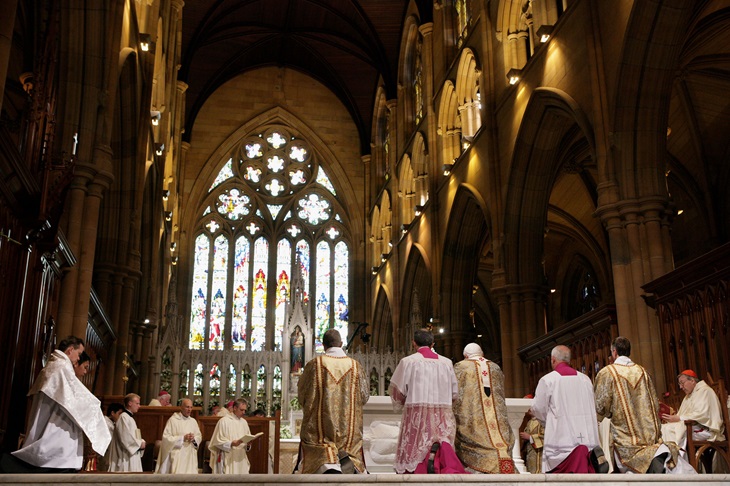
Churches were traditionally built ad orientem (facing east), with the priest and people together oriented toward the Lord. The high altar, elevated sanctuary, vertical lines, and rich symbolism all expressed the truth that worship is first and foremost directed to the Triune God. The horizontal dimension, the communion of the faithful, is real and important, but it was always understood as flowing from and ordered toward the vertical relationship with God.
In the 20th and 21st centuries, however, Catholic life and worship have undergone a noticeable shift toward the horizontal. The legitimate desire for active participation and cultural relevance, encouraged by the Second Vatican Council, sometimes led to an over-correction. Many post-conciliar churches were designed with fan-shaped or theatre-style layouts, freestanding altars, and minimalist aesthetics that prioritise visibility, communal interaction, and pastoral accessibility. While these changes were often motivated by pastoral concern, they frequently resulted in buildings that feel more like assembly halls than sacramental thresholds. The emphasis on the Eucharist as a ‘banquet’ or ‘memorial of the Lord’s Supper’, while true, has sometimes overshadowed its character as the unbloody renewal of Calvary and the anticipation of the heavenly liturgy.
This horizontal tilt mirrors a broader cultural and spiritual reality: the gradual loss of a living sense of God’s transcendence in everyday life. In a secular age, many people, even many Catholics, experience faith primarily through the lens of community, personal fulfilment, or social values. The vertical dimension, the awe-filled recognition that we stand before the living God, has become harder to perceive.
When church buildings themselves no longer clearly proclaim this reality through their form and beauty, the loss is not merely aesthetic. It is theological and spiritual.
Joseph Ratzinger (Pope Benedict XVI) repeatedly warned against this tendency. In his book, The Spirit of the Liturgy, he argued that sacred architecture should not simply reflect contemporary culture but should draw the worshipper into the cosmic and eschatological mystery of Christ. Beauty, proportion, and symbolic order are not decorative luxuries; they are essential to the liturgy’s ability to mediate divine glory.
Denis McNamara has made the same point: church buildings are sacramentals that embody the lex orandi, lex credendi, the law of prayer is the law of belief. When architecture becomes primarily functional or sociological, it risks communicating that the sacred is secondary to the practical.
Badenoch’s concern for the social role of churches is valid and important. Historic churches have indeed helped shape Britain’s moral and communal fabric for centuries. But social cohesion cannot be the ultimate justification for their preservation. A church that survives only as a cultural landmark or community hub will eventually become a museum.
What gives churches their enduring power is their capacity to make God present, to be places where the invisible is made visible, where heaven touches earth. Saving our churches, therefore, cannot be only a political or heritage project. It must be accompanied by a deeper recovery of the Catholic understanding of sacred architecture: a return to the vertical dimension of worship, a renewed appreciation for beauty as a theological necessity, and a commitment to sacred architecture, art, music, and liturgy that honours God with our very best.
Only then will these buildings continue to fulfil their true purpose, not merely to house the faithful, but to draw them into the mystery of Christ.
Britain’s churches are part of a Christian inheritance that formed our civilisation as we know it and still shapes our common life, whether we acknowledge it or not. Preserving them is not nostalgia. It is an act of cultural and spiritual responsibility, one that invites us to remember the God who once stood at the centre of our common life, and who still desires to do so today.
Historically, societies drift away from God, yet they almost always return to Him in time. Having churches standing ready when that return comes is a profound and necessary good.