With the safe return of Artemis II, we are a step closer to humans landing on the moon for the first time since the 1970s. To do this we’ve had to relearn ways of doing things that were in danger of being forgotten.
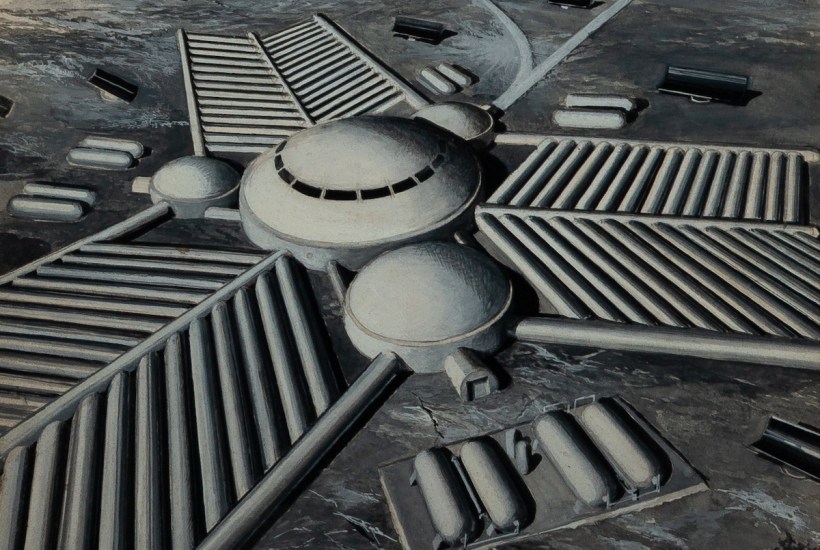
It is perhaps a good time then to remember a man who was one of Britain’s most remarkable visionaries when it came to space. Decades before they came into existence, the artist Ralph Smith (born in 1905) designed a world of spaceships, rovers and moon bases that remain relevant today.
Decades before they came into existence, the artist Ralph Smith designed a world of spaceships, rovers and moon bases that remain relevant today
Not only did he outline procedures for lunar descent and touchdown that closely resembled the retro‑propulsive approach later used by the Apollo Lunar Module, but his illustrations helped create an entirely new artistic world.
The story starts in the inter-war years, when Smith was drawn into the world of space exploration at the British Interplanetary Society (BIS) where he forged a friendship with a remarkable group of enthusiasts that included Arthur C. Clarke, later the author of 2001: A Space Odyssey. Inspired by writers such as H.G. Wells, BIS was established in 1933 in the belief that space technology could positively transform human civilisation.
‘The 1875 Explosives Act meant that in Britain you could not experiment with directly launching rockets, as you could in Europe and America,’ explains Doug Millard, deputy keeper of technologies and engineering at the Science Museum, ‘but BIS was particularly good at things like designing spacesuits, spaceships, rockets and working through the theory of space flight.’
Independent of the British state, BIS had no obligations to trumpet national initiatives and instead developed an ambitious internationalist ethos. Because Smith insisted that his drawings were grounded in technical studies, his work helped BIS attract global renown for engineering papers that anticipated the problems of lunar emissions, rockets, artificial satellites and space stations far ahead of government programmes.
Clarke’s early non-fiction books (illustrated by Smith) were a best-selling mix of scientific speculation and ‘how to’ guides. Chapters from The Exploration of Space progressed smoothly, chapter-by-chapter, from ‘The Rocket’ to ‘Escaping the Earth’ then ‘The Spaceship’ and then ‘The Journey to the Moon’. These books not only fleshed out startling visions of improbable futures, but they also made them plausible. As a result, from the Daily Mail to Pathe newsreels, Smith began to hit the headlines.
‘Smith’s art translated dense technical studies into images that decision makers could grasp,’ explains John Lewin, the current Chief Executive of BIS, ‘his illustrations of the technical papers that BIS produced, for example, made ideas for lunar spacecraft, spacesuits and space stations visible.’
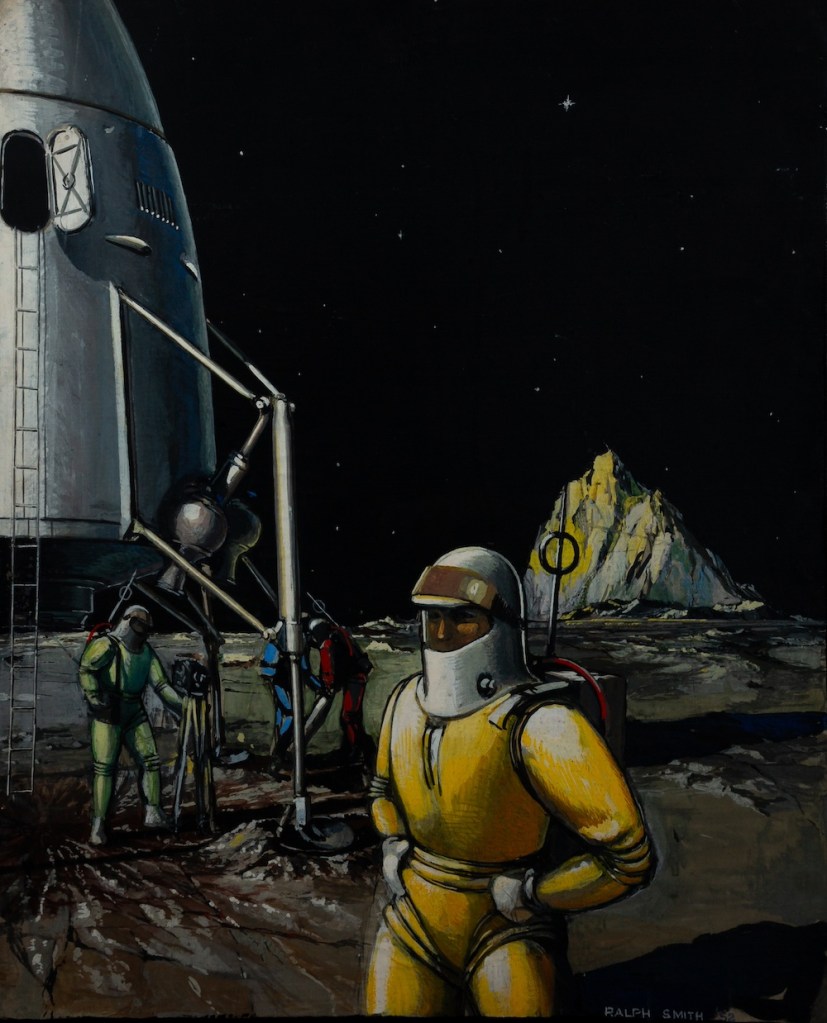
Inspired by the V2 rockets flying overhead, the ‘Megaroc’ ship he designed with Harry Ross in 1946 anticipated US developments of the 1960s and introduced the idea of capsule recovery for manned missions. A model of one of the spacesuits Smith designed is displayed in the National Space Centre in Leicester.
‘Smith gave people an idea of what space exploration would be like,’ says Lewin, ‘For comparison I think of the TV programme Thunderbirds in the 1960s, where you had Brains talking into his watch 50 years before the Apple Watch was invented.’
While his achievements in the field of ‘space art’ are remarkable, Smith’s work was visibly informed (as well as influenced by) the wider cultural milieu.
Theinfluence of his work seeped into comics like Dan Dare; Topps Bubblegum cards and the imagination of writers like J. G. Ballard. Having cut his teeth working on the design of hotels and cinemas, his work helped give birth to Pop Art. Pop Art emerged in a moment where self-educated artists would blend their commitment to the fine arts with an enthusiasm for childhood comics and interest in (for example) the workings of the helicopter. For the Independent Group that coined the term, science, space exploration and new technology offered fresh ways of understanding the world that enabled them to break with the then dominant mode of neo-romanticism.
Yet while Arthur C. Clarke would become globally feted as a prophet of the future after the launch of Sputnik in 1957, Smith’s untimely death would see him slide into obscurity after an unhappy coda to his career. Previously cold shouldered by the British state, Smith took a pay cut to join the Rocket Propulsion Establishment – the government science laboratory at Westcott. Ill health hampered his progress, and he resigned after the collapse of Britain’s ambitions in space led the Establishment’s work to be redirected towards the development of missiles.
The crew of Artemis II have promised to bring ‘all the good stuff’ back with them after they land, in a manner that recalls Smith’s optimistic belief that life, supported by technological development, would get progressively better. It’s perhaps also a good time to recover a tradition of combining engineering ingenuity and artistic experimentation.
‘Paintings, imagination, artist’s imaginations are important,’ concludes Lewin, ‘because they can lead engineers and designers towards the creation of a new reality.’
Scott Anthony is the author of the novel Changi. His most recent book is The Story of British Propaganda Film