If there’s any consolation to be had in the prospect of AI filling the world with humanoids, it will be the look on their glassy faces when they realise that one of us has beaten them to it. The Turner Prize-winning sculptor Sir Antony Gormley, 75, has installed casts of himself from Crosby beach in Liverpool to Gateshead, from Texas to the Netherlands and western Australia. He and his simulacra might not detain our new overlords for very long, of course, but in the meantime ‘The Gormleys versus the Bots’ is the Doctor Who episode I’m here for.
The man responsible for the magnificent ‘Angel of the North’ studied at Goldsmith’s, the playground of Damien Hirst, Sarah Lucas and other YBAs. But he was there a full decade before them, the Tommy Steele or Cliff Richard to their Fab Four (or more). You might have seen a photograph of the young Hirst next to a severed head, the pair of them gurning for the camera from the slab of a Leeds morgue. The body is central to Gormley’s art – his own in particular – but its gamey effluvia hold no interest for him as they have for Hirst, Tracey Emin, Marc Quinn and others. Our flesh and bone intrigues him as so many forms in space. He’s certainly thrown himself into his work; in my lifetime, none of my countrymen has spent longer in plaster, with the possible exception of Eddie the Eagle. These casts are germ-free capsules with Gormley suspended in them like art’s Yuri Gagarin.
Some of the crowd from Hirst’s Sensation show of 1997 now pursue traditional art disciplines. Dame Tracey has emerged from convalescing from cancer in Margate with a new collection of paintings. For his part, Gormley has published a handsome doorstopper of his drawings. It’s the lot of the successful artist in late life to be feted and indulged, to affect unstructured work garb that costs a lot more than it looks and to be attended by minions in a fancy atelier.
It’s better than starving in a garret, but there’s always the chance of a smirk from the ignorant groundlings. The importance of drawing to Gormley is visible in the design of his London workplace, according to Margaret Iversen of the University of Essex, who has contributed one of several essays which interleave Gormley’s artworks. She says:
The façade is dominated by two staircases leading in opposite directions, one of which leads to the communal activity of the studio, the other to the drawing studio where the artist works alone.
The reader can imagine Gormley in this Escher condo, solemnly ascending to his monkish sketching cell.
In the rather airless language of the academy, he writes of his practice that it’s ‘a kind of oracular process that requires tuning in to the behaviour of substances as much as to the behaviour of the unconscious’. Those substances include ‘lampblack, bone black milk, semen and blood’. He prefers to draw at night, ‘when it is easier to withdraw into the inner realm’.
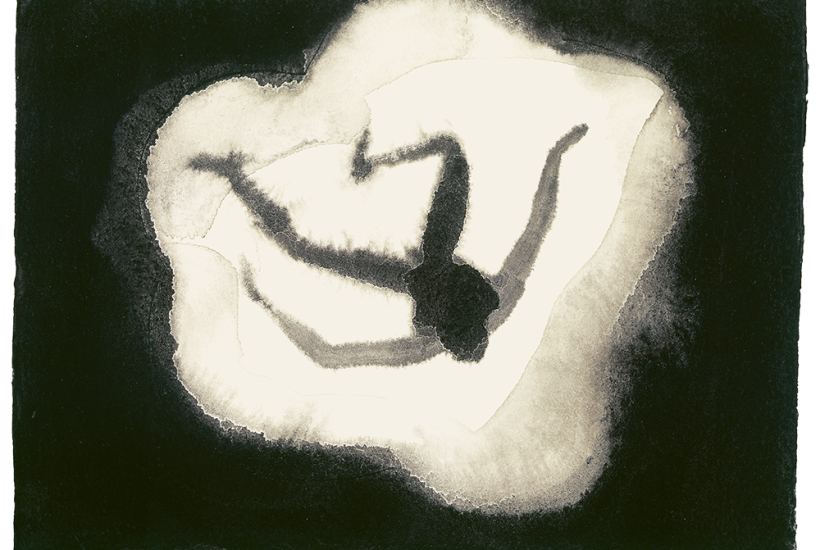
Many of the works in these pages, which Gormley has made throughout his long career, depict a lone male figure in a featureless environment, a man emerging as though from a Rorschach blot. Others are more abstract: grids, lung-like shapes, sunspots on the back of an eyeball. One of the artist’s attractive qualities is a willingness to let chance lend a hand. For his ‘Body and Light’ series, he soaked paper in water before applying pigment and leaving it overnight so that the images were ‘arising’ beyond his control.
The volume will look very fine in the atrium of a gallery, but Gormley’s masterpieces are his cast-iron sentinels, numerous but solitary, turning green on the Mersey riviera and expanding and contracting with the Texan sun. ‘I find protection in Gormley’s work,’ writes the novelist and critic Jeanette Winterson. ‘It’s his body, not mine or yours. Yet I recognise myself there… I am not protected from some tabloid danger “out there”. I am protected from the danger of being too literal.’
Art history may judge the sculptor to be an instructive figure. His efforts as an avatar of our species have something in common with Elon Musk’s dreams of heading up a colony in space, not to mention the Tesla man’s generous distribution of his own DNA. And what is a Gormley if not a Moai for the Insta age, a selfie in metal? That said, the self-portrait is one of the most venerable traditions in art, much favoured by the old masters. In the end, the art history of the future will be written by the bots, like everything else. Chattering like the tin men in the old Smash instant potato adverts, they will descend upon a Gormley only to fall silent in baffled awe before his vision of a fragile human form alone in the world.
Got something to add? Join the discussion and comment below.
You might disagree with half of it, but you’ll enjoy reading all of it. Try your first month for free, then just $2 a week for the remainder of your first year.