It’s a crisp afternoon, and in a darkened room in central Amsterdam a woman is being smothered in snakes. Projected on to three walls is a massive video close-up of her face. She is young and beautiful and remarkably composed: just a nose twitch here, an eyelid flutter there, as a python wriggles across her mouth or languidly caresses her cheekbone with its tail.
In the room behind me, another woman stares fiercely back. Her shoulders are bunched with muscle, arms stiff at her sides, like a nightclub brawler about to nut someone. But it’s the bull’s horns sprouting from her forehead, and the mane of matted fur marching down her back, that make it hard to meet her gaze.
As the exhibition shows, Ovid puts today’s ‘radicals’ in the shade
A few miles away, in the city’s red light district, you pay good money to see such confrontational sights. Here, they are part of a package deal, included in the admission price for the Rijksmuseum’s blockbuster spring exhibition Metamorphoses. A collaboration with the Galleria Borghese, it runs in the Dutch capital until 25 May, and reopens in June in Rome. The Rijksmuseum are good at the pyrotechnics required to get punters in through the door – its 2023 Vermeer exhibition brought together an unprecedented 28 of the artist’s 35 known paintings. And its curators have an apparently inexhaustible supply of ‘lost’ Old Masters up their sleeves. Early this month, they announced the rediscovery of a new Rembrandt, authenticating ‘Vision of Zacharias in the Temple’ as by the 17th-century artist, rather than a student of his school.
Yet Metamorphoses displays ambition, and risk, of a different sort. Alongside the Bible, the epic work by the Roman poet Publius Ovidius Naso – ‘Ovid’, to posterity – was once one of the twin pillars of western artistic inspiration. Now it’s seen as a specialist subject: the niche of scholars at the unfashionable end of university humanities departments, or the kind of schools it’s unwise to admit attending in civil service job interviews. In fact, the Rijksmuseum’s curators claim this is the first major exhibition dedicated to artworks inspired by the poem. It ranges across 2,000 years of art history, taking in 9th-century hunting trophies and contemporary video art, and featuring artists from Bernini and Titian to Magritte and Louise Bourgeois. (The snake installation ‘Spawn’, 2019, by Juul Kraijer, and the female minotaur statue ‘Zeus’, 2009, by the South African artist Nandipha Mntambo, are two of the more successful modern artworks.) Of the 80 pieces, more than half are loans: the result of a web of negotiations more than a decade in the making. It’s an intelligent, thoughtfully curated show, with some spectacular
individual pieces.
It’s also pretty brave. You only need a glancing acquaintance with the modern art scene to realise that getting ahead requires necking a hearty dose of ideological Kool-Aid: progressivism, in all its guises, is good; fluidity, of all kinds, is all but essential. And anything that smacks of the western tradition is suspect – or, at least, worthy of a withering eye-roll. So it’s spiriting to find a celebration of an 8 AD Latin poem in the heart of one of the most liberal cities in the world; as the exhibition shows, Ovid puts today’s ‘radicals’ in the shade.
‘The poem is one of the roots of our common culture,’ says Dr Frits Scholten, the Rijksmuseum’s head of sculpture and the exhibition’s lead curator. ‘It still speaks to us… It holds a mirror back on ourselves through these universal themes – jealousy, love, revenge. One of the surprises of this project is how much of Ovid’s work was still alive.’
Scholten’s own story demonstrates how quickly – and dramatically – we’ve lost touch with that common European culture. ‘Ovid isn’t so well known in Holland any more,’ he admits. The only reason Scholten had studied the classics at all was because he first trained as a biologist: ancient Greek was required to get into the gymnasium of his choice. Fewer than 7,000 British students started classics degrees in British universities in 2023; and only 206 candidates sat ancient Greek at A-level last year – though the subject has, admittedly, always been a somewhat boutique choice. In the space of a generation or two, literature such as Ovid’s Metamorphoses has grown remote and obscure.
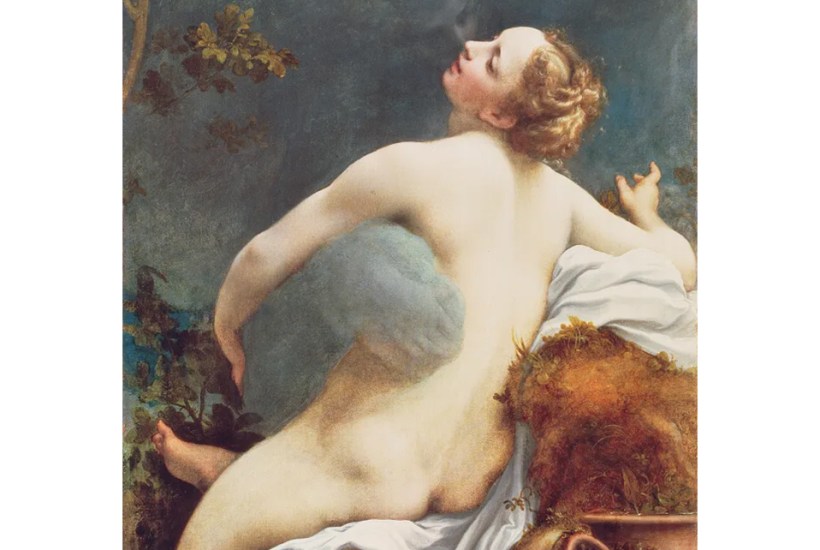
Ovid’s poem – which runs to nearly 12,000 lines across 15 books, and tells the story of the history of the world from creation to the deification of Julius Caesar – had been a touchstone for artists since its composition. In 1604, the Flemish painter and critic Karel van Mander had declared Metamorphoses ‘a Bible for artists’. Its ubiquity was ensured by the invention of the printing press and the mass production of illustrated copies, the poet’s words transmuted into image: another metamorphosis. The early artists drawn to the poem are well accounted for in the Rijksmuseum’s show. Poussin’s ‘Apollo and Daphne’ (1663-64) shows the messenger god inspiring the poet; in Correggio’s gorgeous ‘Jupiter and Io’ (1532-33), meanwhile, the encounter between god and nymph is seductive and tender: Jupiter appears as a vast, cloudy hand, gently reaching down for his lover.
Still, Ovid’s work abounds in what Scholten delicately terms ‘less female-friendly stories’. Rape, abduction and bestiality are commonplace; in 2015, four Columbia University literature undergraduates petitioned to have trigger warnings in place before students embarked on reading it.
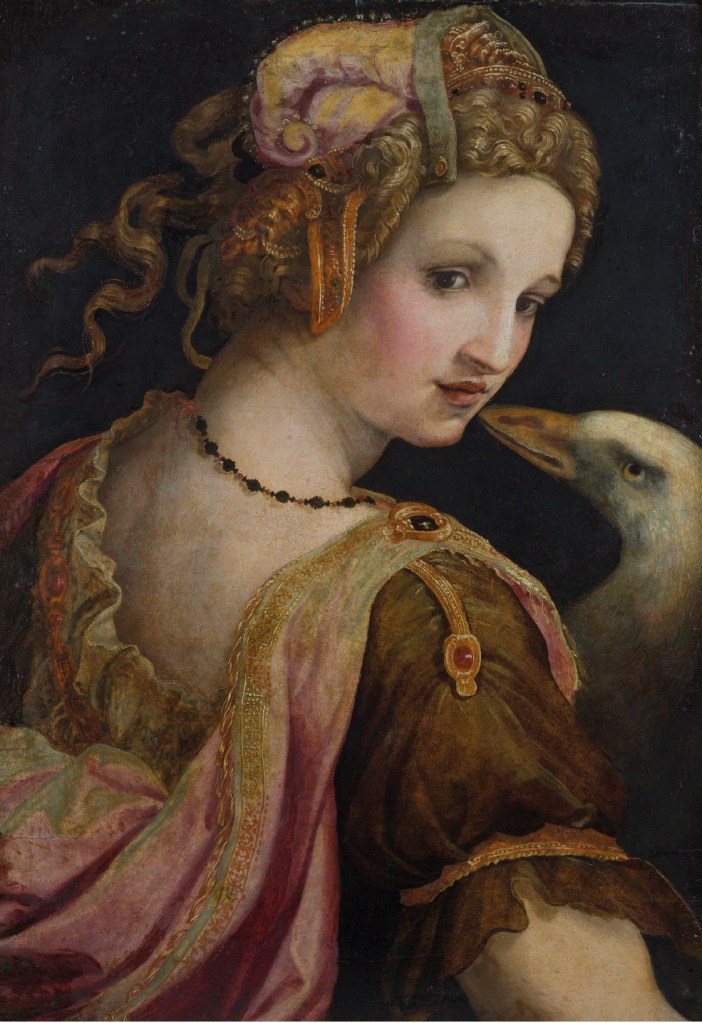 ‘Leda’, c.1560–70, by Michele Tosini. Galleria Borghese, Rome
‘I wanted this exhibition to show a more nuanced side to Ovid,’ says Scholten. ‘I didn’t want to just focus on the gender-fluidity side of his work, or the sexual violence. These debates are very strong in the Netherlands too – it’s not just America or the UK. But when you actually read his work, he’s almost an objective writer. He stands aside. There’s no judgment.’
Scholten points out that Ovid regularly took on female voices in his writing, such as in his letters purporting to be from famous women: Penelope, left behind to mourn the men at Troy, for example. Sexual violence cuts across genders too: the myth of Hermaphroditus has the nymph Salmacis forcing herself on the beautiful youth until their bodies fused. In the show, this story is represented by the 2nd-century AD Roman marble sculpture ‘Sleeping Hermaphroditus’, which, as you move around it, enacts the gender switching of the original tale.
For Scholten, Ovid’s true radicalism comes in Book 15, when Pythagoras advocates for vegetarianism on the grounds of animal welfare. ‘To read that in Ovid was really a revelation – it’s an ecological flash of insight from a 2,000-year-old text,’ he says. ‘We think we’re superior, but our monotheistic culture has placed God outside the cosmos. We don’t have an animistic sense of the world – the knowledge that everything is alive and animated – and so we abuse creation.’
It’s a view echoed by Taco Dibbits, director of the Rijksmuseum. ‘So much has been published about Ovid, but in his own work he left gaps for the imagination to work,’ he tells me. Ovid, for instance, almost never directly described the moments of sexual assault. Rather, as with many of the artworks around us as we talk, ‘he showed the moment before the unimaginable encounter between the human and the divine’.
In Book 15, Pythagoras advocates for vegetarianism on the grounds of animal welfare
As a curator, Dibbits has little truck for the idea that fashionable modern pieties should shape the art on display. ‘Exhibitions are always contested spaces. You need to allow space – you cannot dictate how people should feel. Just give historical context, and let them make up their minds.’
When he first took over the museum in 2016, Dibbits programmed two exhibitions grasping some of the thorniest aspects about the Netherlands’s past – one on the Dutch slave trade, another on its colonisation of Indonesia. ‘Museums cannot react [to politics], they must act,’ he argues. ‘As soon as you start to worry, it limits your curiosity. Art is there to be borderless, to be free.’
In the exhibition’s final room hangs Luca Giordano’s extraordinary 1696 ‘Flaying of Marsyas’. It’s a depiction of Apollo skinning the satyr alive: Marsyas’s face is torn with pain, his flesh hangs in bloody strips, as the cherubic young god digs in with his knife, intent about his work. To modern eyes, it’s a gruesome depiction of torture. But to its original Renaissance viewers, it had a different meaning: that all things change, but nothing truly dies. One body withers, and the soul flits to another form; freedom comes, but always with a cost. It’s a brave, progressive idea. Radical, even.
Exiting through the gift shop, I spotted a bright, cartoonish book on display: Gender Swapped Greek Myths. Somewhere, somehow, Ovid was having a laugh.<//>
Got something to add? Join the discussion and comment below.
You might disagree with half of it, but you’ll enjoy reading all of it. Try your first month for free, then just $2 a week for the remainder of your first year.