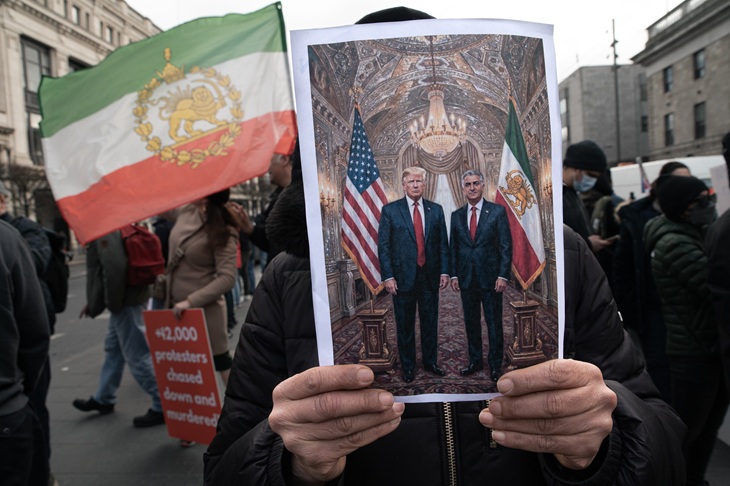
Iran is at the crossroads once again. While bombastic left-wing activists and journalists are strangely quiet about Iranians fighting a theocracy that kills gay people, oppresses women en masse, and murders dissidents, it might be timely to remind the West what Iran, the once proud Persian lion, has been forced to become under the Ayatollahs.
There is perhaps no better source of this than Azar Nafisi’s book, Reading Lolita in Tehran.
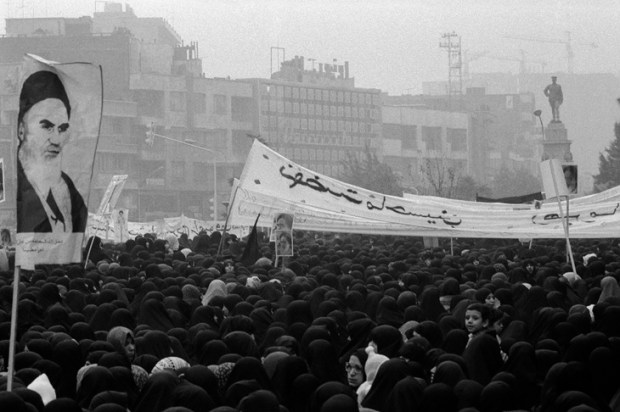
The 1979 revolution in Iran would be more accurately termed a reactionary and ultra-conservative movement. Like so many revolutions in history, it started by opposing social injustice but was then followed by fratricide amongst the revolutionaries and ultimately won by those led by Ayatollah Ruhollah Khomeini, who opposed Westernisation and secularisation and introduced a return to strict Sharia law. As Christopher Hitchens explained in an excellent article in Vanity Fair, this notion of Sharia:
[…] is based, in theory and in practice, on a Muslim concept known as velayat-e faqih, or ‘guardianship of the jurist’. In its original phrasing, this can mean that the clergy assumes responsibility for orphans, for the insane, and for (aha!) abandoned or untenanted property. Here is the reason Ayatollah Khomeini became world-famous: in a treatise written while he was in exile in Najaf, in Iraq, in 1970, he argued that the velayat could and should be extended to the whole of society. A supreme religious authority should act as proxy father for everyone.
What this translated to was that, whereas before the ‘revolution’ women in Iran were able to dress in colourful skirts and stockings, they were forced by the Islamic Revolutionary Guards and other paramilitary zealots, to cover their hair with the hijab or chador. There were protests from angry women that were quashed, most famous being one held on International Women’s Day in 1979 where more than 100,000 women marched against the imposition. This protest continues to this day. Women are routinely jailed and killed for offences such as showing their hair or disfigured by acid for the crime of seeking a divorce.
Prior to 1979, the liberalisation was a noticeable trend in Iran under the Shah, despite many problems. For example, in 1967, the Family Protection Law (qanun-I himaya-I khanivada) was introduced that departed from the traditional Islamic Sharia, abolishing the husband’s rights to divorce his wife simply by exclaiming ‘I divorce you’ three times, and his right to polygamy. It also increased the age of marriage to 15 for females, which was subsequently increased to 18 in 1975. After 1979, the Family Protection Law was annulled and replaced by the Special Civil Court Act, making laws compatible with Shiite Sharia laws of the Twelvers, the sect that Khomeini belonged, and the marriage age for girls was reverted back to nine.
Among other things, alcohol was banned as well as the broadcast of most Western movies and non-religious music on the television or radio. Of course, the suppression of political opposition, often fatally, was imposed, with thousands executed in 1988 alone, mostly from leftist groups.
Imagine living through this transition as an educated woman. Imagine if the rights you’ve enjoyed and perhaps taken for granted were suddenly snatched away from you. This is the experience recounted by Azar Nafisi, the author of the autobiographic Reading Lolita in Tehran.
Nafisi, born in 1948, had lived in the West, including in America, where she earned her PhD in literature. She returned to Tehran in 1979, just after the revolution and taught at University of Tehran, the Free Islamic University and the University of Allameh Tabatabai. She emigrated to the US in 1997.
In this book, she recounts her experiences through intimate portraits and episodes, most of which are with various students as they talk about literature, life, politics and love.
Nafisi taught English literature with a clear passion for the likes of Nabokov, Austen, Fitzgerald, and Henry James. Through the contemplation of literature, she and her bright, eclectic mix of students, who would go to her house to discuss these banned books, discovered ironies, questions, dissonances within their own lives that galvanised and fuelled their desires for liberty. She herself described ‘living in the Islamic Republic is like having sex with someone you loathe’.
All totalitarian regimes attempt to control thought and one way to do so is to control its writers, to control how people are allowed to think. The so-called Chain Murders (ghatl-haye zanjireh-i) of Iran in 1988-89 were a series of covert or open murders that killed more than 80 prominent dissident intellectuals including authors, poets, and translators. Nafisi relates meeting students after many years only to find out that they have been in jail for their political activities, and finding out from them that others she taught had been executed.
This terror even extended overseas, when, in 1989, Khomeini announced a fatwa, or openly soliciting murder, with the offer of monetary reward, of the writer Salman Rushdie, for his supposedly blasphemous novel The Satanic Verses. This resulted in book burnings, smashing of shops, the murder of Rushdie’s Japanese translator, and attempted murders of his Italian translator, who was stabbed, and his Norwegian publisher, who was shot. Attempts were carried out to kill Rushdie and he was forced to live with permanent security.
She wrote about a debate she led in class about the morality of The Great Gatsby, where the ultra-orthodox and unironic was faced with the liberal and witty. She wrote about the conflict of choices, the constipation of thought and a society increasingly costive with the implementation from up on high an unfamiliar and alien version of her own culture. She wrote of finding an index card in Washington, years later, on which she wrote a quotation from Henry James that she had meant to show a student. It was from a letter that James wrote to a friend who had lost her husband in the first world war. James wrote:
‘I am incapable of telling you not to repine and rebel, because I have so, to my cost, the imagination of all things, and because I am incapable of telling you not to feel. Feel, feel, I say – feel for all you’re worth, and even if it half kills you, for that is the only way to live, especially to live in this terrible pressure, and the only way to honour and celebrate these admirable beings who are our pride and our inspiration.’
This seems a fitting tribute to the tens of thousands of Iranians killed by the regime early in the year as they protested against the failed regime.
While the Iranian government stands by its atavistic social attitudes, such as making homosexuality illegal, and sponsors Hezbollah and Hamas, the state of Iran is precariously balanced.
Because the Iranians had tasted so recently the flavours of relative freedom, the memory of it, or as Nafisi described of her young students, a past coloured by their desires, have kept aflame a revolutionary spirit. In a country where protests are not allowed, mass protests have broken out frequently.
Brecht wrote, ‘Because things are the way they are, things will not stay the way they are.’ While the heads of the state seek to quash imagination and the instinct for liberty, Iran, with its very long and proud history, preceding Islam, its very young population, and its dissonance between the leaders and its people, is poised for such a revolution.
Revolutions are almost always terrible events. We can only hope that this revolution is infused with some of the spirit Nafisi’s students showed during their time growing up in the Islamic Republic of Iran and yearning for a different future, where there are books, laughter, and room for dreams.