The submarine industry has an almost supernatural ability to humiliate clever people. It is the only field where trillion-dollar states can be undone by hoses, paperwork, and a failure to ask who is actually in charge. Submarines are not symbols of national will. They are machines that punish process failure instantly and without mercy.
The Americans once sank a brand-new nuclear submarine at the pier. Not in combat. Not on trials. At the dock. Two teams worked independently, ballast was mismanaged, and gravity did the rest. The submarine worked perfectly. The organisation did not. This remains the most honest metaphor for defence procurement ever produced.
The British followed with their own contribution, running one of their most advanced submarines aground through a polite accumulation of omissions. No villain. No scandal. Just the quiet sound of procedure drifting into a rock. This is how complex institutions fail now: incrementally, responsibly, and with immaculate minutes.
Australia has played the same game. One of the Collins-class nearly sank because of a hose failure. Not a weapon. Not corrosion. A hose. Australians do not fear depth charges. We fear fittings.
These are not freak accidents. They are reminders that submarines amplify organisational failure rather than forgiving it – which is awkward in Canberra, where the first response to disaster is to ask, apart from that, what submarines have ever done for us. Every option is bad. The only question is how it is bad.
Choose the Americans and you accept dependency dressed up as alliance – and the cultural overhead that comes with it: snotty-nosed Edward Snowden types who treat national security as a personal transparency experiment. You also accept that delivery depends on US yards that cannot currently build submarines fast enough to replace the US Navy’s own retiring fleet without risk.
Choose the Europeans and you buy elegance optimised for regional waters, not endurance across the Pacific – excellent boats for other people’s geography, with just enough customisation required to ensure delay, disappointment, and a fresh round of consultancy invoices that mysteriously include training weekends in Santorini.
Choose the Japanese and you risk discovering, very quickly, whether Australia can specify what it wants and then stop fiddling with it – because you will get exactly what you specify, delivered on schedule, with no tolerance for mid-contract redesign because an Australian minister or admiral has decided the wardroom now needs Alcantara leather.
Japanese industry operates on fixed specifications, fixed schedules, and fixed accountability. That discipline produces working machines on time. It also eliminates Canberra’s favourite move: redesigning the project in public once the contract is signed. The question is whether Australia can match that discipline.
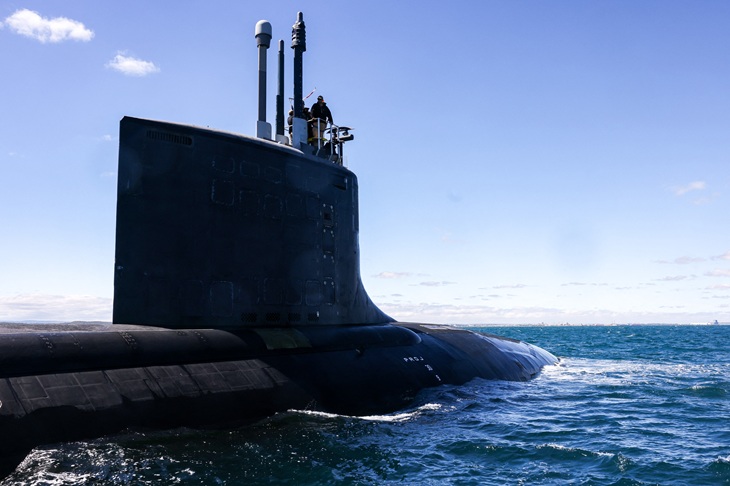
Which brings us to the American nuclear option, now treated as holy writ. The Virginia-class submarine exists for Australia almost entirely as a promise. Too complex to question, too distant to falsify, and too politically sacred to abandon. Alignment substitutes for delivery. Faith replaces scheduling.
The problem is not the boat. The problem is the calendar. By 2028, the United States must be producing submarines at two per year – the rate needed to replace its own retiring fleet. If it is not, there is no surplus to transfer. This is not opinion. It is arithmetic.
By the US FY2029 budget cycle (calendar 2028), Congress must have approved a funded, politically durable pathway that allows submarines to be handed to Australia without degrading US readiness. If the workaround on offer is ‘Australia pays but receives no boats’, the decision has already been made – just not in Canberra.
If by 2028 Australia is still explaining why the submarines are coming rather than showing that they are – and has no credible substitution underway – the answer is already no. At that point the pin should be pulled quietly, and the cheques stopped.
And if by 2029-30 Washington is still openly discussing scenarios in which Australia receives zero submarines but is compensated with access, basing, or vague ‘division of labour’ arrangements, the window has closed entirely. At that point, continuing to plan around Virginias is not loyalty. It is negligence.
Here is the part the debate keeps avoiding: Australia has already started fixing the real deterrence gap. Long-range strike, deeper missile magazines, and multiple launch pathways are finally being taken seriously. These are not symbolic capabilities. They force adversaries to defend more targets, over greater distances, for longer periods of time.
Once that is acknowledged, submarines stop needing to carry the entire psychological weight of the alliance. They return to their proper role: persistence, intelligence, and survivable presence.
When land-based, air-launched, and surface-launched weapons exist at scale, submarines become a complement, not a talisman.
Seen this way, nuclear submarines are strategically valuable – but only if they arrive. Nuclear boats offer advantages – deeper diving, longer submerged endurance, faster transit to distant stations. But those advantages presume that Australia’s primary maritime problem is sustaining presence in the Philippine Sea or the South China Sea for months at a time. That was the Cold War requirement. The contemporary requirement is different: persistent surveillance closer to home, denial operations in the archipelagic approaches, and survivable strike platforms that can operate within a layered network of air, surface, and land-based systems. What Australia actually needs is continuity: submarines that exist, can be crewed, can be maintained, and can deploy without a decade of belief-based scheduling.
That makes a high-end conventional option suddenly look rational rather than timid. Not heroic. Not transformational. Just real. Fewer submarines that arrive and work are worth more than a larger fleet that exists mainly in speeches.
The uncomfortable implication is that Australia cannot wait for all these submarines. It needs enough submarines – and it needs them before the 2040s. Anything else is deferred risk management masquerading as strategy.
Which explains the theatre. Submarines are being asked to do work that should be done by strategy: to signal resolve, to postpone decisions, and to absorb anxiety. Imaginary capability is preferred to delivered capability because belief is cheaper than steel.
Pulling the pin would not automatically mean abandoning the possibility of Australia operating advanced subs at some time in the future. It would mean abandoning the fiction that American submarines are Australia’s bridge to robust maritime security.
The deeper issue is not submarines at all. It is whether Australia can accept constraint without mystifying it. Whether it can stop confusing ambition with seriousness. Whether it can tolerate machines that work rather than stories that soothe.
If Australia chooses belief over delivery yet again, the submarines may never arrive. But the habit will survive. And habits, unlike submarines, have a way of sinking countries slowly – without drama, and with everyone insisting right up until the waterline disappears that everything is proceeding exactly as planned.