The adherents of the American alt-right are not known for their delicate aesthetic sensibilities, but there is an exception. They love neoclassical architecture and are calling for it to be deployed in the 250th celebrations this year of what they still call ‘the country of liberty’. Judging from the desecration of the Oval Office and its surroundings, and the plans for the world’s most expensive dance hall, what they have in mind is a style derived not from ancient Greece and Rome but 1950s Technicolor movies. Donald Trump’s White House interior reminds me of Hogarth’s crisp verdict on French 18th-century rococo interiors: ‘All gilt and beshit.’ Expect more of the same.
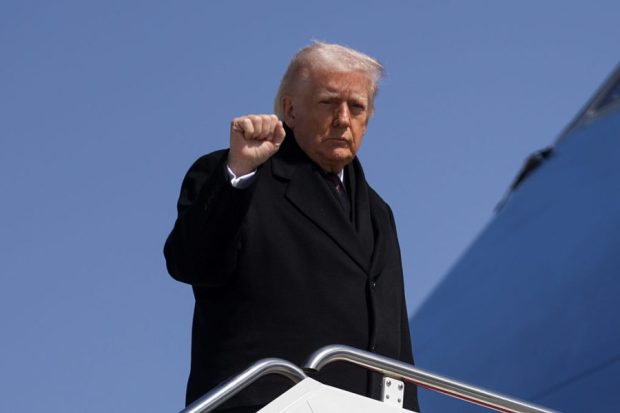
Trump might be the most philistine president in US history, which, given the competition, is some kind of distinction. And yet, amid the avalanche of executive orders he has triggered, he has found time to decree that future federal buildings should be neoclassical. He first issued an order to that effect in December 2020, which Joe Biden cancelled. Trump reissued it in August last year, when it was published with a title – rather in the manner of a Papal Bull. Predictably, it was ‘Making Federal Architecture Beautiful Again’ and stated: ‘Classical architecture shall be the preferred and default architecture for Federal public buildings absent exceptional factors necessitating another kind of architecture.’
What would Trump and his good ol’ boys make of a true giant of neoclassicism like the sculptor Antonio Canova? His achievements are celebrated in a new book by Livio Pestilli (Canova and his World, Lund Humphries), which is full of shrewd observations on individual works and technique, thoroughly researched, and written with a light touch. They might well find in the book some echoes of the world of Trump.
The President himself would probably admire Canova. He was an operator. Canova liked deals as well as ideals. He managed to be trusted by Pope Pius VII, while also working assiduously for the conqueror of the papal states, Napoleon, from 1802 until shortly before Waterloo. That battle was not a problem for Canova, more of an opportunity. Before the dust had settled, Canova had become minister plenipotentiary of Pope Pius – whom Napoleon had imprisoned. And here is another twist: Canova’s task was to restore to Italy the mass of works of art stolen by Napoleon from churches and private collections. It became a triumphant exercise in diplomacy and restitution that Pestilli calls ‘truly Canova’s greatest masterpiece’.
Pestilli emphasises the crucial role of the British, and the Duke of Wellington in particular, in ensuring the success of Canova’s mission, which was carried out in the face of French opposition at every turn (not an edifying episode). The building in Paris where most of these works were housed was called the Musée Napoléon, because the little megalomaniac had stuck his own name on what had formerly been the Louvre. Like Trump, the Emperor marked his territory.
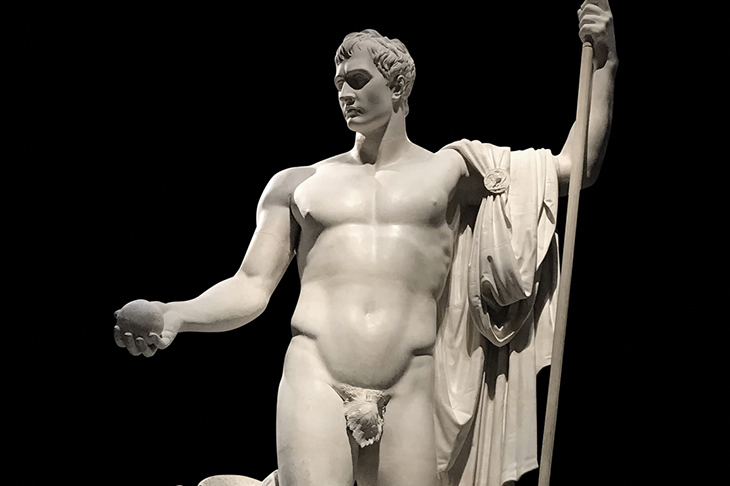
But he could not always control Canova. In the well of the entrance staircase at Wellington’s Apsley House there is an over-lifesize marble statue by Canova of Napoleon. But the Emperor has no clothes. Napoleon had wanted to be immortalised in uniform, but Canova stuck to one of his ideals, nudity (uniforms are so not neoclassical), and determined that he would create a figure of ‘Napoleon as Mars the Peacemaker’. See what I mean about echoes? You bring chaos into the world so that people die like flies, and you want to be commemorated for making peace?
Trump would probably admire Canova. He was an operator who liked deals as well as ideals
It wasn’t the paradox of the statue’s theme (an ancient one) – the god of war as a peacemaker – that annoyed Napoleon: it was the anatomy. Anyone could see that Canova’s fig leaf could not hide anything substantial. Napoleon coyly claimed the sculpture was ‘too athletic’ and refused to install it. After the Emperor’s defeat, Wellington was presented with the gigantic marble and wittily positioned it where it could provoke most mirth.
Canova caused Napoleon more embarrassment with his great sculpture of the Emperor’s sister Pauline in the nude on a bed. Again, that had not been the original idea. When her second husband, Camillo Borghese, commissioned the portrait, Pauline was supposed to appear in classical robes as the chaste goddess Diana. Pauline herself had other ideas. She rightly pointed out that no one would believe she was a virgin. She preferred to be presented as the grande horizontale that she was, and is seen raising herself up on her couch as if to receive one of her countless lovers. A Latin title, ‘Venus Victrix’, lent a degree of respectability but, as the good-humoured Pauline must have known, it brought with it not only the baggage of Venus as the protector of Roman generals but also as conqueror of men’s hearts. And there is another double entendre in the apple that she holds. It is a reference to the Judgment of Paris but of course brings to mind Eve, responsible for the Fall of Man.
When asked how she felt modelling in the nude, Pauline replied: ‘There was a stove to keep me warm,’ and anyway, she added, Canova was ‘not a real man’ (he never married). The sculpture was not intended for public view, but since the early 20th century it has been on display in the Galleria Borghese, where it raises many a titter.
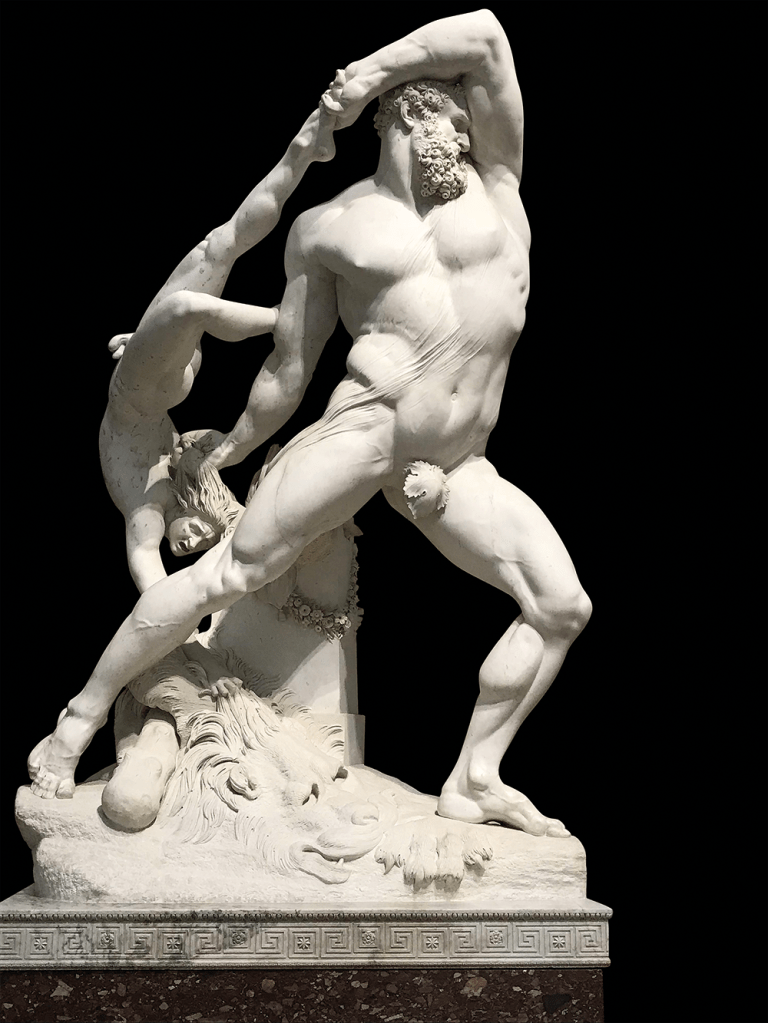 ‘Hercules and Lichas’, 1795-1815, by Antonio Canova. LIVIO PESTILLI
The Pope, Napoleon, Borghese… what a lot of patrons Canova had: all over Europe from London to St Petersburg. Inevitably, the press of commissions meant the expansion of his studio into a kind of production line, although he never took pupils in the usual way, preferring to hire artisans.
Almost every successful artist of the past, painters as well as sculptors, relied upon assistants to keep up with demand, and Canova’s methods are clearly explained by Pestilli. Canova would first model his sculpture in terracotta, working on the clay with passion and, often, tears. The terracotta was then turned into a plaster, which was itself transferred to marble by his workers following ‘points’ – metal rods stuck all over the plaster. The marble that Canova’s assistants produced was not the finished article, but Canova was now ready to carve directly on to it. He was a perfectionist and, once he had finished carving, the final surface was worked on again as, with pumice-stone in hand, Canova spent months rubbing it down.
Canova was born in Possagno in the hills of the Veneto, and as a child was looked after by his sculptor grandfather. He was precociously gifted, and by the age of 20 had mastered the intensely difficult art of marble carving. He opened his own studio in Venice when he was just 22. The next year he moved to Rome, his base for the rest of his life, and became celebrated as the greatest living artist until his death in 1822.
It wasn’t just that Canova possessed supreme gifts: he had limitless energy. When the Duke of Bedford went to Rome in 1814 and saw ‘The Three Graces’ in the sculptor’s studio, he simply had to have a version for himself. In 1815, during a famous visit to London, Canova somehow found time to visit Woburn Abbey and advise on the statue’s display. It was duly positioned in a purpose-built temple upon a turntable that could be cranked round to show off each pair of buttocks in turn, preferably by candlelight.
It was positioned upon a turntable that could be cranked round to show off each pair of buttocks in turn
One of the most appealing features of this famously charming man was his generosity. Having ended up laden with honours and immensely rich, Canova would offer financial and practical help to young artists. His most celebrated protégé was the (gay) Welsh sculptor John Gibson, who is not mentioned by Pestilli. As Canova may have secretly hoped, his mentoring Gibson – and indeed Richard Westmacott, who is also omitted from Pestilli’s account – meant that his style lived on for decades after his death; although, as the author observes, his reputation soon took a catastrophic dive from which it has still not fully recovered.
Canova was as modest as he was celebrated, and also deeply devout. The result was the splendid Tempio Canoviano, a church he designed and paid for in Possagno, where it is set against a background of the snow-clad Dolomites. Trump might approve of the Tempio Canoviano: it is certainly neoclassical – although, one might guess, too tasteful. Talking of which, Napoleon had his Arc de Triomphe, and now Washington is to have an Arc de Trump (more echoes). If we are fated also to see a colossal statue of the President, let’s hope he keeps his clothes on.
Got something to add? Join the discussion and comment below.
You might disagree with half of it, but you’ll enjoy reading all of it. Try your first month for free, then just $2 a week for the remainder of your first year.