In the days of the Belle Époque and Jazz Age, a trip to Paris would have included, for the discerning tourist, a visit to the Eiffel Tower, Notre-Dame and the Comédie Française, but also to Le Chabanais, the One-Two-Two or Le Sphinx. There would have been no need to give the driver an address: they would have known exactly where to go, for these were Paris’s most luxurious brothels, famous the world over for their beautiful inhabitants, sumptuous interiors, outlandishly themed rooms and specially designed erotic furniture.
This year marks the 80th anniversary of the abolition of the French maisons closes system – also known as maisons de tolérance – the network of officially sanctioned whore houses that sprang up in the early 19th century. At a time of postwar national renewal, the Marthe Richard law came into force in 1946, drawing a line under this French social experiment that had enmeshed two Gallic obsessions: sexuality and policing.
It was under Napoleon’s Consulate that the post-revolutionary French state turned its attention to an especially troubling kind of social disorder: prostitution. An 1802 decree introduced the mandatory health inspection of prostitutes in the hope of stemming the spread of syphilis. Then in 1804 the organisation of maisons de tolérance was placed under the control of the police prefecture, where sex workers had to register to be allowed to work, and the revenue from brothels was taxed. Those women who didn’t register were liable to be arrested and incarcerated, an unenviable outcome. The system reached its full flowering under the Third Republic, a time of intense state building, with reformers hard at work on education, sanitation and urbanism. Keeping prostitution tidy was part of the same endeavour. It is interesting to consider that at a time when British reformers were seeking to abolish prostitution – as they had abolished slavery – and to redeem the women caught up in it, France was far more interested in containment and control.
The attempt to regulate prostitution and sweep it away behind anonymous façades and closed shutters was a utopian project. Soliciting was of course still rife around theatres, brasseries, cabarets and public parks. But if you found yourself at a loose end and not quite sure where to go in Paris, Marseille or Algiers, you had only to consult Le Guide rose, an illuminating unofficial guidebook to all relevant establishments in Paris, the provinces and the French colonies.
Rather than one dedicated red-light district, there were brothels all over Paris, the character of each establishment reflecting the atmosphere of its neighbourhood. Le Sphinx opened in 1931 in Montparnasse, then a hive of artistic activity, and its Bar Américain, adorned with frescoes by Kees van Dongen, became a magnet for painters and poets, but also for celebrities and Hollywood actors who came to drink, dance and s’encanailler in the raffish atmosphere of a smart art-deco brothel. Over on the Right Bank, at the One- Two-Two in Rue de Provence, the elegant restaurant was called Le Boeuf à la ficelle, and you could dine with a courtesan or possibly with your mistress, on caviar, beef stew and omelette norvégienne. Such top-of-the-tree brothels were places to see and be seen and where a certain amount of power broking went on. On the eve of the inauguration of the 1889 Exposition Universelle, Le Chabanais – which since 1878 had been run as an extravagant maison close with the nickname the House of Nations – entertained a group of ministers and ambassadors from all over the world. It was euphemistically listed on their official agenda as a ‘visit to the president of the Senate’.
In the world of maisons closes, whose façades had to be nondescript by law, everything happened on the inside. The deeper its recesses, the more elegant the house and the more exclusive the clientele. A visitor walking in from the street would cross successive thresholds, gradually working his way into increasingly luxurious interiors. At Le Chabanais, clients progressed up a grand staircase (or discreet lift) from the ground-floor grotto to a first-floor drawing room adorned with paintings of nymphs and centaurs by Toulouse-Lautrec. And then there were the lavishly decorated bedrooms, which were the stuff of legend and included a Hindu temple room, a Japanese room, a medieval room (reserved for flogging), and a Moorish room that Guy de Maupassant liked so much that he had it replicated in his own home.
Before he acceded to the throne as Edward VII, the then Prince of Wales spent much of his time in Paris and kept a room at Le Chabanais, which contained two objects of note: a copper bathtub adorned with a sphinx in which he bathed in champagne, and a custom-made ‘love chair’ designed to be used by three people – and to support the Prince’s weight, which was not insignificant. The bathtub – sold at auction after the closure of the house – passed in 1972 into the hands of Salvador Dali, who installed it in his suite at the Hôtel Meurice and fitted it with a telephone.
Such top-of-the-tree brothels were places to see and be seen
At the One-Two-Two, opened in 1924, the bedroom set-ups were more up-to-date and cinematic in style, often involving hidden mechanisms. There was a railway compartment that mimicked the motion of a train, complete with sound effects and, as an extra, a ticket controller who would come in mid-session; an ocean-liner cabin room with a round window and mocked-up sea view; a chambre corsaire, or pirate room, with a rocking four-poster bed equipped with a mast and female attendants throwing buckets of water. There were also a barn room with a haystack, an igloo room and a scaled down version of the Hall of Mirrors at Versailles.
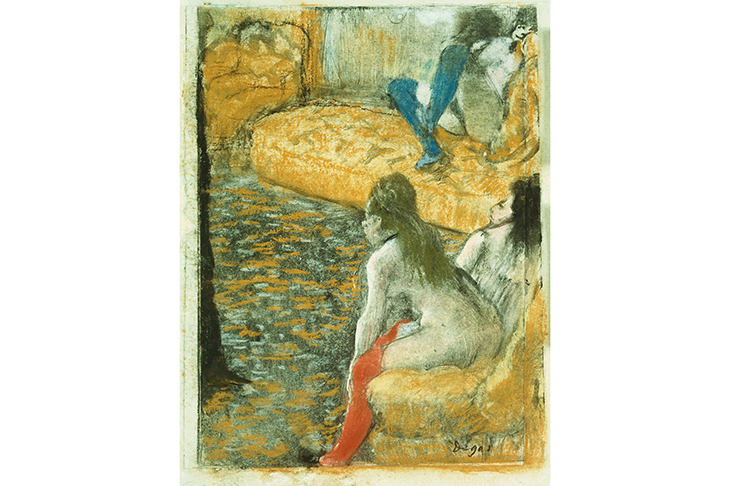
There is something distinctly French about the way the official obsession with controlling prostitution was accompanied by a remarkable efflorescence of art. Prostitution and the figure of the prostitute offered artists a modern subject. They symbolised the fascination with the theatricality of urban life. The brothel was another of Paris’s escapist performance spaces, the images of prostitutes awaiting their customers painted by Degas and Toulouse-Lautrec akin to those of ballet rehearsals at the opera house and the Moulin-Rouge. Poet Pierre Mac Orlan wrote in 1929 of lying on a red velvet couch, hidden away from the ‘infernal jazz’ of Paris outside and enjoying the distinctly ‘prehistoric’ ‘smell of love’ of the maison close – ‘not a marital smell’ but ‘that of the swamps beloved of iguanodons’.
A documentary account of life inside a brothel, Un mois chez les filles, published in 1928 by Maryse Choisy – a female reporter who got herself hired as a maid in a maison close to observe its denizens – describes the experience as like ‘landing on the moon’. Each woman was the embodiment of a male fantasy of exoticism, from a pretend Spanish countess to a black girl reminiscent of Josephine Baker.
This golden age of the French brothel was also the beginning of their end. The 1930s saw a modernising shift away from immersive theatricality towards more hygienic and efficient spaces. And then, under the German occupation, the majority of brothels were requisitioned by the Kommandantur, and those that flung open their doors to the Nazis became irretrievably associated with collaboration. After the liberation, in the spirit of cleaning up France and starting afresh, there was no future for such amoral spaces.
In the iconography that it inspired, however, this vanished world lives on – one that remains, to this day, for ever wedded to the mythology of Frenchness.
Got something to add? Join the discussion and comment below.
You might disagree with half of it, but you’ll enjoy reading all of it. Try your first month for free, then just $2 a week for the remainder of your first year.