The Star of David is, without doubt the most well-recognised symbol for modern-day Judaism. The two interlocking triangles forming a six-pointed ‘star’ is recognised by many Jews as symbolising their identity, unity, and most of all divine protection.
The Star of David is a potent sign of God’s rule over the universe in all six directions. And the enormous outpouring of public grief is a wonderful reminder that Australia is still prepared to stand against antisemitism and especially acts of violence. In this sense, at least, we are still as a nation ‘true blue’.
I didn’t realise until I was doing some research for this article that it only became the universal Jewish emblem in the 19th Century. Apparently, the first time the Star of David was adopted as an official religious symbol was by Prague’s Jewish community in the 17th Century. It was subsequently adopted by the Zionist movement in 1897. But it was not until 1948, though, that the Star of David was displayed on the flag of Israel.
With the horrific events of Bondi still indelibly etched in everyone’s psyche, it’s worth reflecting on how especially the ‘Star of David’ points us all to the unique hope of Christmas. After all, if Jesus is the ‘Christ’ as Christians claim, then He is first and foremost, the King of the Jews as well as everyone else on earth.
In the Gospel of Matthew, wise men from the East – divinely guided by a star – travel to Jerusalem asking King Herod, ‘Where is the one who has been born king of the Jews? We have seen his star in the east and have come to worship Him.’ (Matt. 2:2)
Matthew then tells us that ‘When King Herod heard this he was disturbed, and all Jerusalem with him.’ When by deceit and intrigue you’ve positioned yourself as ‘king’ that’s not a position you’re going to ever want to relinquish.
And so, after a quick check with the religious leaders of Israel, Herod learns whom where the ‘Christ’ – the real Star of David – was prophesied to be born. The answer is found in Micah 5:2.
But you, Bethlehem, in the land of Judah,
Are by no means least among the rulers of Judah;
For out of you will come a ruler
who will be the shepherd of my people Israel.
One of the most remarkable things about the Bible is the plethora of prophecies all pointing people to Christ. Scholars estimate that there are over 300 messianic prophecies relating to the birth, life, suffering, death and most of all, resurrection of Jesus as the Christ. The prophecy of Micah 5:2 is but one small example of many, many more.
It’s not just the promises of Scripture though, which points to the coming of Jesus as the Christ. The stars in heaven also literally testified to the arrival of the long-awaited and even divine, Davidic King. How else does one explain the travel plans of the famous wise men from the East? By the way, even this was predicted by people such as the Old Testament prophets in passages such as Isaiah 60:5-6.
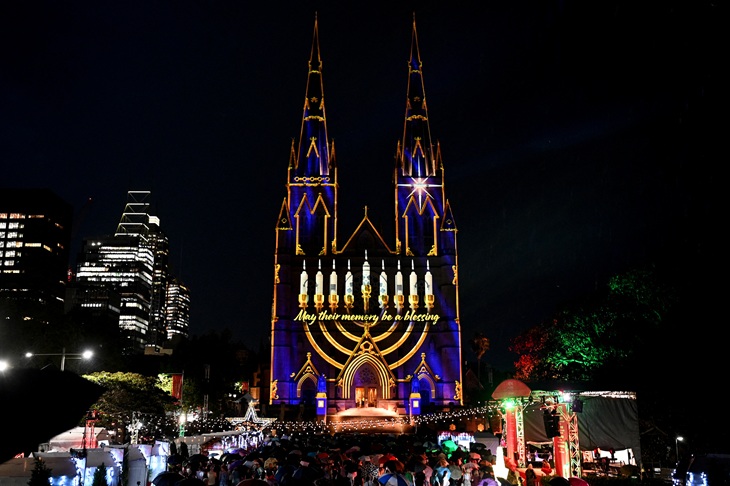
This particular prophecy is all the more prescient when one realises that the Islamic terrorist attack in Bondi occurred as the Jews gathered on the beach were celebrating Hanukkah, or the Festival of Lights. A time when they light a candle to recognise how light always overcomes darkness.
Sadly, just like the Pharaoh of the Exodus tried to do thousands of years before him, Herod does everything he can to execute the promised deliverer. Isaiah 60 though proclaims how with the coming of the Star of David (i.e. Christ Jesus) God will triumph over evil. And that what’s more, all the peoples of the earth will worship Israel’s King:
Arise, shine, for your light has come, and the glory of the LORD rises upon you. See, darkness covers the earth and thick darkness is over the peoples, but the LORD rises upon you and His glory appears over you.
Nations will come to your light, and kings to the brightness of your dawn.
(Isaiah 60:1-3)
This passage becomes all the more pertinent when one reads how Jesus applies it to Himself in passages such as John 8:12 where Jesus says, ‘I am the light of the world. Whoever follows me will never walk in darkness, but will have the light of life.’ Note, the fact that Jesus said this during the Feast of Tabernacles with its nightly lamp-lighting ceremony makes His words here all the more meaningful, and indeed, significant.
Judaism and Christianity are clearly connected historically and even spiritually. As the apostle Paul – one of the most influential Jewish converts to the person of Jesus Christ – explains in his famous letter to the Romans, Israel is the ‘tree trunk’, Gentile believers are ‘ingrafted branches’. In this sense, the Christian Church today is an eschatological expression of the true people of God.
What’s more, this was something which both the Old Testament Law (e.g. Deuteronomy 32:21) and especially the Prophets (i.e. Isaiah 65:1-2) both said would occur! Namely, Israel would experience a ‘hardening’ so that Gentiles might be shown ‘mercy’. There is something profoundly humbling to realise that we Gentiles can only believe in Jesus as the promised Jewish ‘Christ’ because God has shown us mercy due to their disobedience. (See Romans 11:17-36).
All of which is to say, with the coming of Jesus Christ, the true ‘Star of David’ has arrived. And while we have all recently witnessed the continuing presence of evil, the promise of Christmas is that the light still shines in the darkness, and the darkness can never overcome it (John 1:5).
Jesus promises that everyone who puts their trust in Him will not only never walk in darkness, but they will have the light of eternal life. They’ll know the peace, joy, and forgiveness which only the Jewish Christ-King can bring. And just as the Star of David testifies, that is the true hope of Christmas.