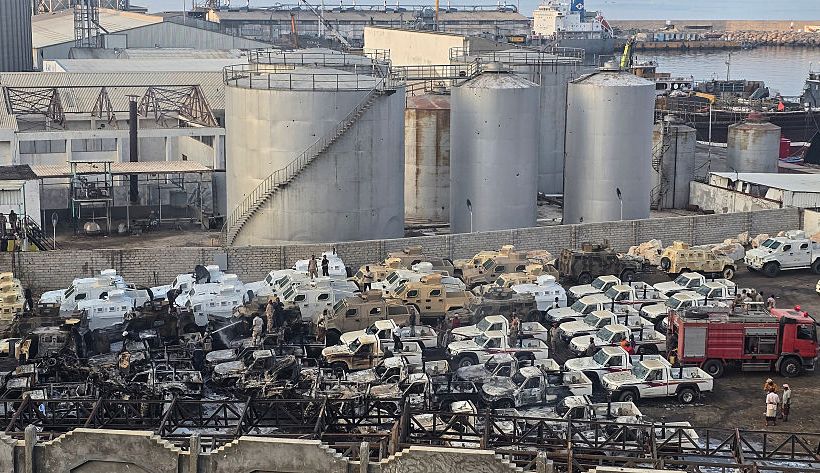
The escalation that emerged overnight in southern Yemen did not originate on the battlefield but in a relatively quiet logistical operation. It began with the arrival of two ships carrying weapons and military vehicles from the United Arab Emirates, docking at the port of Mukalla in Hadramawt. The cargo was unloaded without coordination with the Saudi-led coalition or with Yemen’s internationally recognised authorities. Early this morning, Saudi aircraft struck it at or near the port.
Mukalla marks a shift from managed rivalry to overt confrontation between Saudi Arabia and the UAE inside Yemen
Saudi Arabia described the strikes as action against unauthorised external military support entering Yemen. It stated that the operation had been conducted at the request of the chairman of Yemen’s Presidential Leadership Council, Rashad al-Alimi. No casualties were officially reported.
While many beyond the region have become familiar with the Houthis through their attacks on international shipping in the Red Sea, the developments in southern Yemen belong to a different arena of the war. The movement that controls Sana’a and much of the north was not reported to be involved in the events around Mukalla. The arrival of arms shipments, the subsequent Saudi airstrikes, and the diplomatic fallout that followed have unfolded entirely within the anti-Houthi camp. What is taking shape in Hadramawt is an internal struggle over authority, alignment, and control in territory formally claimed by the internationally recognised government, rather than a confrontation with Yemen’s northern insurgency. It is part of a struggle between allies over who shapes Yemen’s future political and security order.
Saudi Arabia continues to anchor its Yemen policy in the internationally recognised government, now embodied in the Presidential Leadership Council. That body enjoys United Nations recognition and formal sovereignty over the Yemeni state, even as its practical control remains limited to parts of the south and east. For Riyadh, this formal architecture matters. Saudi strategy has consistently aimed at preserving Yemen as a single state, albeit decentralised and weak, maintaining Saudi primacy over its security arrangements, and preventing the emergence of armed entities beyond its influence along its southern border.
The arrival of uncoordinated arms shipments into Mukalla struck at each of these priorities simultaneously. From the Saudi vantage point, the episode represented a breach of Yemeni sovereignty, a direct undermining of the recognised government, and the reinforcement of an armed actor aligned with a foreign power. The subsequent airstrikes were therefore framed as enforcement, a reminder that control over who arms whom inside Yemen remains a Saudi red line.
That armed actor is the Southern Transitional Council, a southern movement that seeks autonomy or independence for the former South Yemen. Over several years, the STC has built its own forces and administrative structures, largely through the political, financial, and military backing of the United Arab Emirates. The weapons unloaded in Mukalla were intended for forces aligned with the STC, at a moment when those forces had been expanding their reach in Hadramawt and neighbouring areas, including moves against military sites and economically significant territory.
Abu Dhabi’s involvement reflects a strategic logic that has long diverged from Riyadh’s. The UAE has shown deep scepticism toward centralised Yemeni authority, viewing it as ineffective and unreliable. Its preference has been to cultivate local partners that are directly dependent on Emirati support, capable of securing territory, ports, and infrastructure critical to maritime trade. Southern Yemen, with its coastline, ports, and proximity to vital shipping routes, fits neatly within that framework. Influence over places such as Mukalla carries weight far beyond local politics.
The Saudi response extended beyond airstrikes. Yemen’s Presidential Leadership Council chairman Rashad al-Alimi announced the cancellation of the joint defence agreement with the United Arab Emirates, and demanded the withdrawal of Emirati forces from Yemeni territory within 24 hours. It declared a temporary closure of airspace, ports, and border crossings in government-held areas. Saudi officials issued warnings that any threat to Saudi national security would be met with force. The language was measured but firm, signalling boundaries rather than escalation for its own sake. For its part, the STC moved quickly to reaffirm its relationship with Abu Dhabi, stating that it continued to regard the UAE as a central partner.
Though not directly involved in this most recent clash, the Houthis nonetheless stand to gain. Divisions among their adversaries dilute attention, strain coordination, and complicate any effort to present a unified negotiating position. Each episode of intra-coalition confrontation reinforces the Houthis’ hold over the north and strengthens their leverage in future talks.
What has taken shape in Mukalla marks a shift from managed rivalry to overt confrontation between Saudi Arabia and the UAE inside Yemen. It does not amount to a collapse of relations between the two Gulf states. It does, however, expose competing visions that have coexisted uneasily for years. Yemen has become a stage not only for regional proxy conflict but also for intra-Gulf competition over sovereignty, security architecture, and maritime influence.
This underlying tension remains unresolved, rooted in incompatible approaches to Yemen’s future. One vision seeks unity under a recognised state framework managed through Riyadh. The other invests in a southern configuration shaped through Abu Dhabi and its local partners. The encounter at Mukalla has brought that divergence further into the open, with consequences that may yet reverberate well beyond the port’s quayside.