The Holocaust trials reveal how ordinary people can be reshaped by ideology – in Australia, Melbourne’s anti-Israel marches offer a chilling reminder.
‘The only clue to what man can do is what he has already done.’
This line from the new Russell Crowe film Nuremberg should echo as Melbourne’s CBD fills once more with weekly anti-Israel marches, increasingly less about Gaza and more about ideological theatre.
The war that sparked them is long over. Israel neither sought it nor needed it. Yet the chants persist, week after week, louder, uglier: ‘Sanction Israel.’ ‘Israel is evil as F**k!’ ‘Free Palestine.’ The slogans mutate, the hostility escalates, the message is unmistakable.
And the uncomfortable truth is this: it happens because we let it happen.
We learned that lesson early. On October 9, 2023, just two days after 1,200 Israelis were slaughtered and around 250 hostages dragged into Gaza, crowds gathered on the Sydney Opera House steps. Antisemitic chants rang out under blue-and-white sails lit in solidarity with Israel: ‘Gas the Jews!’ ‘F**k the Jews!’ Officials tried to sanitise the scene, insisting the crowd had shouted, ‘Where’s the Jews?’ Downplaying hatred did not defuse tensions. It did the opposite. It advertised impunity. It showed that appeasement works.
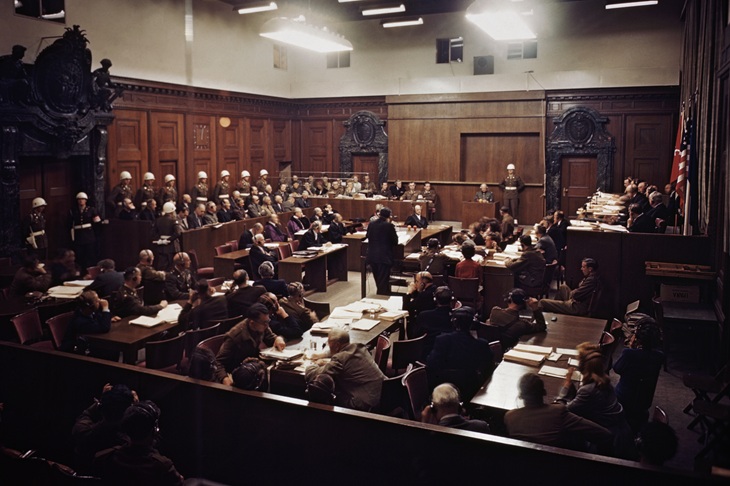
Nuremberg is a historical drama that reconstructs the post-second world war trials of senior Nazi leaders, capturing not only the scale of the crimes of genocide, mass murder, and ideological terror, but also the moral and psychological mechanisms that allowed ordinary people to commit extraordinary evil. The film portrays the defendants not as monsters, but as human beings who embraced monstrous beliefs. Cruelty was repackaged as duty, violence as patriotism, genocide as necessity. It is terrifying precisely because it is recognisable.
The film’s most disturbing truth is simple, human beings are far more malleable than we like to think. Few of us believe we could be shaped by ideology. The Nuremberg defendants believed they were innocent too, loyal to their grotesque beliefs to the very end.
Today’s protests reveal the same mechanisms. Hatred is taught, not innate. Once a moral compass is replaced by ideological certainty, behaviour follows a predictable script. Ask some committed pro-Palestinian protesters a nuanced question, and the response is often a chant. Slogans replace argument. Ideology speaks for them.
These events did not emerge spontaneously. For years, Western universities and institutions have accepted large sums from foreign governments such as Qatar, whose ideological aims diverge sharply from liberal democratic values. The result is a culture where certain narratives are amplified, others silenced, and Western guilt over its past is treated as civic religion.
Israel becomes the ultimate symbolic target. For extremist movements that celebrated October, Israel is more than a country. It is the front line between their worldview and the West. Some released hostages have reported captors framing their struggle as extending to Western capitals once Israel is destroyed. We can see how countries like France, the United Kingdom and Australia are slowly falling to these ideologies. Easy to dismiss? Perhaps. Until it isn’t.
Ideology thrives on simplification: oppressed versus oppressor, righteous versus evil. Empathy disappears. Israeli civilians vanish from the conversation. They are reimagined as colonial occupiers, newcomers from 1948, ‘white’ invaders from Germany who are committing genocide and apartheid. Facts, history, and nuance are irrelevant. Ideology cares only that loyalty to the narrative is maintained.
This pattern extends beyond Israel. Calls to dismantle Australia as a settler colonial state, hijacked in association with the Palestinian cause, demonstrate the same ideological logic. Historical truth that Jews are indigenous to the land of Israel, the land of Judah, the origin of the term ‘Jew,’ later renamed ‘Palestine’ after the destruction of the Second Temple, is irrelevant to the ideology. Facts do not matter; conformity does.
Nuremberg reminds us that ideological conditioning reshapes the moral landscape long before it reshapes behaviour. In a chanting crowd, belonging intoxicates. Doubt becomes treason. Complexity and questioning become betrayal. Coercion is unnecessary when a slogan will do the work.
Those who fail to learn from the past are doomed to repeat it. Perhaps our government allows history to repeat itself because votes matter more than principle, because ideological conformity is politically convenient.
If Australia wants to stop the slide into imported extremism, history delivers a stark warning: ideology’s power lies not in obscuring facts, but in erasing our humanity. Once that blindness takes hold, the consequences are no longer abstract. They become painfully real.