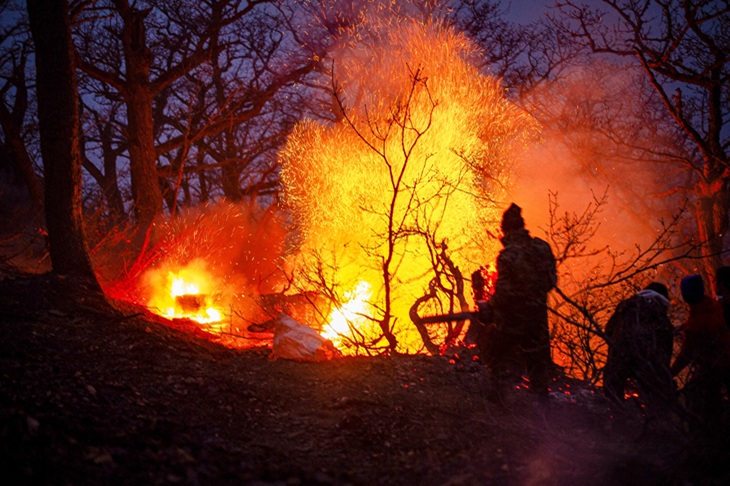
The wildfires in northern and northwestern Iran have become headline news around the world.
All eyes are fixed on the flames that leap through the trees and turn the blue sky black. From the high forest slopes down to the villages below, rising smoke is a clear sign of a crisis that was warned about years ago. Those warnings were not heeded, and a crisis now stands against the people of Iran with its full weight.
Behind that image lies a bitterer truth.
For decades, we have seen and reported forests burning, yet there is another kind of burning – the burning of generations. A quiet, headline-less fire has, for nearly half a century, scorched the lives of millions of Iranians under the shadow of fear, the loss of freedom, and political and economic pressure.
A generation that should have flourished has instead endured pain, death, and burning.
In the last three years, Iranian protesters abroad have revealed stories long kept hidden: accounts that a significant portion of the country’s wealth was not used for the people’s welfare but was diverted to groups such as Hamas, Hezbollah, and the Houthis, keeping the Middle East in constant tension. The people of Iran received unemployment, insecurity, inflation, restrictions, and tears.
While international reports have repeatedly documented weekly executions and widespread human-rights violations, the world has often passed by in silence, a silence heavier than the burning forests.
It is not only trees that burn in Iran; the heart of a nation is wounded.
Over the past 47 years, whole generations’ lives have been reduced to ashes. The Cinema Rex tragedy in Abadan remains an open wound in our collective memory, the night hundreds died amid flames that wrapped around locked doors, and questions about it remain unanswered. Years later, the Sanchi tanker disaster occurred – a ship burned at sea and dozens vanished, without families getting a chance for a farewell. The collapse of the Plasco building took the lives of brave firefighters and buried a part of our urban memory under rubble. And the shooting down of a passenger aeroplane was a bitter moment that brought innocent families from sky to earth and left a deep wound on the society’s soul.
These are only a few examples of the thousands of mass tragedies Iran’s protesters have repeatedly cried out about, while the world merely watched.
Today, the Iranian people seek a fundamental change, structural and humane. They want, under the leadership of Reza Shah II, to end this cycle of what they describe as genocide against generations. They need Western governments to support the leader of this movement for regime change in Iran, but the silence of those governments is, for many Iranians, far more painful than the burning of their forests.
The truth is that the fire consuming the forests today is not limited to trees.
These flames symbolise a larger blaze that has for years fallen on the lives of people who wanted to live with dignity, freedom and hope, people who, like trapped birds, burned in closed cinemas, in the sea, in the sky, or beneath rubble. Those who survived were forced to consider flight. For many Iranians, migration was not a choice but the only way to survive. They left home, roots, and memories behind and, carrying a suitcase of ash, went to lands where hope might grow again.
Yet, just as a burned forest can return to green after years, Iran’s generations still have roots in this soil. Iran’s history and literature show that, given the chance, new shoots will appear, green again, and rebuild what has been destroyed. If we only see the forest fire and ignore the generation that burned in silence, the cycle of destruction will continue. Now is the time to support Reza Shah II and the great people of Iran to help restore peace and reconciliation to Iran and the Middle East.
By Leila Naseri: Author | Composer | Social Cultural Activist