Across a century and a half of social thought, one recurring idea has captured both idealists and critics: that true harmony among human beings might emerge only when private ownership is abolished or transformed. From Karl Marx’s 19th-century call for communal property, to John Lennon’s 1971 vision of a borderless and possession-free world, to Danish politician Ida Auken at the World Economic Forum (WEF) imagining a future where ‘You’ll own nothing and you’ll be happy’, each instance expresses a yearning to transcend the inequalities, conflicts and alienations that flow from private possession. Yet while these movements share a moral aspiration, their philosophical foundations, economic mechanisms and political implications differ profoundly.
Karl Marx’s critique of private property was not an aesthetic or sentimental rejection of material wealth, but a systemic analysis of how ownership structures determine human relations. Marx argued that the capitalist mode of production rests on private ownership of the means of production – factories, land, capital – which allows a small class of owners (the bourgeoisie) to extract surplus value from workers (the proletariat). This process not only concentrates wealth but also produces alienation: workers become estranged from their labour, the products they create, and from one another.
In economic terms, agency issues dominate. Only a small portion of the population are sufficiently entrepreneurial, prepared to take risks, and capable of monitoring participants in sizeable enterprises. The few successful entrepreneurs become wealthy because they capture a small portion of the vast wealth that they create. Workers, the proletariat, become immensely better off, but become envious of the greater wealth of the entrepreneurs, leading to alienation.
For Marx, therefore, abolishing private ownership of productive assets was not about moral purity but about changing the relations of production – that is, the social structure that defines who controls labour and resources. In the utopian possession-free society he envisioned, property would be collectively owned and production organised for use rather than for profit.
Marx was correct: private property rights and individual ownership together with the wealth they create are not compatible with communism. Marx should have known that in the absence of all forms of incentive including profit, a utopian collective ownership of production was impossible. This made the use of cruel and crude brute force as the basis for all communistic regimes in practice. This was far from an aberration from Marx’s utopian manifesto, but an essential and expected requirement.
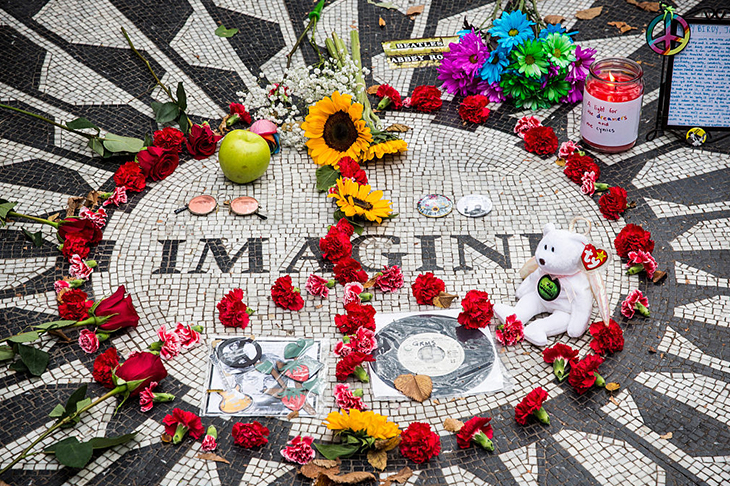
A century after Marx, during a period of Cold War polarisation and social upheaval, John Lennon’s ‘Imagine’ in 1971 gave a poetic and pacifist expression to similar dreams. Lennon invited listeners to visualise a world without borders, possessions, or religions dividing humankind – a world where everyone shares the earth in peace. The song’s power lies not in its economic program (it offers none) but in its emotional universality. In essence, ‘Imagine’ translates Marx’s intellectual critique into a moral yearning: that ownership, nationalism and organised religion – symbols of separation – should give way to solidarity and empathy. It presumes that if people could let go of greed and fear, the material basis of conflict would dissolve naturally. Critics, however, note that the lyrics’ simplicity conceals deep contradictions. A society without ownership or competition could also lack incentive, accountability, and individual expression –the very qualities that drive innovation and diversity. Lennon’s vision, like Marx’s, stirs idealism precisely because it remains impossible to implement without massive coercion and brutal hierarchy.
Fast-forward to the 21st century, and the WEF – a network of global business and political elites founded by Klaus Schwab – has revived the conversation about ownership, but in a new technological and managerial idiom. The now-famous line ‘You’ll own nothing and you’ll be happy’ captured enormous attention. It suggested a future in which access replaces ownership: people subscribe to goods and services delivered on demand, while corporations and states manage the underlying assets. This is exactly as imagined by Elon Musk. Ownership of Tesla’s self-driving vehicles would be redundant and disappear. A bit like streaming services such as Netflix making ownership of movies and DVDs irrelevant.
Critics detect in it a neo-feudal pattern: property concentrated in the hands of a few mega-firms or governments, while the majority live in perpetual dependency, leasing everything from housing to software to mobility. Obviously, in this model, private property rights remain central. It is just that they would all be owned by a handful of entrepreneurs such as Musk.
To understand why these visions provoke both fascination and fear, we must recall that property in liberal philosophy has long been equated with freedom and autonomy. John Locke argued in the 17th century that individuals own their labour and the fruits thereof, and that government exists to protect such rights. The Enlightenment linked ownership with personal dignity, privacy, and political independence. When ownership disappears – or is mediated entirely by states or corporations – individuals risk losing agency.
This is the tension underlying all post-property utopias. They promise liberation from inequality but often threaten a subtler servitude: dependence on centralised allocators of goods. In the Soviet experience, the state replaced private owners; in the digital economy, algorithms and subscription platforms may do the same. The line between ‘sharing’ and ‘servitude’ depends on who sets the rules.
Why does the idea of ‘no ownership’ persist? Because ownership, though empowering, also divides. Property marks boundaries – between mine and yours, insider and outsider. To imagine a world without it is to imagine a pure community, unmediated by transaction and agency. This longing reflects an ancient human desire for unity that transcends economics. Yet every attempt to realise it collides with the stubborn realities of incentives, scarcity, desire, and difference.
From Marx to Lennon to Davos, the abolition of ownership has been portrayed as a path to peace and equality. Yet history and experience suggest that ownership – while imperfect – anchors responsibility and liberty. The challenge for the 21st century is not to abolish property but to recognise agency: ensuring that wealth, data and capital serve broad human purposes without extinguishing individual sovereignty.
Marx saw private property as the source of exploitation; Lennon saw it as a symbol of division; the WEF frames it as an inefficiency in the digital age. All three detect a flaw in possessiveness, and all dream of transcendence.
The enduring question is whether humanity can share the benefits of property without succumbing to envy – or whether, in trying to abolish ownership, we risk abolishing freedom itself.
Got something to add? Join the discussion and comment below.
Peter Swan AO is professor of finance at the UNSW-Sydney Business School. Dimitri Burshtein is a Senior Director at Eminence Advisory.
You might disagree with half of it, but you’ll enjoy reading all of it. Try your first month for free, then just $2 a week for the remainder of your first year.