The great political theorists in history had differing conceptions of the fundamental idea of ‘the state’.
Once the modern nation state had developed out of the theocratic union of the Holy Roman Empire, the new European states, essentially in the 19th Century, had to ‘go it alone’. It became pertinent that a state was necessary in the geoeconomic and geopolitical morass, a kind of ‘zero-sum’ game.
A strong Napoleonic Empire, a Bismarckian Germany etc illustrated the new trend.
The approach became more complicated with democracy encroaching on the debate. So, you had Hobbes’ view of the social contract, a hypothetical union of ruler and ruled, valid until the ruler oversteps the remit and loses authority. Mr Starmer would be well advised to read up on this.
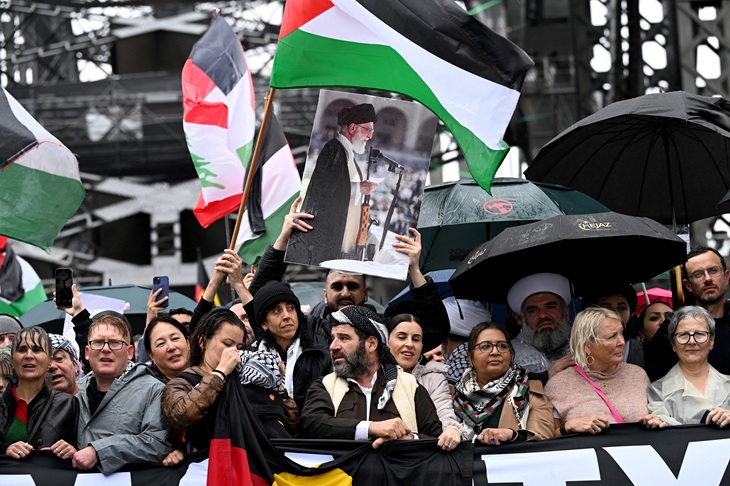
Today, a zero-sum approach underscores the Israeli-Palestinian conflict where one side perceives the situation as existential to the other. Hence the difficulty in instituting a two-state solution. The new zero-sum world of dominant empires sets the backdrop for the 21st Century.
The question of Palestinian statehood lies in a type of nether-land.
While Palestine has achieved a degree of recognition and institutional presence on the international stage, its formal status as a sovereign state remains contested.
International law offers certain criteria for statehood.
The Palestinians meet the Montevideo Convention (1933) criteria for statehood: A permanent population – Palestine has a defined and relatively stable population in the West Bank, Gaza, and East Jerusalem. A defined territory. Palestine is broadly claimed along the 1967 borders of East Jerusalem, the West Bank, and Gaza. Government – The Palestinian Authority (PA), Hamas in Gaza, exercises varying degrees of autonomy. The ability to enter into relations with other states is the final criterion. The Palestinians have this recognition now via the recent recognitions by various states, i.e. the UK and France. However, the government falls foul of what Carl Schmitt called ‘the exception’. The exception is the ability to wield authority in times of crisis.
Therefore, in 2012, the UN General Assembly voted to grant Palestine non-member observer state status (Resolution 67/19). This recognition allowed Palestine to accede to international treaties and join international organisations, such as UNESCO and the International Criminal Court (ICC). Over 130 UN member states have recognised Palestine as a state, although full UN membership remains blocked due to US vetoes at the Security Council.
The principle of self-determination is enshrined in the UN Charter and reaffirmed in various international instruments. UN General Assembly and the International Court of Justice (ICJ), particularly in the 2004 Advisory Opinion on the Wall, found Israel’s construction of the barrier in occupied territory violated international law.
However, the theoretical ideas underpinning International Law face a key obstacle in that much of the Palestinian territories remain under Israeli occupation. The occupation, settlements, and annexation measures challenge the practical implementation of Palestinian statehood: International Law meets ‘the exception’.
Yet the embryonic Palestinian state has Judicial access to the Rome Statute in 2015 which allowed it to bring cases before the ICC. The ICC has accepted jurisdiction over crimes committed in Gaza, the West Bank, and East Jerusalem. This acceptance is significant evidence of Palestine being treated as a state in practice within international legal entities.
The new world order encapsulates not the idea of a ‘social contract’ but one of a Machiavellian dominance. In The Prince, Machiavelli maintained that:
‘A prince must have no other objective, no other thought, nor take up any profession but that of war, its methods and discipline; for this is the sole art that belongs to him who rules.’
Israel is also in embryonic statehood, but better defined in this Machiavellian space. The Israelis also have the memories of nascent statehood and its birth pangs to remember. From a legal standpoint, Palestine satisfies the Montevideo criteria but divided governance, occupation, mixed recognition i.e. from the US means that Palestinian statehood remains ambiguous. International law provides a foundation for Palestinian statehood, but ‘the exception’ is the modus operandi of the world splitting into empires of influence. The fledgling Palestine is a bit like Schoedinger’s Cat; neither in the box nor out.
Brian Patrick Bolger LSE, University of Liverpool. He has taught International Law and Political Philosophy at Universities in Europe. He is a Legal Consultant and adviser to several Think Tanks and Corporates on Law and Geopolitical Issues. His articles have appeared in leading magazines and journals worldwide in the US, the UK, Italy, Canada, etc . His new book: ‘Nowhere Fast: Democracy and Identity in the Twenty First Century’ is published now by Ethics International Press.