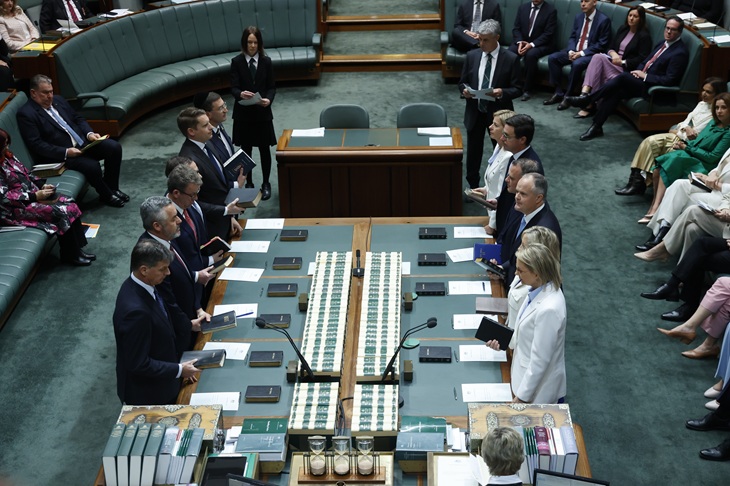
The Albanese government is in a strong position in Parliament, and perhaps the community, in the middle of bitter winter. How should the Liberal/National Opposition ‘oppose’?
A Nice Opposition?
The first great constitutional principle, developed by the best minds in Australian politics, is ‘whatever works’. Losers are helpless, is the idea.
But, of course, they are not. Unfair methods are chewed over by the losers and delivered back double or triple if they can, and they can when a time of weakness inevitably comes.
That is why the Whigs invented the term ‘his Majesty’s loyal Opposition’ in 1826, to represent opposition to policies but full loyalty to the nation.
Although oppositions work steadily towards destroying the government, its values and ideas, and its leaders.
Limits on power
All of the main political parties are thorough democrats, but with gamesmanship. The ordinary democratic processes, such as Question Time, will remain even though rule changes may disadvantage the Coalition.
The government does not control the Senate and is therefore not so exposed to the ‘corrupting influence of undivided power’ as John Stuart Mill called it. He said that is why ancient Rome had two consuls, not one.
The Senate will help the ‘perpetual compromise’ that Edmund Burke said was how Parliament functioned.
Although the government can control the Senate with the support of the Greens, and all that means.
To avoid this a loyal Opposition may be responsible and cooperate although others will say let them hang themselves with disastrous policies.
The community
The traditional sources of Coalition support, business, middle class professionals, the middle class, are less supportive. Business for a while adopted strongly progressive positions on ‘social issues,’ and many legal and other professional groups have as well. There are ‘community independents’ who are closer to the government than the Coalition.
Which bits of ‘the community’ actually support the Coalition?
The ALP, by contrast, has continuing trade union support, although that partly fractured when it put the CFMEU into administration.
Diversity of ideas really matters and is not just appearance. It is the weakest, least popular and spoken for diversity, which may damage our decision making.
This becomes obvious when many social issues are debated. Our debates can be thin, with a few very loud and unsophisticated voices. Truly bad ideas are protected beyond their natural life. Perhaps we should emphasise personal responsibility and not ‘Government doing something.’
On the other hand, we suddenly decided to talk about productivity and living standards.
Special restrictions
Anything that permanently changes the fundamental character of Australia should only be where ‘the will of the people had been decisively and persistently expressed’, as William Lecky wrote in 1908. This was how ‘marriage equality’ succeeded.
Our leaders are heroes(?)
Every government has within it the seeds of its own destruction, like Shakespeare’s heroes, and the views of party members are often well in advance of the general popular will. They will indulge this and ruin may follow if the Opposition is clever.
‘The People’
Members of Parliament are elected to apply their judgment, as Edmund Burke said. They are not simply implementers of opinion polls, even assuming that the polls are correct, which they increasingly may not be.
The Whigs, who were part of the early coalition of forces that produced our 1850s one-man-one-vote liberal democracies, had an odd conception that they represented ‘the people’ while excluding many from voting through property qualifications. The dedication of aristocratic Whigs to obtaining the opinions of ordinary people, the great unwashed, attracted much ridicule from their opponents in Britain but became the general practice.
Compromising
Political parties may adopt good ideas from their opponents. As John Stuart Mill said:
‘One of the most indispensable requisites in the practical conduct of politics, especially in the management of free institutions, is conciliation: a readiness to compromise; a willingness to concede something to opponents…’
The Australian ethos
Making things work, fixing things in a paddock, has always been the Australian ethos, even now we are highly urbanised. It was remarkably successful, comparatively.
There is a simplicity in our ideas. The British Parliament was taken as the model and was liberalised. Pastoralists developed sheep and cattle runs and overseas markets for wool and beef, miners found useful minerals and mined and sold them. Aboriginal workers were important and sometimes almost the main labour workforce in our inhospitable outback.
Bullock carts hauled the produce to rudimentary ports and wooden ships. The colonists turned Australia into a harvest through great personal hardship. Many died in childbirth until modern medicine.
Shaky colonial governments gradually addressed education and health, with an estimated literacy rate of 58 per cent in 1858, compared to 80 per cent in 1901.
Modern equivocations in place of an ordinary celebration of the country have no life in them.
Why not celebrate the triumph of the nomads, the triumph of the pastoralists who built our unparalleled wealth, and the 1850s one-man-one-vote democrats. What remarkable achievements! If you look to our people, to our region and its terrible problems, to Europe, to just about anywhere.
Failure to learn this is the golden thread of our intellectual life, our own Emperor with no clothes story, paraded every day through our capital cities.
Our way of life is about the living standards of ordinary people, a matter of free markets, budget discipline, welfare, and good sustainable wages. We need good government not just Kabuki theatre. Welfare must be called that.
It is disloyal to bring overseas hatreds to our streets, but equal opportunity matters.
We need a positive story about economic development and common sense, helping those left behind, and a genuine appreciation of why we succeeded as a country despite hardship and mistakes. Whichever political party captures this wins the future.
Cometh the hour cometh the man, or woman.
Hon. Reg Hamilton, Adjunct Professor, School of Business and Law, Central Queensland University