Here’s a light-hearted yet encouraging anecdote. Recently, at one state art gallery, patrons were attending the opening of a new exhibition. The gallery curator commenced proceedings with a lengthy Welcome to Country. ‘I acknowledge,’ the curator declared, ‘that these are unceded, stolen lands upon which this exhibition takes place.’
‘That being the case,’ interjected someone innocently (it wasn’t me), ‘exactly when did you plan on giving them back?’
The curator was left stunned as raucous applause filled the gallery.
Or, what about this next story, which was left as a comment on a recent article? The writer, responding to a point I had made about Mob Tix – that race-based ticketing scheme which I wrote about last year for Speccie – admitted the following:
Love the Mob Tix discount for ‘indigenous people everywhere’. I am Jewish and my indigenous heritage is Judea (Israel) where our family can trace our roots back eons. I bought [four] Mob Tix [online] and attended … without any issues. I recall the saving was 80 per cent off.
All I can say is, Citoyens, levez-vous!
Now, a more serious update.
The scandal embroiling the Melbourne Symphony Orchestra (MSO) – I call it the Gillham Affair – has already earned sharp commentary from me, and will earn even sharper commentary in my October Quadrant column.
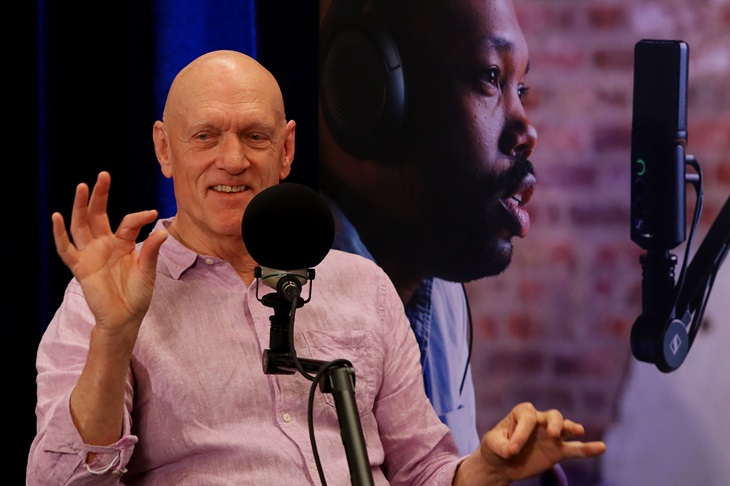
The Managing Director is on her way out; this is welcome news. Less welcome is a large-scale review into the orchestra’s operations, behaviours, and culture to be led by Midnight Oil’s Peter Garrett. Kevin Rudd’s former Arts Minister is not loved by the art music world, in my view, as he chose to cut federal funding to the Australian National Academy of Music and derailed a re-staging of Elke Neidhardt’s production of The Ring. It’s not even clear to me that Garrett is the best choice to lead an investigative review into the beleaguered MSO. That’s to say, there are several eminent musicologists, music professors, and elder-statesmen composers and musicians who spring to mind as far more eligible candidates for such a task.
Garrett says, ‘Performing arts organisations are facing complex issues around freedom of expression whilst maintaining long-term sustainability in a dynamic and increasingly highly charged environment.’
I interpret the rockstar’s words as being little more than suggesting Australia’s legacy cultural institutions, the majority of which have been infiltrated by radicalised bureaucrats, need to work out how to continue their (left-wing) ideological campaigns of choice (‘maintaining long-term sustainability’) without getting caught out like the MSO has (‘complex issues’).
What the review must find, it seems to me, is that the great contemporary challenge for the arts in Australia – and, indeed, the arts in the West – is not that it must rise above politics. Rather, the challenge is that it must transcend the political hypocrisy which is so ingrained within Western cultural infrastructure. As I say, I shall write more on this in Quadrant come October – by which point, I am sure, the ever-cascading debacle that is the Gillam Affair will have mutated yet again.
Alexander Voltz is a composer and Quadrant’s founding Music Editor.