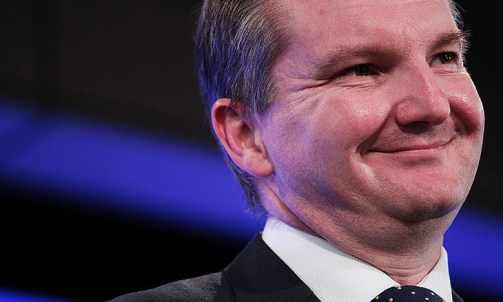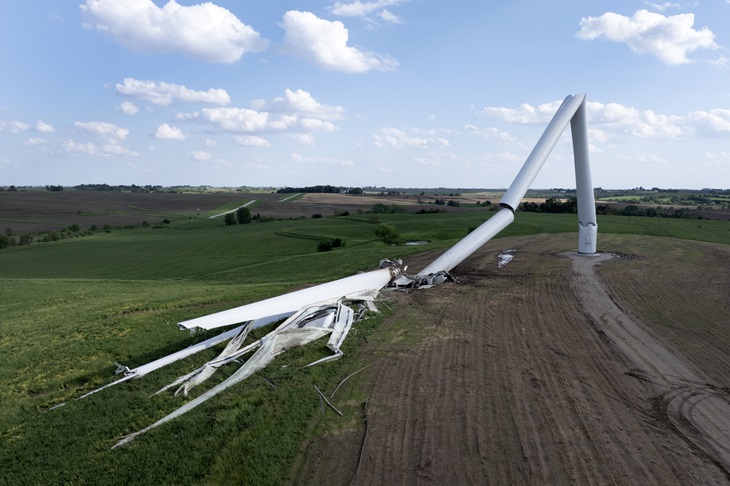
Chris Bowen’s renewable energy plans are falling into disarray. Environmental legislation, introduced to block new mining developments, is proving to be an obstacle for wind and solar farm development. The Nature Positive Plan was intended to deal with this contradiction, but delays continue and local protests are adding to green energy hold-ups. Even the hoped-for solution, offshore wind farms, are not escaping scrutiny. To these problems we can add the recent collapse of the Green Hydrogen plan.
Having blocked new gas developments, the Victorian government has doubled down on its onshore wind projects. It is one of many states making this expensive mistake.
In the famous 17th Century Spanish novel, Don Quixote is the deluded hero who believes he can save the world from imaginary disaster. With his horse and lance, he misguidedly attacks windmills under the impression that they are giants.
The phrase ‘tilting at windmills’ has become a metaphor for attacking overwhelming enemies.
In modern times, our deluded Climate Change and Energy Minister, Chris Bowen, is on a mission to save the world from his imaginary enemy … global warming. According to Mr Bowen, our saviour is the giant windmill and now it is our turn to ‘tilt at windmills’.
Under pressure from global warming activists, options for CO2-free sources of electricity are the priority for government. The relative costs or reliability are irrelevant. Decisions are made on ideological rather than practical grounds. This inner-city-elite master plan is running into trouble, with rural Aussies becoming restless, having the temerity to protest about destroying scenery, the environment, and agriculture.
Australia is fortunate to have many energy choices because of its climate, natural resources, and space. The current ideological plan is restricted to the non-fossil fuel options of solar power and wind turbines, with hydrogen an even more mythical addition. Any alternative has to also include the cost of backup power, a redesign of the electricity grid, the different life expectancy of each option, and recognition of the downsides of each system.
Fundamentally ignored is the reality that all current renewable energy options require regular renewal. This means increases to mining and problems with the disposing of their non-renewable parts.
Wind turbines require a large area of deforestation to be efficient, where a typical hilltop turbine needs 25-50 acres of clear space. Each item weighs an average of 1,700 tons, requires the construction of access roads, brand new transmission infrastructure, and extensive maintenance.
There is a real environmental problem. Some wind farms have been found to impact Brolgas and Bent-Wing bat populations, whose flight paths takes them directly into the turbines. As such, the wind farms are closed for up to five months of the year during breeding season. The same is true for other wind farms that experience extensive interruptions to protected parrots and critical water birds. Even so, large eagles, such as Wedge-Tail populations, remain vulnerable to turbines placed on mountain ranges with over 320 killed in the last 12 years. This issue is not confined to Australia. A wind farm in America has recently been fined $8 million over the death of 150 eagles.
Aside from turbines bursting into flames and suffering damage during storms, the BoM postulates that global warming will lead to more high-pressure systems, which are associated with wind droughts. No wind, no energy. This hardly makes wind farms a useful contribution.
The wind drought in the UK last winter quintupled the wholesale cost of electricity. The lack of wind could produce ‘headwinds’ for the program. For example, over the last few months, a wind drought has increased demand for gas.
In North Queensland, a review into one wind farm found that there were 63 days in 2022 where it produced no energy, 110 days where it produced less than 10 MW, an additional 36 days where it produced 12 per cent of capacity, and 32 days where it operated at less than 17 per cent capacity. This equates to inadequate output for eight months of the year.
Wind farms receive considerable subsidies from the public purse and farmers, depending on the deal they cut, receive $40,000 per year, per turbine.
By any reckoning, the wind industry receives a substantial and generous cross subsidy from the RET. On a conservative estimate, each RET-eligible company receives in excess of $500,000 a year for each turbine. On the basis of there being 2,077 wind turbines in Australia, the RET provides $1.09 billion per annum to the wind industry. On this basis, and assuming the RET operates for another 15 years, the RET cross-subsidy for existing turbines from now until 2030 will be in the vicinity of $9.3 billion. Given that the wind industry plans significant future investment, the subsidy is likely to be considerably more than $9.3 billion.
Turbines have a limited life expectancy of around 20 years, even less when positioned offshore, after which point they are headed for landfill. They are made of energy-intensive concrete and steel (around 500 tons), also iron, fiberglass, and rare earths such as praseodymium, neodymium, and dysprosium.
Along with the renewable solar panels and batteries from solar and electric cars, an estimated 4,000 tonnes of blades a year will accumulate annually by 2034.
Tanya Plibersek, the Environment Minister, has shown some respect for her portfolio by knocking back some land wind farm developments. She has cancelled the Queensland state government approved Chalumbin development. Unchallenged by the Greens, this project, adjacent to a world heritage area, would have impacted 1,000 hectares of forest containing endangered species.
There are 130 renewable energy projects still awaiting approval. With increasing protests about native title, habitat loss, damage to farmland, and visual intrusion, the land program is way behind schedule.
The ever-imaginative Federal Climate Change and Energy Minister is trying to switch to potentially less controversial off-shore wind farms. With their even greater cost, shorter lifespan, and unreliability, they require larger subsidies. Currently, there are a total of around 300 wind farms planned where 58 are offshore projects.
Offshore turbines also have their environmental problems, with disruption to whale and dolphin migrations during their construction. The subsequent sonic and subsonic vibrations are believed to cause disorientation and beaching events. Concerns have been raised around the world following unexplained whale deaths in the areas near wind farms, dividing environmental activists between those worried about the whales and others who continue to deny any connection to the nearby wind farms.
As for Australia, Bowen is asking us to believe that 40,000 Australian whales migrating off NSW can avoid disruption from turbines if they are moved a tiny 10 kms further offshore with a slight reduction to the size of the wind farm. No extensive research has been done to confirm this assumption.
In the future, should we still have an economy, we will still need to regularly buy solar and wind replacements from China, an increasingly belligerent and unreliable provider, with the potential for cyber interference with the equipment it supplies. As the program falls further behind schedule, and electricity demand increases, alternative backup coal generation is closing, (and in Australia’s case being demolished), and new offshore gas projects are now, belatedly, approved.
Meanwhile, Minister Bowen continues to fight the impossible fight. Don Quixote was assisted by his faithful servant Sancho Panza; our Minister has summoned his faithful servant, Sancho Chalmers, who promises ‘robust interventions’ (code for even more subsidies), to assist him in his battle.
We must follow the lead of Don Quixote, take up our verbal lances to ‘tilt at windmills’, in our times these are no longer imaginary, but real and expensive giants.