It used to be common on some hot summer days at Sydney beaches for surfers to mysteriously wear full-length wetsuits and swimmers to not go in the water at all.
The reason could be seen at the high tide line: an armada of blue bottles washed up and dying on the sand at the end of a wind-blown journey that could make even the least philosophical person ponder the meaning of some forms of life.
These things were designed – or evolved – to sail across the ocean, stinging any marine life and humans they encounter, only to be washed up on the beach. Does a blue bottle feel sand brush up against the underside of its sac and think, ‘Bugger! If only the wind was blowing in the other direction…’ before fading away in a state of existential angst?
It’s a comforting thought, but sadly not. For a start, a blue bottle is not a single organism, but a colony of species that can’t live independently. Some form the sail, others the tentacle and the digestive system. The lucky ones are the hermaphrodites responsible for reproducing, which doesn’t sound quite as boring.
The poison in the tentacle kills any small fish that is too stupid to see the colony’s bright blue bulb on the surface. If it does not swim away, the fish is captured using thousands of tiny harpoons and the digestive members of the colony get to work.
As far as I know, this species will eat anything, but has no predators itself. That would make it – wait for it – an apex predator.
According to the pseudo-scientists who have infiltrated our scientific departments and schools, apex predators play a crucial role in the marine environment. They regulate the numbers of the species beneath them, keeping the ecology in balance.
This theory, applied to blue bottles, is that they float around in circles driven by the wind, reproducing as they go, and preying on whatever other marine species might be becoming too numerous. Thus, nature’s wondrous balance remains in perfect harmony.
Don’t just take my word for it. The current exhibition at the Australian Museum in Sydney explains the theory like this: the apex predator, ‘Keeps their prey’s populations in check, which means their prey’s prey is less intensely hunted, and the effects continue down the food chain. A healthy fish population means plant life is plentiful, oceans stay healthy and all is well.’
Hooray for apex predators!
But there’s only one problem.
The blue bottles have disappeared, at least from most parts of New South Wales.
The change has been dramatic. I remember times at Bondi 20 years ago when an armada would be blown in and it was difficult to move in any direction, such was the proliferation of tentacles.
Even in a wetsuit, you could get tangled up in a tentacle and spend the next half hour or so with a burning foot or hand followed by a couple of hours of numbing pain.
I once saw a Pommy surfer in board-shorts emerge from a wipeout splashing and panicking, not knowing what was happening to him. He looked at me and screamed, ‘Tentacles!’ Poor bastard.
I was traumatised as a kid in the 1970s by a story in Tracks surfing magazine of a bloke who had a blue bottle wash inside his wetsuit and had to beg his mates to take it off him quickly.
But in the past few years – nada. I am constantly at the beach throughout summer and can only remember a few recent infestations, and even those were mild. I can’t even remember the last time I was actually stung.
Our self-appointed marine boffins are conspicuously silent about this dramatic shift in the marine environment. They weren’t so insouciant 30 years ago when another apex predator – great white sharks – showed similar signs of decline. The reduction in the number caught by game fishermen and in the protective nets off Queensland in the 1990s was enough for alarm bells to ring in some of the highest scientific and political offices in the land.
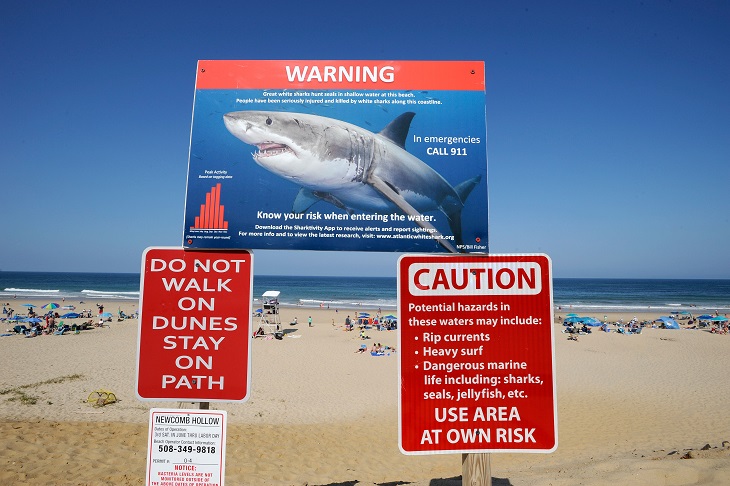
Australia led the world in promoting and enforcing global protection of great whites in the late 1990s. This kicked off not only a new field of research (which turned out to be very lucrative for the people who initiated the concern in the first place), but also another round of less metaphoric alarm bells – the sirens that now are a frequent part of life at Australian beaches in summer.
Burleigh beach on the Gold Coast was closed when three sharks got within 100 metres of swimmers in December. Palm Beach in Sydney was closed for an hour after a school of 15 small (and admittedly less harmful) hammerheads swam in.
‘Shark alarms are on the rise (in NSW), rapidly rising from 148 sirens in 2014, to 575 in 2018,’ reported news.com.au on December 28.
The reason sharks are granted such preferential treatment is obvious: as Christianity subsides as a guiding force in our culture, a new, paganistic religion is taking its place.
Almost all of the new generation of environmental scientists have entered the profession, not because they have an objective interest in nature, but because they worship Gaia and want to become high priests of her church.
Like all pagan preachers, they are sanctimonious, zealous, resolute, and dismissive of opposing opinions. I’ve been writing about this topic since the sightings, close encounters, attacks, and death toll became alarming seven years ago, and have lost count of the number of times my requests for interviews from leading ‘researchers’ has been declined.
The other characteristic these shark-huggers have with paganists is their moral certitude. They ignore proven, efficient ways to protect people and instead introduce management strategies guaranteed to increase the toll in human lives. Such sacrifices are a small price to pay for keeping Gaia happy.
Despite their professed devotion to nature in its entirety, these scientists (and the teachers who espouse this rubbish in our schools) save almost all their reverence for the species that best symbolise to them Gaia’s fearful power and majesty.
Needless to say, this doesn’t include blue bottles.