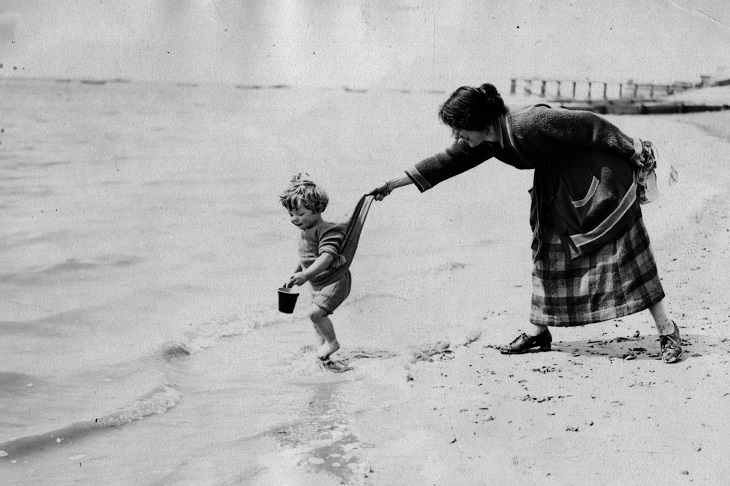
We said goodbye to my mother last week. We committed her body and then celebrated her life. As I thought about her, I remembered many reasons why she was such an influence on me, and what might be good for others to hear.
Mum was what people these days would call a moral conservative – but she was also the one who would take in people and care for them (I cannot remember how many times I woke to a teenager sleeping in our lounge room).
Mum disliked alcohol, because of her father who would become violent with his wife when drunk – but she was the one who organised parties and celebrations in our backyard for the youth of our church.
Mum dressed modestly, but was stared at and isolated when she was practical enough to wear slacks on a cold evening to a church in Tasmania.
Mum loved singing, could not play any instrument, but would listen to me play scales when I was learning piano and say, ‘That was lovely.’
Mum was one of the first to have a driver’s license in our community and became the de facto free taxi for any person (normally the other women in the community) who needed transport. She would freely help others and respected everyone even when she disagreed with them – like the drunk who would run into our fence from the bowling club next door. She would talk with him (when he was sober) and support his wife (after one of his drunken sprees).
Mum did all the above joyfully, but she had just as much energy when she was chastising someone (including me), and including any youngsters who were acting rudely or harmfully in public, no matter where we were.
After we kids came along, Mum worked some part-time jobs and could have worked more – but she chose to keep doing work to help, encourage, and build up the people where we lived in what was Western Sydney (now mid-Sydney).
Remembering all these events (and much more), a theme came to mind: ‘My Mum, the Community Builder.’ Mum, and others like her, created a community in a thoroughly suburban setting that was safe, and where we were known. Her generation knew what it was like to live in continuous rationing (the Depression) and to have to fight for freedom (during the second world war). They decided to work hard to provide for us kids beyond their own needs, and to train us to live with a character that started with respect for everyone. A clip on the ear might come if rudeness came out of our mouths in public or at home.
What I realised through these remembrances was that my Mum (and her most faithful of husbands, my Dad) were committed to democracy in its original sense. What they meant by living freely was a commitment by people to care for each other in whatever way they could (within their imperfections) while taking responsibility for themselves. And this is the original spirit of the phrase, ‘by the people, for the people’, as first expressed before the American framers of the Constitution used it. Os Guinness has reminded us that this phrase, as used by Whitcliffe (an English Reformer), was based on the assumption of ‘self-governance’ being the foundation for democratic governance. Self-governance was to be encouraged by placing a copy of the Bible in everyone’s hand, and teaching them to read it.
Others have termed this having a ‘natural law’ to which we relate, or a ‘Tao’, or later, as ‘inalienable human rights’. But each of these frameworks relies on an external framework that informs us as to what is relatively more valuable within our decision-making – what we can call moving from beliefs to values. As James Davison Hunter described over a decade ago, we have lost this external frame of reference for our character formation. It is therefore no surprise that Martin Luther Jnr’s quote is not holding: we cannot look at the quality of character when all we have at our disposal is a relativistic critical identity framework that only allows for absolutised victims and oppressors.
It is also why it is, therefore, no surprise that even an African-American like Thomas Sowell’s work (for example, when he describes as arrogant and intellectually confused the idea that ‘third parties can determine what someone’s work is “really” worth’) is not readily accepted. Character has become unhinged, and sociological labels run amok, because computer modelled personality theory has become the text for secular priests. But as the recently deceased previous pontiff Joseph Ratzinger noted, ‘This scientific façade hides a dogmatic intolerance that views spirit as produced by matter, and morals as produced by circumstances.’
This is what our current civic leaders have forgotten. Democracy cannot be controlled externally. Socialism simply attempts continuous increased centralisation – which leads to autocracy. Rampant individualistic capitalism attempts psychologised means to convince people to surrender more of their lives on the myth of unlimited personal freedom while making them a slave to their wants. Both rob the poor to pay the rich leaders – political and economic. Both become blinded by their blinkered understanding of life.
A classic example of this dynamic are current pontifications about education. Without understanding the need to develop family-friendly policies, and the voluntary work undertaken by faith communities (for example, as described by Brad Wilcox’s research), our civic leaders cannot understand how hollow education has become, as explained by Jeremy Adams:
The breakdown of order, the absence of discipline, and the extinction of any concept of ‘tough love’ is a brutal everyday reality for modern American educators.
It is why the findings of Ilana Horwitz caused such a stir, because she described that growing up in a family of religious faith had a constructive impact regardless of gender or race or income.
The insight of Yeats stays pertinent: The centre cannot hold… The best lack all conviction, while the worst are full of passionate intensity.
Put more simply, these leaders needed more mums like mine.