Have we become a nation of speeders? That’s the question I asked myself after getting two speeding fines in the past year. It seems I’m part of a trend in which fines have reached a four-year high.
It feels ironic given that I’m a notoriously slow, cautious driver: I’m the one that gets frequently overtaken by more impatient drivers. Until last year, in the decades since passing my driving test, I’d had a single speeding fine for rushing into a village at 38 mph. That felt like a fair cop.
Perhaps, rather than suddenly speeding up, drivers are struggling to comply with the new requirements?
It was in stark contrast to the fine I got a year ago on what I believed to be an A-road with a 40 or 50 mph limit. The letter saying I was summonsed for driving 35 mph evoked a vague memory of a police car in the bushes. I was in a line of vehicles going at the same pace, so Kent Police must have generated considerable revenues that day.
According to data from the Ministry of Justice, speeding convictions in England and Wales have risen by more than a quarter over the past decade, and the number of drivers receiving penalty points has increased by 32 per cent between 2022 and 2025. Road safety charity IAM RoadSmart says this reflects a shift in driving behaviour while the RAC characterises the four-year high as ‘a shocking rise’. The headlines would have us believe we’re becoming reckless drivers.
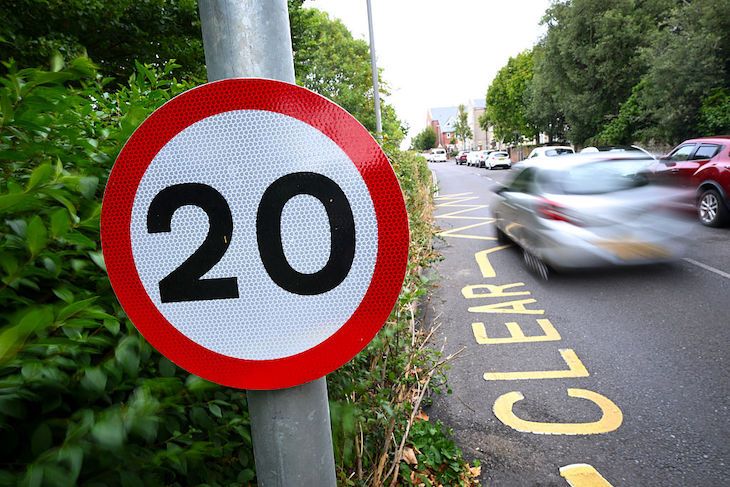
But a closer look at the evidence suggests that the rise in speeding offences is largely due to the introduction of 20 mph speed limits in the 2020s. Over half London’s roads are now 20 mph – as a resident I well know how driving in the capital has become become a stressful nonsense. You can crawl along a main road at 19 mph, your eye firmly on the yellow camera ahead, and then turn into a side street where the limit is 30. My own residential road switches from 30 to 20 mph simply because it’s on the border of two different boroughs.
Little wonder, then, that 3.7 million speeding offences were recorded on Britain’s 20 mph and 30 mph roads between 2023 and 2025, with the police detecting a jump of 26 per cent in three years. Perhaps, rather than suddenly speeding up, drivers are struggling to comply with the new requirements?
It cannot be a coincidence that the same period has seen the emergence of a raft of policies aimed at persuading people to drive less.
The government’s Active Travel programme set up in 2022 offers funding for councils in England to ‘enable behaviour change’ largely through controversial Low Traffic Neighbourhoods. Clean Air Zones have been introduced in a number of cities outside London since 2021, with a scheme in Oxford resulting in £70 fines for bewildered motorists trying to drive across the city.
Meanwhile, Vision Zero, a campaign advocating policies to meet ‘a target of zero deaths and zero serious injuries’ has been gathering support from councils. One signatory is Birmingham City Council, which plans to dramatically reduce private car usage through a series of measures that make driving difficult, such as reducing road space and 20 mph speed limits,.
The dramatic difference between the two speed awareness courses I’ve attended demonstrate a marked shift in the authorities’ attitude towards drivers. The face-to-face session of 2017 felt like a seminar: I enjoyed the hazard perception tests and came away feeling I’d learnt some useful advanced driving skills.
But the online course – which I took to avoid paying the fine – following my recent offence was like nothing else I’ve ever experienced. It began with the trainer accusing participants of behaving like teenagers for not saying ‘hello’ and then telling us, in breach of Zoom etiquette, we all had to answer every question or risk ejection from the course. The requirement to continuously shout out like overexcited children established an oppressive atmosphere, as did the prevailing assumption of our deep, inexcusable guilt. We were discouraged from considering the circumstances of our offences (although I quietly concluded mine was due to my failure to realise that closely-spaced lamp posts indicated 30 mph). The trainer told us we were angry drivers: ‘If your emotions change when you see a cyclist on the road that’s anger coming through’.
The only elements recognisable from the course of the previous decade – largely factual, concerning rules of the road – were covered quickly. Instead, significant time was given to the promotion of 20 mph speed limits. An animated video with a Welsh voiceover explained how 20 mph speed limits encouraged people to walk and cycle more. The trainer expressed his hope that the 20 mph default speed limit imposed on built-up areas in Wales in 2023 would come to Scotland and Northern Ireland.
A segment about the consequences of injuring someone seemed to assume we had never considered the possibility of an accident. The trauma would make us unfit drivers, we were told. We’d be judged by our families and neighbours. We might lose our jobs and bring hardship to our households. We should remember that injuries cost the economy £43.2 billion.
To drive the point home, the trainer made several references to his own experience of losing a family member – the mother of a one-year-old baby – in an accident. After what felt like a barrage of emotional manipulation, I was not surprised to learn that the course had been revamped by psychologists.
So – in answer to my question at the outset – I don’t think Brits are driving faster so much as dealing with new and difficult conditions on the roads. The changes do affect my behaviour as a driver: I’m more stressed and hesitant as I scan the road for signs, lamp posts and cameras. And I feel an underlying resentment about the anti-motorist ideology that is rapidly seeping into everyday life. I don’t think any of this makes for a nation of good drivers.